
Desiccant vs Compressor Dehumidifier UK — Which Type Do You Actually Need?
Last updated: 23 September 2026
| Affiliate Disclosure: This page contains affiliate links. If you buy through these links, we may earn a small commission at no extra cost to you. See our Affiliate Disclaimer for more information. |
The desiccant vs compressor dehumidifier question is the most important decision you will make when buying a dehumidifier in the UK — and getting it wrong is one of the most common reasons people feel their dehumidifier “doesn’t work”. Both types remove moisture from the air. Both prevent mould and condensation. But they work in completely different ways, perform very differently depending on room temperature, and suit entirely different spaces. This guide explains the difference clearly, gives you a simple decision framework, and recommends the best models from each type.
Before choosing between types, it helps to understand why humidity matters. We cover the health and property implications of high indoor humidity in detail in our guide to what humidity level is too high in a house UK.
| Quick decision guide: Is your space heated to above 15°C most of the time? → Compressor (refrigerant). Does the space drop below 15°C in winter — garage, cellar, conservatory, unheated utility room? → Desiccant. Not sure? Read on. |
How Each Type Works
Compressor (Refrigerant) Dehumidifiers
A compressor dehumidifier works on the same principle as a fridge or air conditioning unit. A fan draws warm, moist room air over a set of cold metal coils chilled by a refrigerant gas. The air cools below its dew point, moisture condenses on the coils and drips into the collection tank, and the now-drier air is reheated slightly and returned to the room. The process is energy-efficient when conditions favour condensation — specifically, when the room is warm enough that there is meaningful moisture in the air and the coils can stay cold without icing up.
The critical limitation: below around 15°C, two things happen. First, cold air holds less moisture, so there is less to extract. Second, the cold coils can drop below freezing, causing ice to form on them. The unit detects this and triggers a defrost cycle — during which it stops extracting moisture entirely. In a very cold room, a compressor dehumidifier may spend more time defrosting than working.
Desiccant Dehumidifiers
A desiccant dehumidifier uses an entirely different mechanism. A slowly rotating wheel coated in a moisture-absorbing material (typically zeolite) draws moisture from the air chemically rather than thermally. As the wheel rotates, a small internal heater regenerates the saturated section, driving the collected moisture into a condensate tube and then into the tank. The process is not dependent on temperature — it works just as effectively at 5°C as at 20°C, because it relies on chemical absorption rather than condensation.
The trade-off: desiccant units use more energy per litre extracted in warm conditions than a compressor unit would. They also release warm air — around 10°C warmer than the intake — as a by-product of the regeneration heater. In a cold space this warmth is a benefit; in an already-warm room it is unnecessary heat.
The 15°C Rule — The Most Important Factor
| The 15°C threshold: If your space consistently stays above 15°C, a compressor dehumidifier is the more efficient and cost-effective choice. If it regularly drops below 15°C — particularly in winter — a desiccant is the only type that will perform reliably. This single factor matters more than brand, capacity, or any other specification. |
In practice, this maps to room types as follows:
| Space | Typical winter temp | Recommended type |
| Heated bedroom | 18–21°C | Compressor |
| Heated living room | 18–22°C | Compressor |
| Heated kitchen | 18–22°C | Compressor |
| Heated utility room | 15–18°C | Compressor |
| Unheated utility room | 5–15°C | Desiccant |
| Garage | 2–12°C | Desiccant |
| Cellar / basement | 8–14°C | Desiccant |
| Conservatory (unheated) | 2–15°C | Desiccant |
| Conservatory (heated) | 15–20°C | Compressor |
| Boat / caravan | Variable — often cold | Desiccant |
Desiccant vs Compressor — Full Comparison
| Factor | Compressor (Refrigerant) | Desiccant |
| How it works | Condenses moisture on cold coils | Absorbs moisture in rotating zeolite wheel |
| Best temperature range | Above 15°C | Any temperature — effective to ~1°C |
| Energy efficiency (warm room) | Excellent — low cost per litre | Higher energy use per litre |
| Energy efficiency (cold room) | Poor — frequent defrost cycles | Consistent regardless of temperature |
| Air output temperature | Roughly room temperature | ~10°C warmer than intake |
| Noise | Low-moderate compressor hum | Very quiet — no compressor |
| Weight | Heavier — 9–14kg | Lighter — 5–7kg |
| Running cost (warm room) | Lower | Higher |
| Running cost (cold room) | Very high — largely ineffective | Consistent and predictable |
| Best for | Heated living rooms, bedrooms | Garages, cellars, conservatories, boats |
| Laundry drying | Good in warm room | Excellent — warm air helps drying |
Running Costs — The Honest Numbers
Energy efficiency is one of the most misunderstood areas of the desiccant vs compressor debate. The answer is: it depends entirely on temperature.
In a warm heated room (above 15°C)
A compressor dehumidifier is significantly cheaper to run. The Meaco 20L Low Energy draws just 255W at maximum — exceptionally low for a 20L/day refrigerant unit. Running at 255W for 8 hours per day costs approximately 69p at current UK electricity rates. The Meaco MeacoDry Abc 12L is similarly efficient for its class. A desiccant model running in the same warm room draws 600–700W and extracts less moisture per hour — making it two to three times more expensive to run for equivalent results.
In a cold unheated room (below 15°C)
The calculation reverses completely. A compressor dehumidifier below 15°C spends significant time in defrost mode — drawing power but extracting nothing. Its effective extraction rate drops dramatically, meaning it costs more per litre actually extracted than its nameplate wattage suggests. A desiccant such as the Meaco DD8L Junior or EcoAir DD1 Simple draws more wattage but extracts consistently — making it genuinely cheaper per litre in cold conditions.
Best Compressor Dehumidifiers UK
Meaco MeacoDry Abc 12L — Best for Bedrooms and Standard Rooms
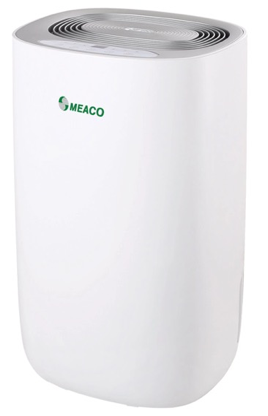
The Meaco MeacoDry Abc 12L is our top compressor pick for heated UK living spaces. Quiet Mark accredited, auto-humidistat, compact, and energy-efficient — it covers bedrooms and standard rooms up to around 30–35m² and is quiet enough for overnight operation. Set to 50–55% on auto and leave it to manage itself.
- Extraction: 12L/day at 20°C/60% RH
- Noise: Quiet Mark accredited — one of the quietest refrigerant models available
- Energy: very efficient for its class
- Min. operating temp: ~15°C
- Warranty: 2 years
Meaco 20L Low Energy — Best for Larger Spaces
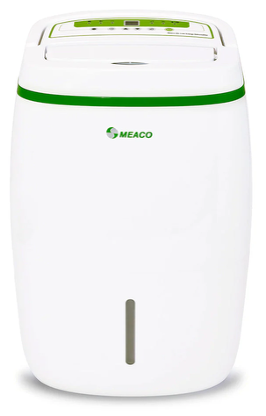
For open-plan rooms, larger living areas, or homes with more serious humidity issues, the Meaco 20L Low Energy is the standout choice. Its 255W maximum draw is exceptional for a 20L/day refrigerant unit — the most energy-efficient high-capacity compressor dehumidifier available in the UK. Auto-humidistat and continuous drainage make it practical for long-term operation.
- Extraction: 20L/day
- Energy: 255W maximum — market-leading efficiency for its capacity
- Auto-humidistat and continuous drainage
- Min. operating temp: ~15°C
- Warranty: 2 years
Pro Breeze 12L — Best Budget Compressor
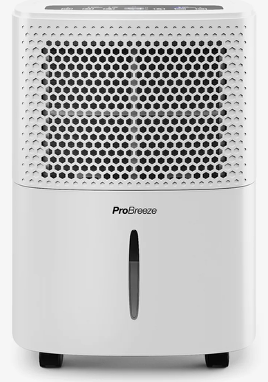
For those who want effective compressor dehumidification at a lower price point, the Pro Breeze 12L covers the essentials — 12L/day extraction, auto-humidistat, laundry mode — at a meaningfully lower upfront cost than the Meaco equivalent. It is louder and less energy-efficient, but for a utility room or infrequently used space where noise is less of a concern, it is a practical choice.
- Extraction: 12L/day
- Noise: moderate — louder than Meaco
- Auto-humidistat and laundry mode
- Min. operating temp: ~15°C
- Warranty: 1 year
Best Desiccant Dehumidifiers UK
Meaco DD8L Junior — Best Overall Desiccant
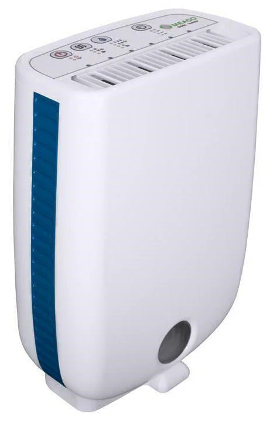
The Meaco DD8L Junior is our top desiccant recommendation for UK garages, cellars, conservatories, and unheated utility rooms. It operates effectively down to around 1°C, is compact for a desiccant unit, and includes an auto-humidistat and laundry mode. The warm air output is a genuine benefit in a cold space — it slightly raises the room temperature as it works, which helps accelerate laundry drying in a cold utility room.
- Extraction: 8L/day at 20°C/60% RH — less in cold conditions but still consistent
- Min. operating temp: ~1°C — reliable in unheated spaces year-round
- Air output: ~10°C warmer than intake — helpful in cold rooms
- Auto-humidistat and laundry mode
- Warranty: 2 years
EcoAir DD1 Simple — Best Budget Desiccant
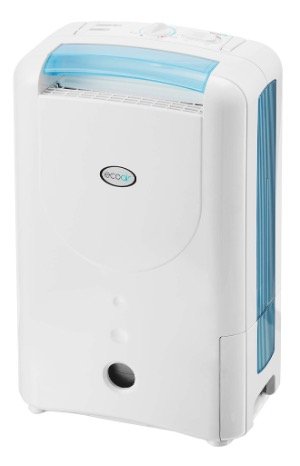
The EcoAir DD1 Simple is an excellent budget desiccant option with an impressive 4.6-star rating from over 3,500 Amazon UK reviews. At 7.5L/day extraction, quiet 34dB operation, and a 3-year warranty — longer than the Meaco’s 2-year cover — it offers strong value for buyers who need a cold-space desiccant dehumidifier without the Meaco price. It does include an ioniser, which is worth being aware of for anyone using it in an occupied living space.
- Extraction: 7.5L/day
- Noise: 34dB — impressively quiet for a desiccant model
- Min. operating temp: ~1°C
- Warranty: 3 years — better than most competitors
- Ioniser: present — worth noting for occupied spaces
Recommended Models at a Glance
| Model | Type | Best for | Key strength | Buy |
| Meaco Abc 12L | Compressor | Heated bedrooms, living rooms | Quiet Mark — quietest in class | View on Amazon View on Meaco |
| Meaco 20L Low Energy | Compressor | Larger heated spaces | 255W — best efficiency in class | View on Amazon View on Meaco |
| Pro Breeze 12L | Compressor | Budget — heated spaces | Lowest upfront cost | View on Amazon |
| Meaco DD8L Junior | Desiccant | Garages, cellars, cold spaces | Operates to 1°C reliably | View on Amazon View on Meaco |
| EcoAir DD1 Simple | Desiccant | Budget cold-space desiccant | 3-year warranty, 34dB quiet | View on Amazon |
Which Should You Buy? — The Decision Framework
Answer these three questions in order:
1. What is the room temperature in winter?
- Consistently above 15°C → compressor
- Regularly drops below 15°C → desiccant
- Borderline 12–16°C → desiccant is the safer choice
2. What size is the space?
- Standard bedroom or room up to ~30m² → Meaco MeacoDry Abc 12L (compressor) or Meaco DD8L Junior (desiccant)
- Larger room or open-plan space → Meaco 20L Low Energy (compressor) or EcoAir DD1 Simple paired with ventilation (desiccant)
3. What is the priority — noise, cost, or convenience?
- Quietest operation → Meaco MeacoDry Abc 12L (Quiet Mark accredited)
- Lowest running cost → Meaco 20L Low Energy (255W in a warm room)
- Longest warranty → EcoAir DD1 Simple (3 years)
- Lowest upfront cost → Pro Breeze 12L (compressor) or EcoAir DD1 Simple (desiccant)
Frequently Asked Questions
What is the main difference between a desiccant and compressor dehumidifier?
A compressor dehumidifier chills air over cold coils so moisture condenses out — efficient in warm rooms but ineffective below 15°C. A desiccant dehumidifier uses a rotating moisture-absorbing wheel and is unaffected by temperature — effective down to around 1°C. The right choice depends almost entirely on the temperature of the space where it will be used.
Which uses less electricity — desiccant or compressor?
In a warm heated room (above 15°C), a compressor uses significantly less electricity per litre extracted. In a cold space below 15°C, the compressor spends much of its time in defrost mode — drawing power but extracting nothing — while the desiccant extracts consistently. Choose the type matched to your temperature conditions and both are reasonably efficient in the right environment.
Can I use a compressor dehumidifier in a garage?
Not reliably during UK winters. Most UK garages drop well below 15°C from October to April, which is when condensation problems are worst. A compressor unit in a cold garage will defrost frequently, extract little, and cost more to run than the results justify. The Meaco DD8L Junior or EcoAir DD1 Simple desiccant models are the right choice for garages.
Is a desiccant dehumidifier better for drying laundry?
In a cold utility room or garage, yes — a desiccant is significantly better because it actually works at low temperatures where a compressor barely functions. The warm air output also slightly raises the room temperature, which helps evaporation. In a warm heated room, a compressor such as the Meaco 20L Low Energy is equally effective for laundry drying and cheaper to run. See our full guide on the best dehumidifier for drying laundry UK.
Do desiccant dehumidifiers make the room warmer?
Yes — noticeably so. Desiccant units release air around 10°C warmer than the intake as a by-product of the internal regeneration heater. In a cold garage or conservatory in winter, this is a genuine benefit — it slightly warms the space as it works. In an already-warm bedroom or living room during summer, this makes a desiccant a poor choice.
Are desiccant dehumidifiers quieter than compressor ones?
Generally, yes. Desiccant units have no compressor motor — the main noise source in refrigerant models. The EcoAir DD1 Simple runs at 34dB — very quiet for any dehumidifier. That said, the Meaco MeacoDry Abc 12Lcompressor holds Quiet Mark accreditation and is also very quiet at its lowest setting — the noise difference between the types is less pronounced at the top end of the compressor market.
Can I use a desiccant dehumidifier in a bedroom?
Yes — but for a heated bedroom above 15°C, a compressor model is typically the better choice. It uses less energy per litre extracted in warm conditions and doesn’t add heat to a room you are trying to sleep comfortably in. The Meaco MeacoDry Abc 12L is our top pick for bedrooms. A desiccant is the right choice for a cold spare bedroom that drops below 15°C overnight in winter — see our guide to the best dehumidifier for bedrooms UK for the full breakdown.
The Verdict
The desiccant vs compressor dehumidifier question has a clear answer once you know your room temperature. For heated UK living spaces — bedrooms, living rooms, kitchens, and warm utility rooms that stay above 15°C — a compressor dehumidifier is more energy-efficient, quieter (at the top end), and better value. The Meaco MeacoDry Abc 12L is the standout for most rooms; the Meaco 20L Low Energy for larger spaces.
For unheated spaces — garages, cellars, conservatories, and any room that drops below 15°C in a UK winter — a desiccant is the only practical choice. The Meaco DD8L Junior is our top desiccant pick; the EcoAir DD1 Simple is an excellent lower-cost alternative with a strong 3-year warranty. Don’t put a compressor dehumidifier in a cold garage in winter — it won’t work properly and you will conclude the machine is faulty when it is simply the wrong tool for the conditions.
Related Reading
For more on managing humidity at home, see our guides to the best dehumidifiers for bedrooms UK, the best dehumidifier for drying laundry UK, the best dehumidifier for cellars UK, How to choose a Dehumidifier and what humidity level is too high in a house UK

25 Comments