Best Air Purifier for Hay Fever UK: Top Picks for 2026
Last updated: 29 May 2026
| Affiliate disclosure: This page contains affiliate links. If you buy through these links, we may earn a small commission at no extra cost to you. See our Affiliate Disclaimerfor more information. |
The best air purifier for hay fever UK sufferers needs a true HEPA filter, a CADR high enough to clean the room 4–5 times per hour, and quiet enough operation to run overnight — because that is when pollen exposure does the most damage. Hay fever affects around one in five people in the UK, and with grass pollen season now in full swing from mid-May through July, getting your indoor air right matters more than ever.
This guide cuts through the noise: honest specs, correct CADR figures, room size guidance, and running costs for every model we recommend — so you can pick the right unit with confidence.
| Quick picks — best air purifier for hay fever UKBest for bedrooms: Levoit Core 300S — 258 m³/h CADR, 24dB sleep mode, 26W, covers 20m² Best for larger rooms: Levoit Core 400S — 330 m³/h CADR, 24dB sleep mode, covers 35m² Best for open-plan spaces: Levoit Core 600S — 697 m³/h CADR, covers up to 59m² Best all-rounder: Winix 5500-2 — 246 m³/h CADR, PlasmaWave off by default, covers 40m² Best budget: Levoit Core 300 — 258 m³/h CADR, no smart features, covers 18m² Best mid-range all-rounder: Coway AP-1512HH — 240 m³/h CADR, 4-stage filtration, covers 33m² |
| Key TakeawaysA true HEPA filter captures 99.97% of particles down to 0.3 microns — pollen grains measure 10–100 microns, making them easy targets for HEPA filtration.Grass pollen is the most common UK hay fever trigger, peaking in the first two weeks of June and again in early July according to the Met Office.For a bedroom of 15–20m², look for a minimum CADR of 150–240 m³/h and a sleep mode below 30dB — the Levoit Core 300S delivers 258 m³/h at just 24dB.Run your purifier continuously during pollen season with windows closed during peak pollen hours (6–10am and 5–7pm) for maximum effect.Start running your purifier two weeks before your symptoms usually begin — getting ahead of pollen exposure is more effective than reacting once symptoms have taken hold. |
Do air purifiers actually help with hay fever?
Yes — with an important caveat. A true HEPA air purifier will meaningfully reduce the concentration of pollen in the room it is running in, which reduces your total allergen exposure indoors and can lessen symptom severity. What it cannot do is affect outdoor pollen levels, remove pollen that has settled on surfaces and bedding, or replace medication for moderate-to-severe hay fever.
Pollen grains typically measure between 10 and 100 microns in diameter. HEPA filters are certified to capture 99.97% of particles down to just 0.3 microns — meaning pollen is captured with ease on every pass through the filter. The key variable is how often the purifier turns over the air in the room, which is why CADR and room size matching matter so much.
Research published in peer-reviewed journals has found HEPA air purifiers are associated with meaningful reductions in nasal congestion, eye symptoms, and activity limitation in allergy sufferers, primarily by reducing airborne particle and allergen concentrations. Some studies found reduced reliance on antihistamines and nasal steroids with consistent purifier use. Asthma + Lung UK recommends air purifiers as part of a combined approach to reducing indoor allergen exposure.
UK pollen seasons: when is your risk highest?
| Pollen type | Peak season | Main sources | % of sufferers affected |
| Tree pollen | Late March to mid-May | Birch, oak, ash, plane | ~25% |
| Grass pollen | Mid-May to July | Ryegrass, Timothy, meadow grass | ~80% |
| Weed pollen | June to September | Nettle, dock, mugwort | ~5–10% |
| Mould spores | July to September | Alternaria, Cladosporium | Varies |
Grass pollen is Britain’s most common airborne allergen, affecting around 80% of hay fever sufferers. According to the Met Office, the grass pollen season typically has two peaks — the first in the first two weeks of June, and a second lower peak in early July — as different grass species flower in sequence. Climate change is causing pollen seasons to start earlier and last longer, with tree and grass pollen increasingly overlapping.
If you are reading this in late May or June, you are in the highest-risk window of the year. Now is the time to have a purifier running, not to still be researching one.
What to look for in an air purifier for hay fever
True HEPA filtration — non-negotiable
You need a true HEPA filter certified to EN 1822 (the UK and EU standard), which guarantees at least 99.95% particle removal at 0.3 microns. HEPA-type, HEPA-like, and washable HEPA are marketing terms that do not meet this certification. Every model in this guide uses true HEPA filtration.
CADR matched to your room size
CADR (Clean Air Delivery Rate) measures how much filtered air the purifier produces per hour in m³/h. For hay fever, aim for 4–5 air changes per hour. A typical UK bedroom of 15–20m² with a 2.4m ceiling has a volume of 36–48m³, meaning you need a CADR of at least 150–240 m³/h. Many budget purifiers are marketed for larger rooms than their CADR genuinely supports — we use accurate figures throughout this guide.
Quiet operation for overnight use
Hay fever symptoms are frequently worst overnight — nasal congestion and itchy eyes disrupt sleep precisely when your body needs rest most. Running the purifier all night is where it earns its money, which means noise on the lowest setting matters. Look for models below 30dB in sleep mode; anything above 40dB will be noticeable.
Auto mode with air quality sensor
An auto mode that responds to real-time air quality changes is genuinely useful during pollen season. When you open a door or bring pollen in on your clothing, the purifier ramps up automatically and then quiets back down once the air is clean. This removes the need to manually adjust settings throughout the day.
Ozone-free operation
Avoid any purifier that produces ozone as a by-product — ozone irritates the airways and worsens respiratory symptoms, which is the opposite of what hay fever sufferers need. All models in this guide are either confirmed ozone-free or include an ioniser that is switched off by default.
Best air purifiers for hay fever UK — our top picks
1. Levoit Core 300S — Best for bedrooms
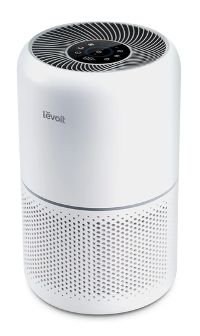
The Levoit Core 300S is our top pick for most UK bedrooms. It delivers a CADR of 258 m³/h — enough to cover rooms up to 20m² at 5 air changes per hour — and runs at just 24dB in sleep mode, making it genuinely inaudible during the night. At 26W, it costs around £25–30 per year to run continuously, making it one of the most energy-efficient HEPA purifiers available.
- Coverage: Up to 20m²
- CADR: 258 m³/h
- Noise (sleep mode): 24dB
- Power draw: 26W
- Filter life: 6–8 months (~£18–22 to replace)
- Smart features: VeSync app, Alexa, auto mode, PM2.5 sensor
- Ozone: Confirmed ozone-free, CARB-certified
Verdict: The best value HEPA air purifier for a hay fever sufferer’s bedroom. Quiet enough to sleep next to, smart enough to manage itself, and genuinely effective.
2. Levoit Core 300 — Best budget option
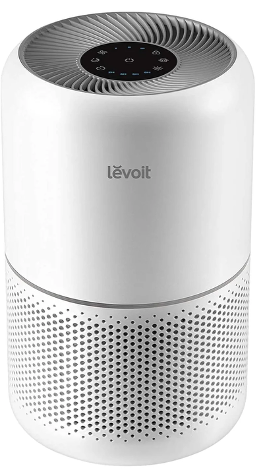
The Levoit Core 300 uses the same three-stage true HEPA filtration as the 300S and delivers the same 258 m³/h CADR, but without Wi-Fi, app control, or the air quality sensor. If you want effective pollen filtration without smart features, this is the most cost-efficient way to get it.
- Coverage: Up to 18m²
- CADR: 258 m³/h
- Noise (sleep mode): 26dB
- Power draw: 45W
- Smart features: None — manual controls only
- Ozone: Confirmed ozone-free
Verdict: Straightforward, reliable, and effective. The right choice if you want HEPA filtration without the app ecosystem.
3. Levoit Core 400S — Best for medium to large rooms
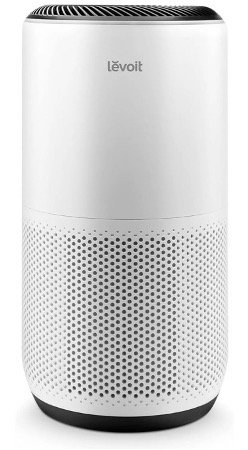
The Levoit Core 400S steps up to a CADR of 330 m³/h and covers rooms up to 35m², making it the right choice for a larger bedroom, living room, or open-plan kitchen-diner. It includes a laser PM2.5 sensor, auto mode, VeSync app, and Alexa connectivity, and runs at 24dB in sleep mode — matching the 300S on noise despite moving significantly more air.
- Coverage: Up to 35m²
- CADR: 330 m³/h
- Noise (sleep mode): 24dB
- Smart features: VeSync app, Alexa, auto mode, laser PM2.5 sensor
- Ozone: Confirmed ozone-free
Verdict: The natural step up from the 300S for anyone whose bedroom or living room exceeds 20m². Same noise profile, substantially more power.
4. Levoit Core 600S — Best for large and open-plan spaces
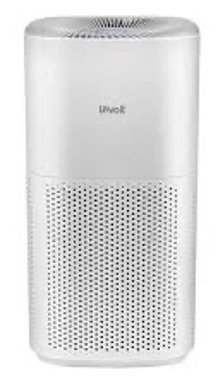
The Levoit Core 600S is Levoit’s flagship model and one of the most powerful HEPA purifiers at its price point. With a CADR of 697 m³/h and coverage up to 59m², it is built for open-plan living areas, large reception rooms, or anyone who wants a single unit to cover a substantial space. It includes H13 true HEPA filtration, VeSync app, Alexa and Google Home compatibility, and a laser PM2.5 sensor.
- Coverage: Up to 59m²
- CADR: 697 m³/h
- Smart features: VeSync app, Alexa, Google Home, auto mode, laser PM2.5 sensor
- Filter: H13 true HEPA — highest grade in the Levoit range
- Ozone: Confirmed ozone-free
Verdict: The strongest performer in the Levoit range for large spaces. If your living room or open-plan area exceeds 35m², this is the one to choose.
5. Winix 5500-2 — Best all-rounder for larger spaces
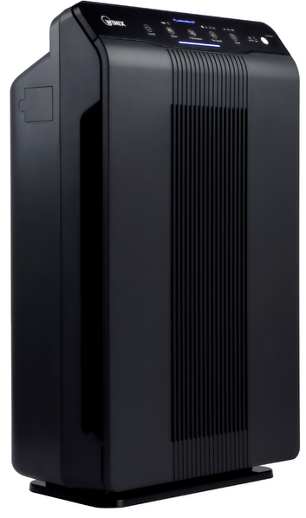
The Winix 5500-2 is a well-established HEPA air purifier with a strong track record among allergy sufferers. It delivers a CADR of 246 m³/h, covers rooms up to 40m², and includes a true HEPA filter, an activated carbon layer, and Winix’s PlasmaWave ionisation — which can and should be switched off if you prefer ozone-free operation. Auto mode responds to real-time air quality changes, and sleep mode dims the display and reduces fan noise overnight. Note: the Winix 5500-2 has been discontinued in the US market but remains available in the UK, with filter production confirmed until at least 2032.
- Coverage: Up to 40m²
- CADR: 246 m³/h
- Noise (sleep mode): 27.8dB
- Smart features: Auto mode, sleep mode, air quality indicator
- Ioniser: PlasmaWave included — switch off for ozone-free operation
Verdict: A reliable, well-priced choice for living rooms and larger bedrooms. Switch the PlasmaWave off and you have a straightforward, high-performing HEPA purifier.
6. Coway AP-1512HH — Best mid-range all-rounder
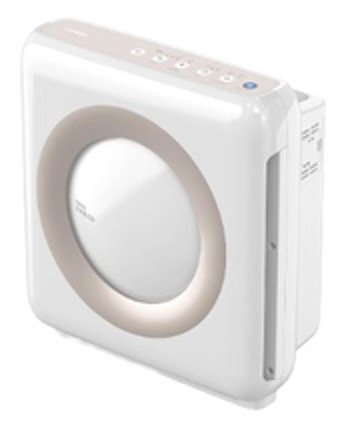
The Coway AP-1512HH has one of the strongest long-term reliability records of any HEPA air purifier available in the UK. It delivers a CADR of 240 m³/h, covers rooms up to 33m², and uses a four-stage filtration system: pre-filter, deodorisation filter, true HEPA, and a vital ioniser that is switched off by default. Auto mode, an air quality indicator, and an eco mode that cuts power when air quality is consistently good make it practical for all-day use.
- Coverage: Up to 33m²
- CADR: 240 m³/h
- Noise (sleep mode): ~30dB
- Smart features: Auto mode, eco mode, air quality indicator
- Ioniser: Switched off by default — leave it off for ozone-free operation
Verdict: A dependable, consistently well-reviewed mid-range purifier. Not the newest model on the market, but one of the most proven for allergy sufferers.
Air purifier comparison — hay fever UK
| Model | CADR | Room size | Sleep mode dB | Power | Auto mode | Best for |
| Levoit Core 300S | 258 m³/h | Up to 20m² | 24dB | 26W | Yes | Small bedroom |
| Levoit Core 300 | 258 m³/h | Up to 18m² | 26dB | 45W | No | Budget bedroom |
| Levoit Core 400S | 330 m³/h | Up to 35m² | 24dB | ~38W | Yes | Medium/large rooms |
| Levoit Core 600S | 697 m³/h | Up to 59m² | ~26dB | ~55W | Yes | Large/open-plan |
| Winix 5500-2 | 246 m³/h | Up to 40m² | 27.8dB | ~70W | Yes | Living rooms |
| Coway AP-1512HH | 240 m³/h | Up to 33m² | ~30dB | ~82W | Yes | All-rounder |
How to use an air purifier for hay fever — 7 tips
- Put it in your bedroom first. You spend more time in your bedroom than anywhere else. Running a purifier overnight — for seven or eight hours — gives you the greatest reduction in total pollen exposure across the day.
- Run it continuously during pollen season. If you switch the purifier off, airborne pollen rebuilds quickly through normal air movement. Auto mode keeps it running efficiently — ramping up when needed and quieting down when the air is clean.
- Keep windows closed during peak pollen hours. Pollen counts are highest between 6–10am and 5–7pm. Keep windows shut during these periods. If you want fresh air, open windows briefly after midnight when counts are at their lowest.
- Start two weeks before symptoms usually begin. If your hay fever typically starts in late May or early June, begin running the purifier in early to mid-May. Getting ahead of exposure is more effective than reacting once symptoms are established.
- Change clothes when you come indoors. Pollen clings to clothing, hair, and pets. Changing out of outdoor clothes and leaving shoes at the door significantly reduces how much pollen you carry into the room.
- Shower before bed. Rinsing pollen from hair and skin before sleep reduces overnight exposure in the bedroom — even with the purifier running.
- Replace filters on schedule. A clogged filter loses effectiveness progressively. Most models in this guide need a filter change every 6–12 months. Check the indicator light or set a calendar reminder at purchase.
Will an air purifier replace my hay fever medication?
For most people, no — but it can meaningfully reduce how much medication you need. Research suggests that consistent HEPA purifier use lowers the concentration of airborne allergens enough that some sufferers can manage on reduced antihistamine and nasal steroid doses. Think of it as reducing your total exposure load, so your medication — and your immune system — has less to deal with.
Asthma + Lung UK advises combining multiple strategies: medication where needed, reducing outdoor exposure on high-pollen days, and improving indoor air quality. An air purifier is one component of that combination. For clinical guidance on hay fever treatment, the NHS hay fever guide covers symptoms, diagnosis, and the full range of treatment options.
Frequently asked questions
Does an air purifier help with hay fever?
Yes, if it uses a true HEPA filter. HEPA filtration captures 99.97% of airborne particles down to 0.3 microns — pollen grains measure 10–100 microns, so they are captured on every pass through the filter. Consistent use in a closed bedroom during pollen season can meaningfully reduce symptom severity and the amount of antihistamine medication needed.
Which is the best air purifier for hay fever in the UK?
For most bedrooms, the Levoit Core 300S is our top recommendation — 258 m³/h CADR, 24dB in sleep mode, 26W power draw, and confirmed ozone-free. For larger rooms up to 35m², step up to the Levoit Core 400S. For open-plan spaces up to 59m², the Levoit Core 600S is the most powerful option in the range. For a living room all-rounder, the Winix 5500-2 or Coway AP-1512HH are both reliable choices.
Can I run an air purifier with the windows open?
You can, but effectiveness drops significantly. An air purifier works by repeatedly cycling room air through its filter. With a window open, fresh pollen-laden air continuously enters the room, overwhelming the purifier’s capacity to maintain low pollen concentrations. For best results, run the purifier with windows closed — particularly during peak pollen hours between 6–10am and 5–7pm.
Where should I put my air purifier for hay fever?
Your bedroom is the highest-priority location. You spend seven or more hours there, and overnight pollen exposure has the greatest cumulative impact on symptoms. Place the unit on a bedside table or the floor near the bed, with at least 30cm clearance on all sides for airflow. If you work from home with significant symptoms during the day, a second unit in your home office is worthwhile.
What is the difference between the Levoit Core 300 and Core 300S?
The Levoit Core 300S adds a laser PM2.5 air quality sensor, Wi-Fi connectivity, VeSync app control, and Alexa compatibility — features the Core 300 lacks. The 300S also draws just 26W compared to the Core 300’s 45W, making it cheaper to run. For most hay fever sufferers, the 300S is worth the small price premium for the auto mode alone — it adjusts fan speed automatically when pollen enters the room without any manual input.
Do air purifiers help with dust mites and mould spores as well as pollen?
Yes. True HEPA filters capture pollen, dust mite debris, mould spores, and pet dander — all common triggers for allergic rhinitis. If your symptoms persist outside of pollen season, an air purifier will continue to provide benefit year-round by reducing these additional allergens. A dehumidifier used alongside the air purifier addresses the moisture conditions that allow dust mites and mould to thrive in the first place.
How long should I run an air purifier for hay fever?
During peak pollen season, run it continuously — or at minimum for the full time you are in the room. Most models with auto mode consume very little energy at lower fan speeds, making all-day running practical. The Levoit Core 300S draws just 26W at maximum and significantly less in auto mode, costing roughly £25–30 per year to run continuously.
Our verdict
The best air purifier for hay fever UK sufferers does three things well: true HEPA filtration to capture pollen on every pass, a CADR high enough to clean the room 4–5 times per hour, and quiet enough operation to run all night without disrupting sleep. The Levoit Core 300S hits all three benchmarks for most UK bedrooms — 258 m³/h CADR, 24dB in sleep mode, 26W — and remains our top recommendation.
For medium to large rooms, the Levoit Core 400S delivers more power at the same noise level. For large open-plan spaces, the Levoit Core 600S covers up to 59m² with a CADR of 697 m³/h. For a living room all-rounder, the Winix 5500-2 and Coway AP-1512HH are both dependable choices — just switch the ionisers off.
Pair whichever model you choose with the simple habits in this guide — closed windows during peak pollen hours, changing clothes when you come in, showering before bed — and you have a meaningful, practical indoor defence during hay fever season.

14 Comments