
Best Air Purifier for Mould UK 2026: Spores, Smells, and What Actually Works
Last updated: 31 May 2026
| Disclosure: This page contains affiliate links. If you buy through these links, we may earn a small commission at no extra cost to you. See our Affiliate Disclaimer for more information. |
The best air purifier for mould UK homes need is one that combines a certified True HEPA filter with a substantial activated carbon layer — the HEPA captures airborne mould spores (1–100 microns), while the carbon addresses the musty VOCs that mould produces as it metabolises. But before we cover the products, there’s an important distinction that most articles in this space skip over: an air purifier and a dehumidifier solve different parts of the mould problem, and you almost certainly need both.
This guide explains exactly what an air purifier can and cannot do for mould, recommends the best models for different room sizes, and gives honest advice on how to use them as part of a complete mould management strategy.
| ✅ Key TakeawaysAn air purifier with a True HEPA filter captures airborne mould spores — typically 1–100 microns — at 99.97% efficiency. It addresses the symptom (spores in the air) but not the cause (high humidity). For complete mould control, you need both an air purifier and a dehumidifier. Mould spores are most dangerous when airborne — after disturbing a mouldy surface, spore counts in the room air spike dramatically. Running a HEPA purifier immediately after cleaning mould captures these spores before they settle elsewhere.The Levoit Core 300S (CADR 141 m³/h) is our top pick for bedrooms and smaller rooms up to 18m². The Levoit Core 400S (CADR 230 m³/h) suits living rooms and larger spaces up to 38m².Activated carbon filtration — included in all recommended models — also captures the musty VOCs produced by mould metabolism, addressing both the health risk and the smell simultaneously. Never use an ioniser in a mouldy room. Ionisers produce trace ozone which can react with mould VOCs to create harmful secondary pollutants. Disable ionisers on any unit that includes one. |
| ⚠️ Critical distinction: An air purifier cleans the air. It does not reduce humidity, remove mould from surfaces, or prevent mould from growing back. If indoor humidity stays above 60–70% RH, mould will continue to grow regardless of how good your air purifier is. A HEPA air purifier used without humidity control is treating the symptom, not the cause. For complete mould management, pair the air purifier with a desiccant dehumidifier set to 55% RH. |
What an Air Purifier Can and Cannot Do for Mould
| ✅ Air purifier CAN help with mould | ❌ Air purifier CANNOT do |
| Capture airborne mould spores (1–100 microns) | Remove mould growing on walls or surfaces |
| Reduce spore counts after disturbing mould | Reduce indoor humidity or fix damp |
| Neutralise musty VOC odours (with carbon filter) | Prevent mould returning if humidity stays high |
| Protect occupants during mould remediation | Treat structural damp or penetrating damp |
| Reduce allergy and asthma triggers from spores | Replace cleaning or professional remediation |
Quick Comparison: Best Air Purifiers for Mould UK
| Model | CADR | Room Size | Noise | Ioniser | Best For |
| Levoit Core 300S | 141 m³/h | Up to 18m² | 24 dB | No | Bedrooms |
| Levoit Core 300 | 141 m³/h | Up to 18m² | 24 dB | No | Budget bedroom |
| Levoit Core 400S | 230 m³/h | Up to 38m² | 26 dB | No | Living rooms |
| Coway AP-1512HH | 246 m³/h | Up to 41m² | 30 dB | Yes — disable | Larger rooms |
| Levoit Core 600S | 697 m³/h | Up to 59m² | 28 dB | No | Open plan |
Why Airborne Mould Spores Are a Health Risk
Mould reproduces by releasing microscopic spores into the air — typically 1–100 microns in diameter. Under normal conditions, spore counts in a mouldy room are elevated but relatively stable. The danger spikes when mould is disturbed: cleaning a mouldy wall, opening a damp wardrobe, or even walking past a mouldy surface can release millions of spores into the room air in seconds.
Once airborne, mould spores can be inhaled deep into the respiratory tract. According to Asthma + Lung UK, mould spore exposure is a significant trigger for asthma attacks, allergic rhinitis, and respiratory infections — particularly in children, elderly people, and anyone with a compromised immune system. The NHS advises that living in a damp, mouldy home is bad for health and that the risks are especially serious for infants.
A True HEPA air purifier captures these spores before they can settle on new surfaces or be inhaled. Running one continuously in a mouldy room reduces the ambient spore count, and running one immediately after cleaning mould captures the spike in spores that cleaning disturbs — preventing them from spreading to other areas of the room.
Mould also produces volatile organic compounds (VOCs) as byproducts of its metabolic processes — these are responsible for the characteristic musty smell. Activated carbon filtration adsorbs these VOCs, addressing both the smell and a secondary chemical air quality concern that HEPA alone cannot tackle.
| ℹ️ Air purifier + dehumidifier: the correct combination. The air purifier captures spores already in the air and neutralises odours. The dehumidifier removes the moisture mould needs to grow. Run both simultaneously in a room with a mould problem — there is no conflict between them and the combined effect is substantially greater than either alone. See our best dehumidifier for mould UK guide for dehumidifier recommendations. |
Levoit Core 300S — Best Air Purifier for Mould in Bedrooms
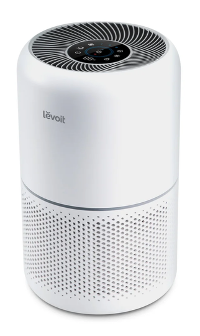
| 🏆 Top Pick for Rooms Up to 18m²The Levoit Core 300S is our top recommendation for mould-affected bedrooms and smaller rooms. With a CADR of 141 m³/h it cycles the air in an 18m² room approximately four times per hour — the threshold at which clinical studies show meaningful airborne particle reduction. At 24dB on its lowest setting it’s near-silent, and it has no ioniser — important in a mould-affected room where ozone-VOC interactions are a concern. |
Key Specifications
- CADR: 141 m³/h
- Room coverage: Up to 18m²
- Noise level: 24 dB (sleep mode)
- Wattage: 45W maximum
- Filter: True HEPA + activated carbon
- Ioniser: No
For mould specifically, the Core 300S’s 360-degree air intake is a practical advantage — it draws air from all directions rather than just the front, which means it captures spores circulating from multiple sources rather than only those directly in front of the unit. Place it centrally in the room where possible, or near the mould-affected wall.
The activated carbon layer addresses musty mould odours directly. While not as substantial as the carbon in larger models, it is sufficient for a standard bedroom — most users report a noticeable reduction in musty smell within 24–48 hours of continuous operation.
If smart features aren’t a priority, the standard Levoit Core 300 delivers identical filtration performance at a lower price — the only difference is the absence of Wi-Fi and app control.
Verdict
The Levoit Core 300S is the best air purifier for mould in most UK bedrooms. True HEPA, substantial carbon layer, no ioniser, near-silent operation. Pair it with a desiccant dehumidifier for complete mould control.
Levoit Core 400S — Best for Living Rooms and Larger Spaces
Key Specifications
- CADR: 230 m³/h
- Room coverage: Up to 38m²
- Noise level: 26 dB (sleep mode)
- Wattage: 38W maximum
- Filter: True HEPA + activated carbon
- Ioniser: No
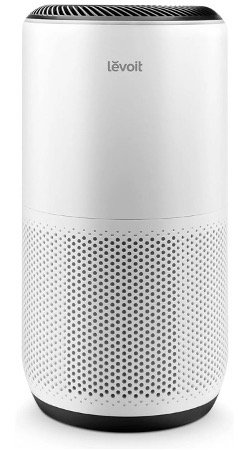
The Levoit Core 400S steps up to 230 m³/h CADR, covering rooms up to 38m² with four-plus air changes per hour. For a mould-affected living room, open-plan kitchen-diner, or larger bedroom, this is the correct size — an undersized unit cycling air only once or twice per hour makes little meaningful difference to airborne spore counts.
The carbon layer on the 400S is more substantial than on the 300S, making it noticeably more effective against mould VOCs and musty smells. If odour as well as spore reduction is a priority — which it usually is in a room with visible mould — the 400S is the better choice for any room above 18m².
At 38W maximum it’s also one of the most energy-efficient purifiers at this capacity — cheaper to run continuously than many budget alternatives with lower CADR ratings.
Verdict
The Levoit Core 400S is our top pick for mould in living rooms and larger spaces. Better carbon filtration than the 300S, no ioniser, and correctly sized for rooms where an undersized unit would be ineffective.
Coway AP-1512HH — Best for Rooms with Active Mould Monitoring
Key Specifications
- CADR: 246 m³/h
- Room coverage: Up to 41m²
- Noise level: 30 dB (low)
- Wattage: 77W maximum
- Filter: True HEPA + activated carbon + pre-filter
- Ioniser: Yes — disable on first use
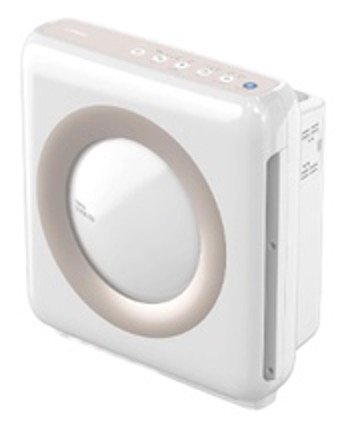
The Coway AP-1512HH brings one feature particularly useful in a mould-affected room: its real-time PM2.5 air quality sensor with a colour-coded ring indicator. Mould spores register as particulate matter — the sensor turns red when spore counts spike (typically after disturbing mould or opening a damp wardrobe) and the unit ramps up fan speed automatically. This makes it a practical monitoring tool as well as a purifier.
| ⚠️ Ioniser: The Coway AP-1512HH includes a built-in ioniser. In a mould-affected room this is particularly important to disable — ionisers produce trace ozone that can react with mould VOCs to create secondary pollutants including formaldehyde and ultrafine particles. Press and hold the ioniser button on first setup to disable it permanently. The HEPA filter performs fully without the ioniser. |
With the ioniser disabled, the Coway is an excellent choice for anyone who wants visual confirmation that the purifier is responding to mould spore events. The washable pre-filter also extends HEPA filter life by catching larger spores and debris before they reach the main filter.
Verdict
The Coway AP-1512HH is the best choice for rooms where active monitoring of air quality is a priority. The sensor provides real-time feedback on spore levels. Disable the ioniser immediately on setup.
Levoit Core 600S — Best for Large and Open-Plan Spaces
Key Specifications
- CADR: 697 m³/h
- Room coverage: Up to 59m²
- Noise level: 28 dB (sleep mode)
- Wattage: 47W maximum
- Filter: True HEPA + activated carbon
- Ioniser: No
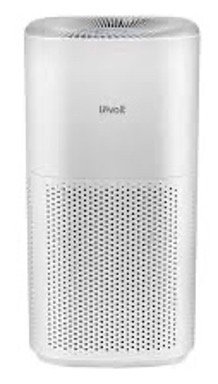
For genuinely large spaces — open-plan ground floors, large reception rooms, or properties where mould is affecting multiple connected areas — the Levoit Core 600S delivers class-leading CADR of 697 m³/h at just 47W. It handles spaces up to 59m² and at 28dB on sleep mode is remarkably quiet for a unit of this power.
In a mould remediation context, the 600S is also useful as a temporary high-capacity unit during the clean-up phase — running on maximum speed during and immediately after cleaning mould captures the spike in airborne spores that remediation disturbs, reducing the risk of cross-contamination to other rooms.
Verdict
The Levoit Core 600S is the right choice for large open-plan spaces or as a high-capacity temporary unit during mould remediation. No ioniser, exceptional energy efficiency at 47W for 697 m³/h CADR.
How to Use an Air Purifier Effectively for Mould
Run it before, during, and after cleaning mould
The highest spore counts in a mould-affected room occur when mould is physically disturbed — during cleaning. Run the air purifier on maximum speed for at least 30 minutes before cleaning to reduce baseline spore counts, keep it running throughout the cleaning process, and continue running it on maximum for at least 2 hours afterwards to capture the spores released. Wear an FFP2 mask during the cleaning itself regardless.
Keep it running continuously
In a mould-affected room, continuous operation at your preferred setting is far more effective than running intermittently. Mould spores are released continuously, not in discrete events. A purifier running 24 hours a day on medium speed maintains consistently low spore counts; one switched on for a few hours a day allows levels to rebuild between sessions.
Keep the door closed
An air purifier is cleaning a defined volume of air. An open door connects it to the rest of the house, multiplying the effective room volume and reducing the number of air changes per hour the unit delivers in its target area. For mould management specifically, keeping the room closed also prevents spores from migrating to other rooms during high-spore events like cleaning.
Position it near the mould source
Place the unit within 2–3 metres of the mould-affected wall or area where possible, with clear airflow on all sides. This positions it to capture spores as they are released rather than only after they have dispersed across the room. Avoid placing it directly against the mould-affected surface — it needs breathing room to draw air effectively.
Replace filters on schedule
In a mould-affected room, filters load faster than in a clean-air environment. Check the filter monthly for discolouration and replace if significantly darkened. Do not try to clean or vacuum a HEPA filter — this damages the filter medium and reduces efficiency. Levoit Core 300S and 400S genuine replacement filters cost £15–£20 and take under a minute to swap.
Frequently Asked Questions
Can an air purifier get rid of mould?
No — an air purifier cannot remove mould growing on surfaces or prevent mould from growing if humidity remains high. It captures airborne mould spores and neutralises mould odours, which reduces health risks and makes a mouldy room more liveable. For complete mould elimination, you need to clean the visible mould, run a dehumidifier to control humidity below 60% RH, and use an air purifier to manage airborne spores during and after remediation.
Do air purifiers help with mould allergies?
Yes, meaningfully. Mould spore allergy symptoms — sneezing, runny nose, itchy eyes, and worsened asthma — are triggered by inhaled spores. A True HEPA purifier capturing 99.97% of particles at 0.3 microns or larger removes the vast majority of mould spores from room air. Asthma + Lung UK recommends HEPA air filtration as part of an allergen management strategy for people with mould-triggered asthma. The effect is most pronounced when the purifier is correctly sized for the room and running continuously.
Will an air purifier remove the musty mould smell?
Yes, if it includes a substantial activated carbon filter. The musty smell from mould is caused by microbial volatile organic compounds (mVOCs) — chemical byproducts of mould metabolism including geosmin, 1-octen-3-ol, and 2-methylisoborneol. Activated carbon adsorbs these VOCs effectively. All the models recommended in this guide include activated carbon filtration. HEPA alone — without carbon — does not address odour. Budget purifiers with only a thin carbon pre-filter may reduce smell partially but not eliminate it.
Should I use an air purifier or a dehumidifier for mould?
Both — they address different aspects of the problem and work best together. A dehumidifier removes the moisture that allows mould to grow, preventing new growth and killing existing mould over time by drying it out. An air purifier captures the spores that existing mould releases and neutralises VOC odours. In a room with an active mould problem, running both simultaneously gives the most complete protection. If you can only choose one: a dehumidifier has the greater long-term impact because it addresses the root cause. An air purifier alone, without humidity control, reduces health risk but does not stop mould from spreading.
Is the Levoit Core 300S good for mould spores?
Yes — its True HEPA filter captures mould spores (1–100 microns) at 99.97% efficiency, and at a CADR of 141 m³/h it delivers around four air changes per hour in a standard UK bedroom up to 18m². It also includes activated carbon for mould odour. No ioniser means no ozone risk in a mould-affected room. For rooms larger than 18m², step up to the Levoit Core 400S (38m²) or Levoit Core 600S (59m²).
Can mould damage an air purifier?
Over time, yes. In a heavily mould-affected room, spores accumulate on and inside the unit — particularly on the pre-filter and the filter housing. This is why filter replacement on schedule is important: a heavily loaded filter becomes a mould reservoir itself. Check and replace filters monthly in rooms with significant mould. If you move a purifier from a mouldy room to a clean room, wipe down the exterior with a dilute bleach solution and replace the filter before first use in the new location.

3 Comments