Meaco vs Ebac Dehumidifier UK 2026: Which Brand Should You Buy?
Last updated: 18 July 2026
This page contains affiliate links. If you buy through these links, we may earn a small commission at no extra cost to you. See our Affiliate Disclaimer for more information.
Meaco vs Ebac is the great British dehumidifier debate. Both brands are UK companies, both have loyal followings, and both regularly feature in best-buy lists from Which?, Ideal Home, and independent reviewers. But they take meaningfully different approaches — and depending on how and where you plan to use a dehumidifier, one will suit you considerably better than the other.
This guide compares the two brands honestly across every dimension that matters for UK homes: extraction performance, energy running costs, noise, build quality, warranty, and where each brand is strongest. We focus on the Meaco models already featured on this site — the MeacoDry Abc 12L, the Meaco 20L Low Energy, and the Meaco DD8L Junior — and compare them against Ebac’s current lineup.
The Brands: Two Very Different Takes on the Same Problem
Meaco
Meaco is a British brand based in Guildford, Surrey, founded in 1991. While the brand is British, its dehumidifiers are manufactured in China and engineered for the broader European market. What Meaco is known for is energy efficiency, quiet operation, and a thoughtful feature set — night modes, laundry modes, HEPA filters on certain models, and consistently low running costs. The MeacoDry Abc 12L holds the Quiet Mark award at 35–36 dB, making it one of the quietest dehumidifiers on the market. Meaco models are widely available on Amazon UK and carry a two-year warranty as standard, extendable to five years on some models.
Ebac
Ebac is a North East England manufacturer based in Newton Aycliffe, County Durham. Founded in 1972 by John Elliott — who invented the UK’s first residential dehumidifier in 1980 — Ebac is the only dehumidifier brand that actually manufactures its products in the UK. This is not just a marketing point: Ebac’s machines are specifically engineered and calibrated for the UK’s damp, temperate climate, rather than for hotter, more humid European or tropical conditions. Ebac’s flagship feature is Smart Control — patented software that learns your home’s humidity patterns and runs the machine only when needed, rather than cycling on a simple humidistat. Ebac claims this can reduce running costs by up to £113 a year compared to humidistat-controlled competitors.
The Key Differences at a Glance
| Meaco | Ebac | |
| Made in | China (UK brand) | UK (Newton Aycliffe) |
| Optimised for | European climate broadly | UK climate specifically |
| Key technology | Low-energy compressor / desiccant | Smart Control (AI humidity learning) |
| Noise | 35–40 dB — class-leading quiet | 40–48 dB — moderate |
| Running costs | Very low — from 4p/hr (Abc 12L) | Low with Smart Control — ~5p/hr |
| Amazon availability | Yes — wide range | Limited — mainly sold direct / Currys |
| Warranty | 2 years standard (5yr extendable) | 5 years (direct purchase) |
| Price range | £80–£250 | £160–£480 |
Extraction Performance: How Much Moisture Can They Remove?
Extraction rates are measured in litres per 24 hours, tested at a standard temperature of 20°C and 60% relative humidity. This is the figure to compare when sizing a dehumidifier for your home.
| Model | Type | Extraction Rate | Best For |
| Meaco MeacoDry Abc 12L | Compressor | 12L/24hr at 20°C/60%rh | Flats, 1–2 bed homes |
| Meaco 20L Low Energy | Compressor | 20L/24hr (8.48L at 20°C/60%rh practical) | 3–4 bed houses |
| Meaco DD8L Junior | Desiccant | 8L/24hr (consistent at low temps) | Cold rooms, garages, winter use |
| Ebac 4250 (15L) | Compressor | 15L/24hr at 20°C/60%rh | 2–3 bed homes |
| Ebac 4850e (21L) | Compressor | 21L/24hr at 20°C/60%rh | Up to 6 bed homes |
Important caveat: extraction rates quoted at 20°C and 60% relative humidity are the industry standard test condition — but UK homes in winter are often cooler than this, sometimes 15°C or below. Compressor dehumidifiers (both Meaco and Ebac) become less effective as temperatures drop. The Meaco DD8L Junior uses desiccant technology, which maintains consistent extraction performance regardless of temperature — making it a better choice for cold rooms, garages, or homes that are rarely heated above 15°C.
Ebac Smart Control vs Meaco’s Approach
This is the central technical difference between the two brands and where Ebac makes its strongest argument.
Ebac Smart Control: Most dehumidifiers use a humidistat — a simple sensor that turns the machine on when humidity exceeds a set level and off when it drops below it. Ebac’s Smart Control goes further: it takes hourly readings of your home’s humidity and builds a profile over time, learning when your home is most prone to moisture (after showers, cooking, morning condensation peaks etc.) and running proactively rather than reactively. Ebac claims this can reduce annual running costs by up to £113 compared to standard humidistat machines, because the machine runs less often but at the right times.
Meaco’s approach: Meaco does not use predictive Smart Control, but its machines have reliable humidistats, laundry modes, night modes, and on some models (the Arete range) a smart app. The MeacoDry Abc 12L and 20L Low Energy are straightforward, effective machines — set your target humidity, select a mode, and leave them to it. For most households, this is entirely sufficient. Meaco’s machines are also exceptionally energy-efficient by design: the Abc 12L runs at just 4p per hour at current UK electricity rates, and the 20L Low Energy at around 5–6p per hour.
In practice, both approaches deliver clean, dry air. Ebac’s Smart Control has more value in homes with highly variable humidity patterns or where the owner wants a truly set-and-forget solution. Meaco’s simplicity suits most standard households well.
Noise Levels
Meaco has a clear lead here, and it is one of the brand’s most consistent strengths.
- Meaco MeacoDry Abc 12L: 35–36 dB — winner of the Quiet Mark award and one of the quietest dehumidifiers available at any price. Essentially inaudible in a living room or bedroom on its lowest setting.
- Meaco 20L Low Energy: slightly louder at medium to higher fan speeds but still quiet for its extraction capacity. Well within comfortable living room use.
- Meaco DD8L Junior: desiccant dehumidifiers are generally quieter than compressors at low speed; the DD8L Junior is suitable for bedroom and overnight use.
- Ebac 4250 / 4850e: Ebac machines are not marketed primarily on quiet operation. Reviewers consistently note they are functional and not disruptively loud, but louder than Meaco at equivalent settings — typically 42–48 dB on their lower speeds. On higher speeds they are more audible.
If noise matters — particularly for bedroom, living room, or open-plan use — Meaco is the clear choice. The Abc 12L is in a class of its own for quiet dehumidification.
Running Costs and Energy Efficiency
At current UK electricity rates (approximately 24–26p per kWh), here is a realistic comparison of hourly and annual running costs:
| Model | Power Draw (approx.) | Cost per Hour | Annual Est. (8hrs/day) |
| Meaco MeacoDry Abc 12L | ~165W | ~4p/hr | ~£117/yr |
| Meaco 20L Low Energy | ~200–220W | ~5–6p/hr | ~£146–175/yr |
| Meaco DD8L Junior | ~650W | ~17p/hr | ~£496/yr (seasonal use) |
| Ebac 4250 (15L) | ~190W | ~5p/hr (with Smart Control) | ~£146/yr |
| Ebac 4850e (21L) | ~210W | ~5p/hr (with Smart Control) | ~£146/yr |
Note on desiccant running costs: The Meaco DD8L Junior uses significantly more power than compressor models because desiccant technology uses a heating element. Annual costs above assume seasonal use (autumn/winter only, approximately 5 months). If run year-round, costs are higher. This is the trade-off for consistent cold-temperature performance — desiccant is more expensive to run but works reliably when compressors struggle.
On compressor models, both Meaco and Ebac are closely matched on running costs. Ebac’s Smart Control can reduce actual annual spend if your humidity patterns are variable, but headline per-hour figures are similar.
Warranty, Build Quality, and Reliability
Ebac’s 5-year warranty (when purchased direct) is one of the strongest in the market, and it reflects genuine confidence in the product’s longevity. Ebac machines are built to last: there are customers reporting 10–12 years of continuous use from older Ebac models. The brand also offers a 30-day condensation cure guarantee — if the machine hasn’t improved your condensation problem in 30 days, Ebac will refund you. That is a level of after-sales commitment unusual in this category.
Meaco offers a 2-year standard warranty on its MeacoDry Abc and Low Energy ranges, extendable to 5 years on some models. Build quality is solid for the price point. Customer service reviews are generally positive, and the brand has a strong reputation for responsive support. Reliability is good, though Ebac’s decades of manufacturing heritage and UK-made construction gives it a marginal edge for long-term durability.
One note on Ebac customer service: independent review sites show mixed ratings, with some customers reporting slow email response times. Worth factoring in if after-sales support matters to you.
The UK Climate Argument: Does It Matter?
Ebac makes much of the fact that its machines are calibrated for the UK climate specifically, while Meaco’s are built to a broader European specification. This is worth unpacking.
The UK has a cool, damp, maritime climate with relatively low temperature extremes. Many European dehumidifiers are tested and optimised for higher temperatures (typically 30°C and 80% RH conditions common in southern Europe or continental summers). At these conditions, extraction rates look impressive on spec sheets. At UK winter conditions of 10–15°C, all compressor dehumidifiers extract significantly less moisture than their headline rating.
Ebac’s calibration for UK conditions means its machines are tuned to work effectively in the 10–20°C range typical of British homes in autumn and winter. Meaco’s compressor models (Abc 12L and 20L) are also competent in this range — the Abc 12L in particular is well-regarded by Which? for normal UK home temperatures. However, if your home regularly drops below 15°C in winter (older properties, unheated rooms), the Meaco DD8L Junior desiccant or an Ebac model may serve you better than the Abc 12L compressor.
Meaco vs Ebac: Head-to-Head Summary
| Category | Meaco | Ebac |
| Noise | Class-leading — 35–36 dB (Abc 12L) | Functional — 42–48 dB |
| Running costs | Very low — from 4p/hr | Low with Smart Control — ~5p/hr |
| Smart humidity control | Basic humidistat + modes | Patented Smart Control (learns home patterns) |
| Cold temp performance | Good (compressor); excellent (DD8L desiccant) | Good — calibrated for UK winter temps |
| Warranty | 2 yrs standard, 5 yrs extendable | 5 yrs (direct purchase) |
| Build / longevity | Good | Excellent — UK-made, 10+ yr track record |
| Amazon availability | Yes — affiliate links available | Limited — mainly direct / Currys |
| Price range | £80–£250 | £160–£480 |
| Best for | Quiet homes, flats, bedrooms, laundry drying | Persistent damp, older homes, long-term reliability |
Verdict: Which Should You Buy?
Choose Meaco if…
- Noise is a priority — the MeacoDry Abc 12L is the quietest dehumidifier on the UK market. If it will be running in a living room, bedroom, or open-plan space, Meaco wins clearly.
- You want the best value for money on Amazon UK — Meaco’s range is widely available with strong reviews and competitive pricing.
- Your home is a flat or 1–2 bedroom house with moderate damp — the Abc 12L is ideal.
- You want a desiccant option for cold rooms or a garage — the DD8L Junior is the right choice.
- You want smart app connectivity — some Meaco Arete models support the Meaco app.
Choose Ebac if…
- You have a persistent or serious damp or condensation problem and want the machine specifically calibrated for UK conditions.
- Long-term reliability and build quality matter most — Ebac’s UK-made machines have a track record of 10+ years in challenging conditions.
- You want a strong warranty and after-sales support — Ebac’s 5-year warranty and condensation cure guarantee offer real peace of mind.
- Smart Control’s predictive humidity management appeals — particularly useful for variable or seasonally damp homes.
- Noise is less of a priority than performance and longevity.
Shop the Meaco Range on Amazon UK
Ebac dehumidifiers are best purchased direct from Ebac.com or via Currys. The Meaco range is widely available on Amazon UK with fast delivery:
Meaco MeacoDry Abc 12L — Best for Flats and Small Homes
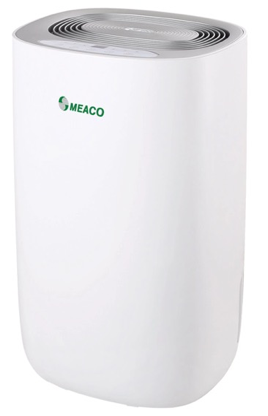
Quiet Mark award winner at 35 dB. Ideal for flats and 1–2 bedroom homes. Laundry mode, night mode, 2-year warranty.
Meaco 20L Low Energy — Best for Larger Homes
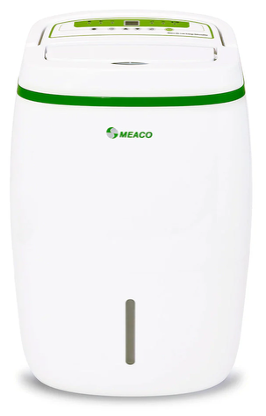
Covers 3–4 bedroom homes. Low running costs, rotating louvre, laundry and night modes, 2-year warranty.
Meaco DD8L Junior — Best for Cold Rooms and Garages
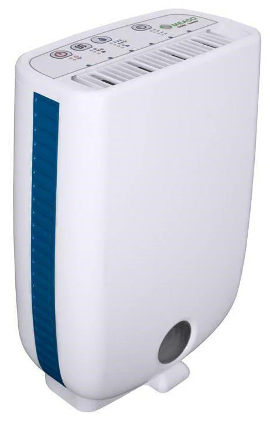
Desiccant technology — works consistently at low temperatures. Ideal for garages, unheated rooms, and winter use.
Frequently Asked Questions
Is Ebac or Meaco better for damp?
Both effectively remove damp when sized correctly. Ebac has a slight edge for persistent or serious damp problems in older UK homes, thanks to its UK-specific calibration, Smart Control, and proven long-term reliability. For moderate damp in a typical modern flat or house, Meaco delivers equivalent results at a lower noise level and often lower cost.
Are Meaco dehumidifiers made in the UK?
No — Meaco is a British brand based in Guildford but its dehumidifiers are manufactured in China. Ebac is the only dehumidifier brand that manufactures in the UK, in Newton Aycliffe, County Durham.
What is Ebac Smart Control?
Smart Control is Ebac’s patented humidity management software. Rather than simply cycling on and off based on a target humidity level (as a standard humidistat does), it records hourly humidity readings and learns your home’s patterns over time — running proactively at the optimal moments to prevent condensation and damp, while minimising unnecessary running time and energy cost.
Which Meaco dehumidifier is best for a flat?
The MeacoDry Abc 12L is the top choice for flats and smaller homes. It is exceptionally quiet (35 dB — Quiet Mark certified), inexpensive to run (4p/hour), and well-sized for spaces up to a typical 1–2 bedroom flat. See our dedicated guide: Best Dehumidifier for Small Flat UK.
Can I use a dehumidifier to dry laundry?
Yes — both Meaco and Ebac models include a laundry mode that runs the fan at full speed for several hours to accelerate clothes drying. It is significantly cheaper than a tumble dryer and gentler on fabrics. See our full guide: Best Dehumidifier for Drying Laundry UK.
Related Guides
Not sure whether to buy a compressor or desiccant model? Read: Desiccant vs Compressor Dehumidifier UK.
Dealing with mould and damp? Start here: Best Dehumidifier for Mould UK.
For guidance on damp, condensation, and their health effects, see the NHS advice on damp and mould.
