
Best Dehumidifier for Small Flat UK (2026): Stop Damp in Tight Spaces
Last updated: 16 June 2026
This page contains affiliate links. If you buy through these links, we may earn a small commission at no extra cost to you. See our Affiliate Disclaimer for more information.
Best dehumidifier for small flat living is a harder question than it looks. Small spaces create more moisture per cubic metre than large ones, have less room for a bulky unit, and often belong to renters who cannot install ventilation or tackle structural damp. Add indoor laundry drying — the single biggest source of moisture in most UK flats — and you have a specific, challenging set of conditions that most buying guides gloss over.
This guide covers five honest picks matched to real flat-living scenarios: the everyday one-bed, the tight budget, the larger flat with persistent damp, the cold unheated room, and the renter who wants something minimal they can move room to room. All specs are verified against manufacturer data.
The NHS recommends keeping indoor humidity between 40% and 60% RH. Above 60%, condensation and mould follow quickly — and in a poorly ventilated flat, humidity can spike to 70–80% after a single shower with the door closed.
Key Takeaways
| At a glance: The Meaco MeacoDry Abc 12L is the best all-round pick for a one-bed flat — 36–40 dB (Quiet Mark certified), 12L/day, Laundry Mode, 3-year warranty. The Pro Breeze 12L is the best budget option at a lower price with comparable extraction. The Meaco 20L Low Energy suits larger or persistently damp flats. The Meaco DD8L Junior is the only correct choice for a cold unheated room — desiccant, works from 1 °C. The Pro Breeze 500ml Mini is a renter-friendly no-commitment option for mild single-room issues only. Compressor dehumidifiers stop working effectively below 15 °C — do not put one in a cold room. |
Quick Picks at a Glance
| Use case | Our pick |
| Best overall (one-bed flat) | Meaco MeacoDry Abc 12L |
| Best budget pick | Pro Breeze 12L |
| Larger flat or persistent damp | Meaco 20L Low Energy |
| Cold unheated room | Meaco DD8L Junior |
| Renter, single-room mild issue | Pro Breeze 500ml Mini |
Why Small Flats Are Harder Than Houses
A small flat concentrates moisture from cooking, showering, and laundry into a much smaller volume of air. A one-bedroom flat of roughly 50 m² might hold only 120 m³ of air — roughly a quarter of what a two-storey house holds. Every shower, pan of pasta, and indoor washing load saturates that volume faster.
Three specific challenges make small flats harder to manage:
- Limited ventilation. Most UK flats — particularly Victorian conversions and 1960s–80s purpose-built blocks — have inadequate extraction. Extractor fans are often weak or broken, and tenants frequently cannot fit additional ventilation.
- No outdoor drying. Balconies are rare in UK flats, and many tenancies prohibit external drying racks. Indoor laundry drying is the norm — and one load adds roughly 2–5 litres of water vapour to your air.
- Structural constraints. Renters cannot drill through walls for condensation traps, install positive input ventilation, or undertake any structural work. The dehumidifier has to do all the heavy lifting.
The result: flat living demands a dehumidifier that is quiet enough to run in a bedroom, compact enough not to dominate a small living room, and powerful enough to handle the moisture that a house would spread across multiple rooms.
| ⚠️ Cold Room Warning: Compressor dehumidifiers stop working efficiently below 15 °C and can be damaged below 5 °C. If your flat has a cold conservatory, unheated spare room, or any space that drops below 15 °C in winter, choose a desiccant model instead. The Meaco DD8L Junior works reliably from 1 °C and is the right tool for cold rooms. |
What Humidity Should You Aim For in a Flat?
For everyday living, set your dehumidifier to 50–55% RH. This sits comfortably within the NHS recommended range and keeps condensation off windows without making the air feel dry. If you have allergies or asthma, Asthma + Lung UK advises keeping humidity below 50% to reduce dust mite populations.
| Situation | Target RH |
| Everyday living | 50–55% RH |
| Allergy / asthma sufferers | 40–50% RH |
| During laundry drying | Run on Laundry Mode / continuous |
| Overnight (bedroom) | 50–55% RH — run on auto mode |
| After shower / cooking | Ventilate first, then dehumidify |
The Best Dehumidifiers for Small Flats: Our Top Picks
1. Meaco MeacoDry Abc 12L — Best Overall for a Small Flat
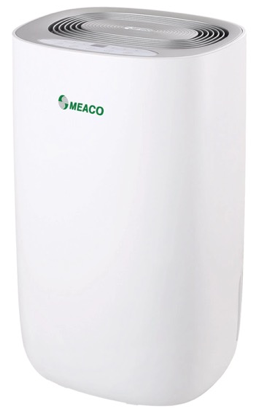
The Meaco MeacoDry Abc 12L is the strongest all-round choice for a one-bedroom flat, and it is the one we recommend to most people asking this question. It combines a Quiet Mark-certified noise level of 36–40 dB with a practical 12L/day extraction rate and a compact, wheel-mounted body that moves easily between rooms. Meaco designed it specifically for smaller homes and apartments, and it shows — the proportions and feature set are well-judged for flat living.
Laundry Mode runs the fan at full power for six hours then auto-shuts — exactly what you need for a drying rack in a small living room. The adjustable humidistat (30–80% RH) prevents over-drying, and the 3-year warranty is the best available at this size.
| Specification | Detail |
| Type | Compressor (refrigerant) |
| Extraction rate | 12 litres/day (at 30 °C, 80% RH) |
| Noise level | 36–40 dB (Quiet Mark certified) |
| Power consumption | 149–196W |
| Tank capacity | 2.6L |
| Operating temperature | 10–35 °C |
| Humidistat | Yes — adjustable 30–80% RH |
| Modes | Auto, Laundry (6-hr timer), continuous |
| Continuous drain | Yes |
| Running cost | ~4p/hr at 24p/kWh |
| Warranty | 3 years (Meaco) |
Pros
- Quiet Mark certified — 36–40 dB, quiet enough for bedroom use
- Laundry Mode runs 6 hours full power then shuts off automatically
- Compact and wheel-mounted — easy to move room to room
- Adjustable humidistat prevents over-drying
- 3-year warranty — best in class for this size
Cons
- 2.6L tank is small — needs emptying every 1–2 days in humid conditions
- Compressor: stops working well below 10 °C — not for cold rooms
- Not the cheapest option
| Verdict: The Meaco MeacoDry Abc 12L hits every mark for flat living — quiet enough for the bedroom, powerful enough for laundry, compact enough for a small living room. The 3-year warranty seals it. This is the one most people should buy. |
2. Pro Breeze 12L — Best Budget Pick
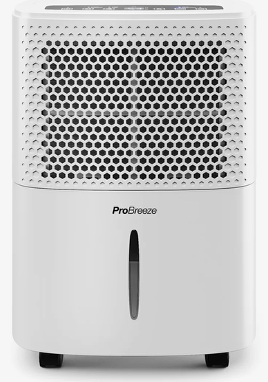
The Pro Breeze 12L is a Which? Best Buy winner that costs significantly less than the Meaco while delivering comparable extraction. At ≤38 dB, it is not quite as quiet as the Meaco Abc in real-world use but it is perfectly acceptable for daytime running in a flat. If budget is the primary concern and the Meaco is out of reach, this is the confident recommendation.
| Specification | Detail |
| Type | Compressor (refrigerant) |
| Extraction rate | 12 litres/day |
| Noise level | ≤38 dB (manufacturer spec) |
| Power consumption | ~200W |
| Tank capacity | 1.8L |
| Operating temperature | 5–32 °C |
| Humidistat | Yes — adjustable 30–80% RH |
| Modes | Auto, continuous, sleep, laundry |
| Continuous drain | Yes — hose included |
| Running cost | ~5p/hr at 24p/kWh |
| Award | Which? Best Buy |
| Warranty | 1 year |
Pros
- Which? Best Buy — independently verified performance
- Lower purchase price than equivalent Meaco models
- Drain hose included — useful for leaving it to run continuously
- 4 wheels — easy to move between rooms
Cons
- 1.8L tank — daily emptying required in high-humidity conditions
- Not Quiet Mark certified — slightly noisier than the Meaco Abc in real-world use
- 1-year warranty vs 3 years on the Meaco
- Compressor: not suitable below 5 °C
| Verdict: If the Meaco MeacoDry Abc 12L is out of budget, this is the one to buy. Which? Best Buy endorsement means the core performance is real, and the drain hose inclusion is a practical bonus. The 1.8L tank and shorter warranty are the trade-offs you make for the lower price. |
3. Meaco 20L Low Energy — Best for Larger Flats or Persistent Damp
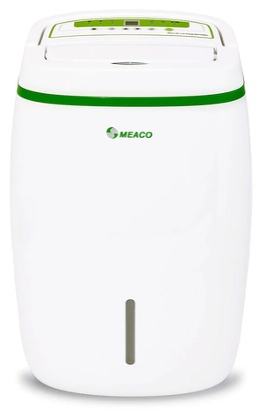
The Meaco 20L Low Energy is the heavy-duty option for a larger one-bed flat, a two-bed flat, or any flat where damp is a serious ongoing problem rather than occasional condensation. At 20L/day and 219W, it processes significantly more air per hour than the 12L models. The 6L tank means emptying every two to three days rather than daily.
It is not as quiet as the Meaco Abc — rated at 46 dB — so it is less suitable for overnight use in a bedroom. For a hallway or living room covering the whole flat, though, it is excellent. The Control Logic system runs the compressor for roughly 10 minutes per hour under typical UK conditions, which makes the effective running cost considerably lower than the headline wattage suggests.
| Specification | Detail |
| Type | Compressor (refrigerant) |
| Extraction rate | 20 litres/day |
| Noise level | 46 dB |
| Power consumption | 219W |
| Tank capacity | 6L |
| Operating temperature | 5–35 °C |
| Humidistat | Yes — Control Logic, adjustable 30–80% RH |
| HEPA filter | Yes — included |
| Continuous drain | Yes |
| Running cost | ~5p/hr at 24p/kWh (~12p/day effective) |
| Warranty | 3 years (Meaco) |
Pros
- 20L/day — handles larger flats and persistent damp a 12L model cannot keep up with
- 6L tank — significantly less frequent emptying than 12L models
- Control Logic runs compressor ~10 min/hr under typical conditions — very efficient in practice
- HEPA filter included — doubles as a light air purifier
- 3-year warranty
Cons
- 46 dB — noisier than the Abc; not ideal for overnight bedroom use
- Larger physical footprint — takes up more floor space in a small flat
- Higher upfront cost
- Compressor: not suitable below 5 °C
| Verdict: The right choice when a flat has a genuine damp problem rather than occasional condensation, or when the floor area is larger than a typical one-bed. Place it in the hallway, set the humidistat to 50%, and let the Control Logic do the work. The 6L tank makes it genuinely low-maintenance despite the power. |
4. Meaco DD8L Junior — Best for Cold Rooms
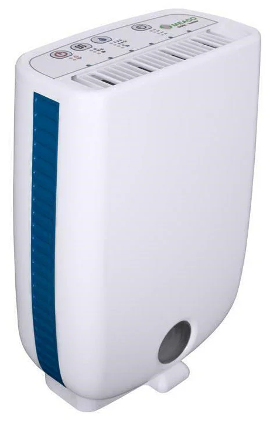
If any part of your flat is cold or unheated — a north-facing bedroom that drops below 15 °C in winter, an unheated storage room, or a flat with a poorly insulated external wall — a compressor dehumidifier will not do the job. The Meaco DD8L Junior is the answer. As a desiccant unit, it uses a heated rotor rather than a refrigerant circuit and works reliably from 1 °C — long after any compressor model has given up.
It is also the right call for renters in older Victorian flats where one or two rooms are noticeably colder than the rest. Desiccant machines run slightly warmer than compressor units — the warm exhaust air is actually welcome in a cold room — and the DD8L Junior’s auto-restart means it keeps working through any brief power interruptions without needing a manual reset.
| Specification | Detail |
| Type | Desiccant (heated rotor — no refrigerant) |
| Extraction rate | 8 litres/day (at 20 °C, 60% RH) |
| Noise level | 34–42 dB |
| Power consumption (auto) | 330W (~8p/hr at 24p/kWh) |
| Power consumption (laundry) | 650W (laundry/high speed only) |
| Tank capacity | 2L |
| Operating temperature | 1–35 °C |
| Continuous drain | Yes — gravity hose |
| Auto-restart | Yes |
| Running cost | ~8p/hr at 24p/kWh (auto mode) |
| Warranty | 3 years (Meaco) |
| ⚠️ Wattage note: The DD8L Junior draws 330W on auto mode — this is the normal running figure. The 650W figure sometimes seen online refers to laundry/high-speed mode only. Use 330W for running cost calculations. |
Pros
- Works from 1 °C — the only reliable option for cold rooms
- Warm exhaust air is useful in a cold room
- Auto-restart after power interruptions
- Continuous drain for unattended use
- 3-year warranty
Cons
- Higher running cost than compressor models in warm conditions (330W vs 149–200W)
- Generates heat — not ideal for summer use in already-warm rooms
- 2L tank — use continuous drain for unattended running
| Verdict: Non-negotiable for cold rooms. If any space in your flat drops below 15 °C in winter, a compressor dehumidifier simply will not work — the Meaco DD8L Junior is the only portable dehumidifier that handles British cold-room conditions reliably. For heated rooms at normal flat temperatures, the Meaco Abc 12L is the better choice. |
5. Pro Breeze 500ml Mini — Best for Renters or Single-Room Mild Issues
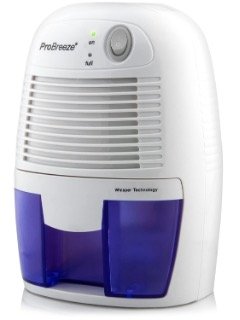
The Pro Breeze 500ml Mini is a completely different category from the four models above. It uses Peltier (thermoelectric) technology — no compressor, no moving parts — which makes it virtually silent at ≤33 dB and costs less than 1p per hour to run at 24p/kWh. The trade-off is extraction: at 250ml per day, it is not capable of managing a damp flat. Its role is targeted and specific.
Be honest with yourself before buying this: if your flat has visible mould, condensation running down windows, or laundry that refuses to dry, the 500ml Mini will not solve the problem. It is the right tool for a single wardrobe with a musty smell, a bathroom corner where nothing larger will fit, or a renter who wants something cheap and portable they can take when they move.
| Specification | Detail |
| Type | Peltier (thermoelectric — no compressor) |
| Extraction rate | ~250ml/day |
| Noise level | ≤33 dB |
| Power consumption | 20W (~0.5p/hr at 24p/kWh) |
| Tank capacity | 500ml |
| Min operating temp | ~15 °C (ineffective below this) |
| Continuous drain | No |
| Weight | ~1 kg |
| Running cost | Under 0.5p/hr at 24p/kWh |
| Warranty | 1 year |
Pros
- ≤33 dB — virtually silent, ideal for bedrooms and offices
- Under 0.5p/hr running cost — genuinely negligible
- ~1 kg — the most portable option by far
- No installation, no plumbing, no commitment
Cons
- Only ~250ml/day — not suitable for whole-flat damp or laundry drying
- Ineffective below ~15 °C
- No continuous drain — must empty manually
- 500ml tank fills quickly in high humidity
| Verdict: A practical option for renters who want something cheap, light, and zero-commitment. Perfect for a single bedroom with mild condensation, a wardrobe, or a bathroom corner. Not a substitute for a proper 12L+ model if damp is a real problem. |
Side-by-Side Comparison
| Model | Type | Extraction | Noise | Tank | Best for |
| Meaco MeacoDry Abc 12L | Compressor | 12L/day | 36–40 dB | 2.6L | One-bed flat, everyday use |
| Pro Breeze 12L | Compressor | 12L/day | ≤38 dB | 1.8L | Budget, laundry drying |
| Meaco 20L Low Energy | Compressor | 20L/day | 46 dB | 6L | Large flat, persistent damp |
| Meaco DD8L Junior | Desiccant | 8L/day | 34–42 dB | 2L | Cold unheated rooms |
| Pro Breeze 500ml Mini | Peltier | 250ml/day | ≤33 dB | 500ml | Single room, mild issues |
Running Costs at 24p/kWh
All figures at 24p/kWh (Ofgem unit rate). The Meaco 20L effective daily cost accounts for the Control Logic running the compressor for approximately 10 minutes per hour, not continuously.
| Model | Power | Cost/hr | Cost/day (8 hrs) | Cost/day (24 hrs) | Est. annual* |
| Meaco MeacoDry Abc 12L | 149–196W | ~4p | ~32p | ~96p | ~£36–48 |
| Pro Breeze 12L | ~200W | ~5p | ~40p | ~£1.15 | ~£55–65 |
| Meaco 20L Low Energy | 219W | ~5p | ~12p (effective) | ~37p (effective) | ~£45–60 |
| Meaco DD8L Junior (auto) | 330W | ~8p | ~64p | ~£1.90 | ~£73–88 |
| Pro Breeze 500ml Mini | 20W | ~0.5p | ~4p | ~12p | ~£3–5 |
* Annual estimates assume 8 hours of daily operation across the heating season. Running a 12L model for 8 hours a day costs roughly 32–40p — under £10 per month.
How to Size a Dehumidifier for Your Flat
A useful rule of thumb: roughly 10 litres of daily extraction capacity per 50 m² of floor space, with an upward adjustment if you dry laundry indoors. One indoor load adds roughly 2–5 litres of moisture to your air — factor that in.
| Flat size | Suggested capacity | Best pick |
| Studio or bedsit (up to 30 m²) | 8–12L/day | Meaco Abc 12L or Pro Breeze 12L |
| One-bedroom flat (30–55 m²) | 12L/day | Meaco Abc 12L |
| Larger one-bed / two-bed (55–80 m²) | 20L/day | Meaco 20L Low Energy |
| Cold / unheated room (any size) | Desiccant — 8L/day | Meaco DD8L Junior |
| Single room, mild issue only | Peltier mini | Pro Breeze 500ml Mini |
Renter’s Guide: What You Can and Cannot Do
Most UK flat renters face practical constraints that homeowners do not. Here is what matters:
What you can do without landlord permission
- Run a freestanding portable dehumidifier — no installation required
- Use a continuous drain hose into a sink (no plumbing, just gravity)
- Open windows and trickle vents to improve ventilation
- Apply anti-mould paint or treatment to surfaces (reversible)
- Request that your landlord repairs extractor fans — they are legally required to maintain these under the Landlord and Tenant Act
What you generally cannot do without permission
- Drill through walls for positive input ventilation (PIV) systems
- Install permanent drainage pipework
- Replace extractor fans with higher-capacity models
The good news: a freestanding dehumidifier with a gravity drain hose running to a nearby sink is genuinely effective and requires zero permission or installation. Both the Meaco Abc 12L and Pro Breeze 12L support continuous drain as standard.
Where to Place a Dehumidifier in a Small Flat
- Place it centrally. In a one-bed flat, the hallway or open-plan living area is usually best. With doors open, it can draw from bedroom and living space simultaneously.
- Keep internal doors open. Closing the bedroom door with the dehumidifier in the hallway cuts airflow significantly. Leave doors ajar when running.
- Allow 30 cm clearance. Do not tuck it into a corner — it needs clear space around the intake and exhaust to work efficiently.
- Run it in the bathroom briefly after showering. A 30–60 minute run after a shower then back to the hallway removes the steam burst effectively.
- Position Laundry Mode near — not at — the drying rack. Air flowing past the side of the rack is more efficient than pointing the unit directly at wet clothes.
- Do not leave it in the bathroom full-time. Sustained high-humidity bathroom air can overwhelm smaller units and cause internal damage over time.
Frequently Asked Questions
Can a small dehumidifier actually stop mould in a flat?
Yes — if the mould is caused by condensation rather than structural damp or a leak. A dehumidifier like the Meaco Abc 12L can maintain humidity at 50–55% RH, the level at which mould cannot easily grow. If mould keeps returning after cleaning, humidity control is almost certainly what is missing. For structural or rising damp, you need your landlord involved.
Is it worth buying a dehumidifier as a renter?
Generally yes, especially if you dry laundry indoors. A Pro Breeze 12L or Meaco Abc 12L is portable, requires no installation, and comes with you when you move. The running cost at 32–40p per day is modest, and the reduction in mould risk and improvement in air quality is significant.
Should I run a dehumidifier overnight in the bedroom?
Yes, if condensation on your bedroom windows is a problem. The Meaco Abc 12L at 36–40 dB is quiet enough for most people to sleep alongside. Set the humidistat to 50–55% and it will only run when needed. The Pro Breeze 500ml Mini at ≤33 dB is even quieter, though its extraction is far more limited.
What is the difference between a compressor and a Peltier dehumidifier?
Compressor models — like the Meaco Abc 12L and Pro Breeze 12L — use a refrigerant circuit to condense moisture. They are efficient per litre removed and suitable for whole-flat use. Peltier models — like the Pro Breeze 500ml Mini — use a thermoelectric chip with no moving parts. Near-silent but very low extraction rates. Peltier models are supplementary tools for mild localised issues, not primary solutions for a flat.
Can I use a compressor dehumidifier in a cold spare room?
No — compressor models stop extracting effectively below 15 °C and can be damaged below 5 °C. For any cold or unheated space, choose a desiccant model. The Meaco DD8L Junior works reliably from 1 °C and is the correct tool for cold rooms. See our guide on desiccant vs compressor dehumidifiers UK for a full comparison.
My flat has a musty smell but no visible mould — do I need a dehumidifier?
A persistent musty smell without visible mould usually means humidity is borderline high — possibly 60–70% — and mould is growing in hidden spots (behind furniture, under flooring, inside walls). Buy an inexpensive digital hygrometer (under £10) to check your actual humidity. If it regularly reads above 60%, the Meaco Abc 12L or Pro Breeze 12L will address it. If the smell persists after reducing humidity, report it to your landlord — it may indicate a hidden leak.
How much does it cost to run a dehumidifier in a flat?
At 24p/kWh: the Meaco Abc 12L costs around 4p/hr; the Pro Breeze 12L around 5p/hr; the Meaco 20L Low Energy around 5p/hr (but its Control Logic means it cycles on and off, so effective daily cost is lower); the Meaco DD8L Junior around 8p/hr on auto; and the Pro Breeze 500ml Miniunder 0.5p/hr. Running a 12L model for 8 hours costs roughly 32–40p — under £10 per month.
Quick Decision Guide
| Your situation | Best pick |
| Standard one-bed flat, everyday use | Meaco MeacoDry Abc 12L |
| Tight budget, similar extraction needed | Pro Breeze 12L |
| Larger flat or serious damp problem | Meaco 20L Low Energy |
| Cold unheated room — any flat size | Meaco DD8L Junior |
| Renter, single-room mild issue, minimal commitment | Pro Breeze 500ml Mini |
For most readers, the Meaco MeacoDry Abc 12L is the answer. If budget is the constraint, the Pro Breeze 12L delivers comparable performance for less. If your flat is larger or has a real damp problem, step up to the Meaco 20L Low Energy. And if any room in your flat is cold in winter, add the Meaco DD8L Junior for that space — no compressor model will cope.

4 Comments