
Best Dehumidifier for Drying Laundry UK (2026): Dry Clothes Faster Indoors
Last updated: 29 September 2026
This page contains affiliate links. If you buy through these links, we may earn a small commission at no extra cost to you. See our Affiliate Disclaimer for more information.
Best dehumidifier for drying clothes you can buy is one of the most practically useful purchases you can make as a British homeowner or renter — and the case for it has never been stronger. Energy prices have made tumble dryers increasingly expensive, outdoor drying is unreliable for around eight months of the year, and draping clothes over radiators dumps enough moisture into the room to cause condensation, mould, and dust mite problems. A dehumidifier paired with an indoor airer solves all three: clothes dry in 3–6 hours, humidity stays under control, and your running costs are a fraction of a tumble dryer.
This guide covers which models actually work for laundry drying, what laundry mode really does, and the cold-room problem most buyers discover too late.
Key Takeaways
| At a glance: Meaco 20L Low Energy is the best overall pick — highest extraction, lowest running cost per litre, 6L tank handles back-to-back loads. Meaco MeacoDry Abc 12L is quieter and more compact — ideal for flats and smaller households, doubles as a bedroom dehumidifier overnight. Pro Breeze 12L is the budget option with Which? Best Buy backing. Meaco DD8L Junior is the only model here that works in a cold unheated room — desiccant, operates from 1 °C. Drying laundry over radiators releases ~2 litres of moisture per load into your room air. A dehumidifier dries the same clothes in 3–6 hours for 8–15p versus 50–85p for a vented tumble dryer. |
Dehumidifier vs Radiator vs Tumble Dryer — The Honest Numbers
Before picking a model, it is worth understanding what you are actually comparing. Most people know tumble dryers are expensive — but the radiator method looks deceptively free.
| Method | Drying time | Cost per load | Humidity impact | Verdict |
| Tumble dryer (vented) | 45–90 min | ~50–85p | None — vented outside | Fast but expensive |
| Radiators | 4–12 hours | Heating already on | Adds ~2L to room air — condensation and mould risk | Free but raises humidity significantly |
| Dehumidifier + airer | 3–6 hours | 8–15p | Removes moisture — humidity stays controlled | Best all-round for UK winters |
| Dehumidifier + heated airer | 2–4 hours | 15–25p combined | Removes moisture | Fastest without a dryer |
The radiator method is worth examining honestly. It feels free because the heating is already on — but a full load drying over radiators releases approximately 2 litres of moisture into the room. That moisture lands on cold windows and walls, setting up the exact conditions for condensation and mould. It is not cost-free: it is a hidden cost you will eventually pay in mould treatment or structural damage.
What Does Laundry Mode Actually Do?
Most dehumidifiers marketed for laundry drying include a dedicated laundry mode. What this means varies, and it is worth understanding before you buy.
Laundry mode typically does one or more of the following:
- Runs the fan at maximum speed continuously, regardless of current humidity, to maximise air movement through damp clothing
- Disables or overrides the humidistat — so the unit does not switch off when ambient humidity drops, and keeps running until clothes are dry or you stop it manually
- Targets a lower humidity threshold — typically around 40% rather than the usual 50–55% — to drive the room dry enough to accelerate evaporation from wet fabric
Not all laundry modes are equal. A well-implemented one — like those on the Meaco models — makes a meaningful difference to drying time. When in doubt, higher extraction capacity (litres per day) is a more reliable indicator of laundry performance than the presence of a laundry mode button alone.
| ⚠️ Cold room warning: Compressor dehumidifiers stop working reliably below 15 °C. If your utility room, garage, conservatory, or any other drying space drops below this in winter, a compressor model will perform poorly or extract almost nothing. This is physics, not a product flaw. For cold unheated spaces you need a desiccant model — the Meaco DD8L Junior is the correct tool. |
The Best Dehumidifiers for Drying Laundry: Our Picks
1. Meaco 20L Low Energy — Best Overall
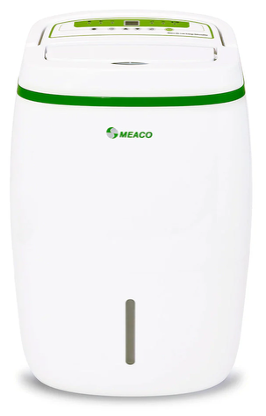
For most UK households drying regular loads of laundry indoors, the Meaco 20L Low Energy is the outstanding choice. Its 20L/day extraction capacity handles a full washing machine load in a closed room significantly faster than a 12L model, and at 219W maximum it is the most energy-efficient machine in its class — lowest running cost per litre extracted of any 20L compressor dehumidifier available in the UK. The 6L tank provides generous headroom during active laundry sessions: a family load releases around 1.5–2.5 litres of moisture, so you are unlikely to need to empty it mid-session.
The Control Logic system is worth highlighting specifically for laundry use. It samples the air every 30 minutes and cycles the compressor intelligently rather than running flat out continuously — meaning the effective daily running cost is considerably lower than the headline 219W figure implies. For a household drying laundry daily through winter, the energy savings over a less efficient 20L model are real and cumulative.
| Specification | Detail |
| Type | Compressor (refrigerant) |
| Extraction rate | 20L/day (at 30 °C, 80% RH) |
| Tank capacity | 6L |
| Noise level | 44–46 dB |
| Power consumption | 219W maximum |
| Running cost | ~6p/hr at 26p/kWh |
| Laundry mode | Yes — higher fan speed drives air through hanging clothes |
| Continuous drain | Yes — run indefinitely without emptying |
| HEPA filter | Included — doubles as light air purifier |
| Min. operating temp | ~15 °C — heated rooms only |
| Warranty | 3 years (Meaco) |
Pros
- Highest extraction capacity in this guide — fastest drying times for full family loads
- 219W — most energy-efficient 20L compressor model; lowest running cost per litre extracted
- 6L tank rarely needs emptying mid-session even with heavy loads
- Continuous drain for unattended operation across multiple back-to-back washes
- HEPA filter included — useful year-round as a light air purifier
- 3-year Meaco warranty
Cons
- Higher upfront cost than the 12L models
- Bulkier and heavier — less convenient to move between rooms daily
- 44–46 dB — audible in occupied spaces; not ideal for overnight bedroom use
- Not suitable for unheated rooms below 15 °C
| Verdict: If you dry laundry indoors regularly throughout autumn and winter, the Meaco 20L Low Energy is the most cost-effective choice over a full season. At 219W and ~6p/hr, the energy savings over a less efficient model running daily offset the higher purchase price within one to two winters. The 6L tank and continuous drain make it the most practical choice for families with frequent laundry loads. |
2. Meaco MeacoDry Abc 12L — Best for Smaller Loads and Flats
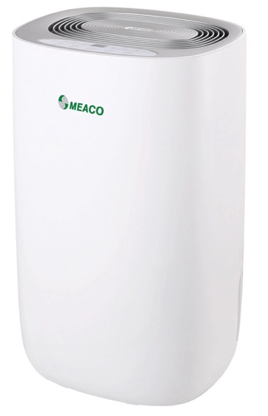
For smaller households, flats, or anyone drying one to two loads per week rather than daily, the Meaco MeacoDry Abc 12L is the most versatile pick in this guide. Its compact size makes it easy to position close to a drying rack, its Quiet Mark accreditation at 36–40 dB means it is genuinely tolerable in a living space during a drying session, and its 12L/day capacity handles a standard single-household load comfortably. On other days it doubles as a bedroom dehumidifier overnight — something no other model in this guide does as naturally.
The 6-hour Laundry Mode timer is well-judged for flat living: switch it on before you go out or go to bed, and it runs hard for six hours then shuts off automatically. No timer to set, no tank overflow risk, no coming home to a unit that has been sitting idle for hours.
| Specification | Detail |
| Type | Compressor (refrigerant) |
| Extraction rate | 12L/day (at 30 °C, 80% RH) |
| Tank capacity | 2.6L — use continuous drain for laundry sessions |
| Noise level | 36–40 dB (Quiet Mark certified) |
| Power consumption | ~160W |
| Running cost | ~4p/hr at 24p/kWh |
| Laundry mode | Yes — runs full speed for 6 hours then shuts off |
| Continuous drain | Yes — recommended for laundry sessions |
| Min. operating temp | ~15 °C — heated rooms only |
| Warranty | 3 years (Meaco) |
Pros
- Quiet Mark certified at 36–40 dB — significantly quieter than most competitors
- Compact and light at ~10.4 kg — easy to position next to the airer and move between rooms
- Laundry Mode runs 6 hours then shuts off — set and forget
- Doubles as a bedroom dehumidifier overnight — the most versatile pick in this guide
- ~4p/hr — lowest running cost of the compressor models
- 3-year Meaco warranty
Cons
- 12L/day means longer drying times for large family loads — step up to the 20L for frequent family washes
- 2.6L tank fills quickly during active laundry drying — connect continuous drain for any session over 2 hours
- Not suitable for unheated rooms below 15 °C
| Verdict: If you dry laundry indoors regularly throughout autumn and winter, the Meaco 20L Low Energy is the most cost-effective choice over a full season. At 219W and ~6p/hr, the energy savings over a less efficient model running daily offset the higher purchase price within one to two winters. If you regularly dry large family loads, step up to the Meaco 20L Low Energy. |
3. Pro Breeze 12L — Best Budget Pick
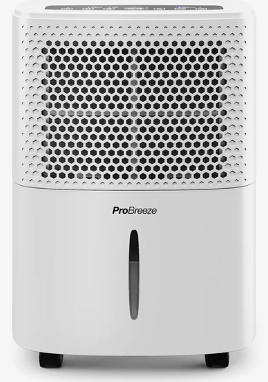
If upfront cost is the main constraint, the Pro Breeze 12L is the confident budget recommendation. It earned a Which? Best Buy award and its 12L/day extraction capacity covers the core requirements for indoor clothes drying in a heated room. The trade-offs versus the Meaco models are a smaller 1.8L tank, slightly higher ~200W power draw, and no Quiet Mark accreditation — honest compromises for the lower price point.
One practical note: the 1.8L tank will fill faster than you expect during a laundry session. Connect the included continuous drain hose to a nearby sink before you start — this turns it from a unit you need to babysit into one you can leave running unattended.
| Specification | Detail |
| Type | Compressor (refrigerant) |
| Extraction rate | 12L/day (at 30 °C, 80% RH) |
| Tank capacity | 1.8L — connect continuous drain for laundry sessions |
| Noise level | ≤38 dB (manufacturer spec) |
| Power consumption | ~200W |
| Running cost | ~5p/hr at 26p/kWh |
| Laundry mode | Yes |
| Continuous drain | Yes — hose included |
| Filter | Washable |
| Award | Which? Best Buy |
| Min. operating temp | ~15 °C — heated rooms only |
| Warranty | 2 years |
Pros
- Lowest upfront cost in this guide
- Which? Best Buy — independently reviewed and verified
- Continuous drain hose included — essential for laundry sessions
- Laundry mode, auto-humidistat, and 4 wheels for easy positioning
Cons
- 1.8L tank — the smallest in this guide; continuous drain is not optional for laundry use
- ~200W vs ~160W on the Meaco Abc 12L — marginally higher running costs over a full winter
- Not Quiet Mark certified — slightly noisier than the Meaco Abc in real-world use
- 2-year warranty vs 3-year on the Meaco models
| Verdict: The right choice if upfront cost is the deciding factor. The Which? Best Buy award is a genuine endorsement — the core performance is solid. Connect the continuous drain before any laundry session and it runs reliably without babysitting. For a utility room where noise is less of a concern, it represents excellent value. |
4. Meaco DD8L Junior — Best for Cold and Unheated Spaces
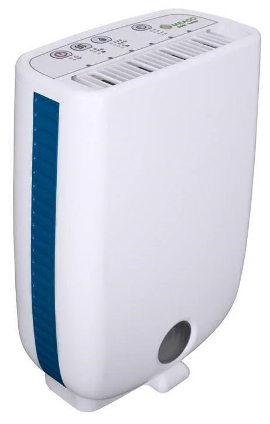
If you dry laundry in an unheated utility room, garage, conservatory, or any space that drops below 15 °C in winter, stop reading about compressor models — none of them will do the job reliably. The Meaco DD8L Junior is a desiccant dehumidifier, which means it uses a heated rotor rather than a refrigerant circuit and works from 1 °C. That makes it the only model in this guide that functions properly in a cold UK utility room throughout autumn and winter.
As a bonus, desiccant units release slightly warm air during operation. In a cold room, this gently raises ambient temperature — which itself accelerates evaporation from wet fabric. It is a marginal effect but a real one, and it makes the DD8L Junior a more effective laundry dryer in cold conditions than its 8L/day extraction rate might suggest.
| Specification | Detail |
| Type | Desiccant (heated rotor — no refrigerant) |
| Extraction rate | 8L/day (at 20 °C, 60% RH) |
| Tank capacity | 2L — continuous drain recommended for laundry |
| Noise level | 34–42 dB |
| Power consumption (auto) | 330W (~8p/hr at 24p/kWh) |
| Power consumption (laundry) | 650W (laundry/high speed only) |
| Running cost | ~9p/hr at 26p/kWh (auto mode) |
| Air output | Slightly warm — helpful in cold rooms |
| Laundry mode | Yes |
| Continuous drain | Yes — gravity hose |
| Min. operating temp | 1 °C — reliable in unheated spaces year-round |
| Auto-restart | Yes |
| Warranty | 3 years (Meaco) |
| ⚠️ Wattage note: The DD8L Junior draws 330W on auto mode — this is the normal running figure. The 650W figure quoted elsewhere refers to laundry/high-speed mode only. Use 330W for running cost calculations. |
Pros
- Works from 1 °C — the only model here that functions reliably in cold unheated spaces
- Slightly warm air output is a genuine benefit in a cold utility room or garage
- Continuous drain and auto-restart for unattended operation
- Compact at ~6.4 kg — easy to position near the drying rack
- 3-year Meaco warranty
Cons
- Higher running cost than compressor models in a warm room — not the right choice for a heated space
- Generates heat — less comfortable in a warm room in summer
- 2L tank — connect continuous drain for any laundry session
| Verdict: The only model in this guide that will reliably dry laundry in an unheated space in a UK winter. Do not be misled by the lower extraction figure — 8L/day from a desiccant in a cold room consistently outperforms a 20L compressor struggling below 15 °C. If your drying space drops below 15 °C from October to April, this is the unit you need. |
Quick Comparison: Best Dehumidifiers for Drying Laundry
| Feature | Meaco 20L Low Energy | Meaco Abc 12L | Pro Breeze 12L | Meaco DD8L Junior |
| Type | Compressor | Compressor | Compressor | Desiccant |
| Extraction | 20L/day | 12L/day | 12L/day | 8L/day |
| Noise | 44–46 dB | 36–40 dB (QM) | ≤38 dB | 34–42 dB |
| Power (normal) | 219W | ~160W | ~200W | 330W (auto) |
| Running cost | ~6p/hr | ~4p/hr | ~5p/hr | ~9p/hr |
| Tank | 6L | 2.6L | 1.8L | 2L |
| Laundry mode | Yes | Yes (6-hr timer) | Yes | Yes |
| Continuous drain | Yes | Yes | Yes | Yes |
| Min. temp | ~15 °C | ~15 °C | ~15 °C | 1 °C |
| Warranty | 3 years | 3 years | 2 years | 3 years |
| Best for | Family / frequent | Smaller loads, flats | Budget pick | Cold unheated spaces |
Running Costs at 24p/kWh
A full laundry drying session typically runs 3–6 hours. All figures at 24p/kWh (Ofgem unit rate).
| Model | Power | Cost/hr | 3-hr session | 6-hr session |
| Meaco 20L Low Energy | 219W | ~6p | ~17p | ~34p |
| Meaco MeacoDry Abc 12L | ~160W | ~4p | ~13p | ~25p |
| Pro Breeze 12L | ~200W | ~5p | ~16p | ~31p |
| Meaco DD8L Junior (auto) | 330W | ~9p | ~26p | ~52p |
For comparison: a vented tumble dryer drawing 2,500W for one hour costs approximately 60p at 24p/kWh. Even the least efficient model here (the DD8L Junior at 48p for a 6-hour session) undercuts a one-hour tumble dry — and dries the same clothes with less fabric wear.
How to Dry Laundry Faster with a Dehumidifier
The dehumidifier is only part of the equation. How you set up the room makes a significant difference to drying times.
1. Close the door and windows
A dehumidifier works most efficiently on a contained volume of air. Run it in a room with an open door and it is fighting to reduce humidity across the whole house rather than focusing on the drying space. Close the door, shut the windows, and let it work on the air in the room — drying times drop significantly compared to an open setup.
2. Position it close to the airer
The unit draws in moist air from its intake and returns drier air from its outlet. Position it within 1–2 metres of the drying rack, with clear airflow between the unit and the hanging clothes. Do not tuck it in a corner on the opposite side of the room from the airer.
3. Space clothes well on the airer
Overlapping clothes trap moisture between layers and slow drying significantly. A well-spaced airer where each item hangs freely dries two to three times faster than a heavily loaded one with items bunched together. Thicker items — towels, jeans, hoodies — benefit most from additional spacing.
4. Use laundry mode for the first 2–3 hours
Switch to laundry mode for the initial phase when clothes are at their wettest and generating the most moisture. Once clothes are mostly dry — usually after 2–3 hours — switch to auto mode, which maintains target humidity at lower fan speed and lower energy use.
5. Add a desk fan
A small desk or pedestal fan pointed at the drying rack works in combination with the dehumidifier to accelerate evaporation. The fan increases the rate at which moist air lifts from damp fabric; the dehumidifier removes it from the room. Together they can reduce drying time by 30–40% compared to a dehumidifier running alone.
6. Use continuous drain for laundry sessions
During a laundry session, the tank fills much faster than in normal operation — a full load releases 1.5–2.5 litres of moisture into a closed room. The Meaco 20L Low Energy‘s 6L tank provides good headroom, but for the Meaco Abc 12L, Pro Breeze 12L, and Meaco DD8L Junior, connecting the continuous drain to a nearby sink before you start is the most practical option.
7. Set a target humidity, not a timer
Rather than running the dehumidifier for a fixed number of hours, set it to a target of 45–50% RH for a drying session. When the room reaches that level, clothes will be dry or very nearly so. This uses exactly as much energy as needed and avoids over-drying, which can make some fabrics stiff.
Frequently Asked Questions
Does a dehumidifier actually help dry clothes faster?
Yes — significantly. Clothes dry by evaporation: moisture lifts from the fabric into the surrounding air. When that air is already saturated — as it quickly becomes in a closed room full of wet washing — evaporation slows dramatically. A dehumidifier continuously removes moisture from the air, maintaining the humidity gradient that allows evaporation to continue. In a closed room with a correctly sized model on laundry mode, most loads dry in 3–6 hours.
Is a dehumidifier cheaper to run than a tumble dryer?
Yes — considerably. A vented tumble dryer drawing around 2,500W for one hour costs approximately 65p at 26p/kWh. The Meaco 20L Low Energy at 219W running for four hours costs approximately 34p — and dries the same load with less wear on fabrics. Even the Pro Breeze 12L at ~200W costs under 31p for a full session. Over a full winter of regular indoor drying, the savings are substantial.
What size dehumidifier do I need to dry laundry?
For a single person or couple washing two to three times per week, a 12L/day model such as the Meaco MeacoDry Abc 12L is sufficient. For a family of three or four washing more frequently, step up to the Meaco 20L Low Energy — the higher extraction capacity handles the larger moisture load without running for hours longer than necessary. Undersizing is the most common mistake.
Can I use a dehumidifier to dry laundry in a cold garage or utility room?
Not with a compressor model — they perform poorly below 15 °C and barely extract anything in a cold garage in winter. For an unheated space, use the Meaco DD8L Junior desiccant, which operates from 1 °C. The slightly warm air it releases is a helpful bonus in a cold utility room, gently raising the ambient temperature and further accelerating drying.
Is it bad to dry laundry indoors without a dehumidifier?
Not dangerous short-term, but damaging to your home over time. A full load drying over radiators or on an airer in a closed room releases approximately 2 litres of moisture into the room air. That raises indoor humidity, promotes condensation on cold surfaces, and — in homes already struggling with damp — significantly accelerates mould growth. See our guide to the best dehumidifier for mould UK for more on mould prevention.
Does laundry mode use more electricity?
Yes — laundry mode runs the fan at maximum speed continuously, drawing more power than auto mode cycling at lower speeds. However, because laundry mode dries clothes significantly faster, the total run time is shorter. Total energy used for a drying session is often similar to or less than auto mode running longer to achieve the same result.
Should I get a 12L or 20L dehumidifier for drying laundry?
It depends on how often you dry laundry and how large your loads are. A 12L/day model — such as the Meaco MeacoDry Abc 12L — handles one to two loads per session comfortably and is the better choice if you also want to use it as a bedroom dehumidifier, since it is significantly quieter. A 20L/day model — such as the Meaco 20L Low Energy — is the better choice for families drying multiple loads daily or for anyone with persistent damp throughout the home.
Where is the best place to put a dehumidifier for drying laundry?
In the same closed room as the drying rack, positioned 1–2 metres from the airer with clear airflow between the unit and the clothes. Keep the door and windows closed. Do not place it in an adjacent room or hallway — it needs to be working on the same body of air as the wet laundry. Adding a desk fan pointed at the clothes while the dehumidifier runs is the single most effective way to accelerate drying further.
The Verdict
For most UK households drying laundry regularly indoors, the Meaco 20L Low Energy (219W, 6L tank, ~5p/hr) is the best investment — its extraction capacity, energy efficiency, and generous tank make it the most capable and cost-effective option for frequent laundry drying over a full winter.
For smaller households or anyone wanting a unit that doubles as a bedroom dehumidifier, the Meaco MeacoDry Abc 12L (~160W, 36–40 dB Quiet Mark certified, ~5p/hr) is the quieter and more versatile choice. On a tight budget, the Pro Breeze 12L (Which? Best Buy, ~200W, ≤38 dB) gets the job done at the lowest upfront cost — connect the continuous drain and it is a capable laundry dryer.
For anyone drying laundry in an unheated utility room, garage, or conservatory that drops below 15 °C in winter, the Meaco DD8L Junior is the only model here that will work reliably. Do not put a compressor dehumidifier in a cold unheated space in winter and expect it to perform — it will not.

7 Comments