Best Air Purifier for Bedroom UK (2025): Sleep Better, Breathe Better
Last updated: 5 September 2026
| Affiliate Disclosure: This page contains affiliate links. If you buy through these links, we may earn a small commission at no extra cost to you. See our Affiliate Disclaimer for more information. |
Finding the best air purifier for bedroom UK use comes down to one requirement above all others: it has to be quiet enough to actually run while you sleep. An air purifier that sits on silent mode but barely moves air, or a powerful unit that keeps you awake at 55 dB, are both failures in a bedroom context. This guide cuts through the noise — literally — with honest picks for every bedroom size and sleep sensitivity, alongside the buying criteria that actually matter.
| Key Takeaways: For a bedroom, noise level is the #1 buying criterion. Target a unit that runs below 30 dB in sleep mode — the equivalent of a quiet whisper. Top pick for most UK bedrooms: Levoit Core 300S — 22–24 dB in sleep mode, 26 W, True HEPA H13, CADR 258 m³/h, auto mode with laser PM2.5 sensor. Upgrade for larger bedrooms or open-plan: Levoit Core 400S — CADR 442 m³/h, 24–52 dB, 38 W, covers up to 37 m² at 4.8 ACH. Best for allergy sufferers and pet owners: Winix 5500-2 — CADR 232–246 across smoke/dust/pollen, washable carbon filter, PlasmaWave ioniser (can be switched off). Note: UK availability and filter support confirmed until at least 2032 despite US discontinuation. Budget pick: Levoit Core 300 — same True HEPA filtration as the 300S at a lower price, 24–48 dB, 45 W, no auto mode or air quality sensor.ACH (air changes per hour) matters more than CADR alone — aim for at least 4–5 ACH for allergy control in your specific room size. |
What Makes a Bedroom Air Purifier Different
You spend roughly a third of your life in your bedroom. That makes it the single most important room for sustained air quality — and it creates a specific set of requirements that do not apply in a living room or kitchen.
Noise: The Non-Negotiable
An air purifier running at 45 dB in a quiet bedroom at 2am is the equivalent of a running refrigerator next to your head. It will either wake you up or prevent you from falling asleep. For bedroom use, the maximum useful noise level is around 30 dB on sleep/low mode. Below that threshold, most people find white-noise-style airflow sounds neutral or even soothing. Above it, it becomes a disturbance.
Key distinction: many manufacturers quote noise levels only on the lowest setting, not the lowest setting with auto mode active. An air purifier with an air quality sensor in auto mode may ramp up the fan mid-sleep if it detects a particle spike — from a partner turning over, a pet entering the room, or a brief smell from a downstairs room. Check whether auto mode has a sleep-mode ceiling, or whether it can override the noise level you set.
What Bedrooms Actually Contain
Common bedroom pollutants differ from the rest of the house:
- Dust mites: found in mattresses, pillows, and carpets. They do not float — a HEPA filter captures their shed skin and faecal matter when disturbed. Regular hoovering is also required; an air purifier alone cannot eliminate dust mites.
- Pet dander: if pets share your bedroom, dander is continuously shed and remains airborne for hours. A unit with a high pollen/dust CADR running on auto mode is the most effective response.
- VOCs from bedding, mattresses, and paint: off-gassing from memory foam, synthetic fabrics, and wall paint contributes to background VOC levels. Only purifiers with an activated carbon layer address these — HEPA alone does not.
- CO2 from overnight breathing: note that air purifiers do not address rising CO2 from overnight occupation — this requires ventilation, not filtration. If you wake with headaches, brief morning ventilation (cracking a window for 10 minutes) is more effective than any purifier for CO2.
Sizing for Your Room
CADR alone does not tell you whether a purifier suits your room. What matters is ACH — air changes per hour — which is how many times the unit cycles all the air in the room through the filter each hour. For general comfort, 2–3 ACH is adequate. For allergy control, 4–5 ACH is recommended. To calculate: CADR (m³/h) ÷ room volume (m³). A typical UK double bedroom of 15 m² with a 2.4 m ceiling has a volume of 36 m³. The Levoit Core 300S at 258 m³/h delivers 7.2 ACH in that room — well above the allergy threshold.
The Best Air Purifiers for Bedrooms UK
1. Levoit Core 300S — Best for Most UK Bedrooms
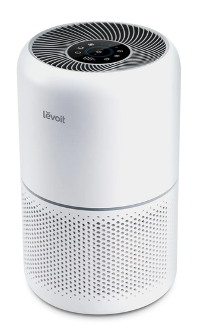
| Specification | Levoit Core 300S |
| Filter type | True HEPA H13 — captures 99.97% of particles ≥0.3 microns |
| CADR | 258 m³/h (dust/smoke/pollen combined) |
| Coverage (4 ACH) | Up to ~18 m² — a typical UK double bedroom |
| Noise level | 22–24 dB (sleep mode) / 48 dB (max) |
| Power consumption | 26 W (max) — energy efficient DC motor |
| Sleep mode | Yes — panel lights off, fan at minimum, 22 dB |
| Auto mode | Yes — laser PM2.5 sensor adjusts fan automatically |
| App / Wi-Fi | Yes — VeSync app, Alexa and Google Assistant compatible |
| Filter choice | Original / Pet / Toxin Absorber / Mould — four variants |
| Filter lifespan | 6–8 months |
| Dimensions | 22 x 22 x 36 cm |
| Weight | 2.7 kg |
| Best for | Small-to-medium bedrooms, allergies, light sleepers |
The Levoit Core 300S is the best starting point for most UK bedrooms. At 22–24 dB in sleep mode it is genuinely imperceptible for all but the most sensitive sleepers — HouseFresh’s independent testing recorded 24 dB on the lowest setting, which they describe as equivalent to a whisper. The upgraded DC motor draws only 26 W compared to the 45 W of the older Core 300, making it meaningfully cheaper to run overnight on a continuous basis.
The laser PM2.5 sensor in auto mode detects particles faster than optical sensors in older budget models and adjusts fan speed accordingly. Critically, sleep mode in the 300S sets a ceiling on how loud the unit can get — so you can leave it in auto mode overnight without worrying that a particle spike will ramp the fan to full volume and wake you up.
Four filter variants let you choose based on your primary concern: the standard Original HEPA for general use, a Pet filter for households with animals, a Toxin Absorber filter with enhanced activated carbon for VOCs and odours, and a Mould filter. All are H13 HEPA grade. Filter replacement every 6–8 months at typical UK prices keeps running costs moderate.
| Pros | Cons |
| 22–24 dB sleep mode — independently verified as whisper-quietLaser PM2.5 sensor with sleep-mode ceiling on fan speed26 W DC motor — low running costsFour filter variants for different bedroom needsApp control and auto schedulingCompact footprint — fits on a bedside table or windowsill | 2.6 L tank — small unit, so coverage limited to ~18 m² at 4 ACHNo ioniser (this is a pro for many buyers — 100% ozone-free)Replacement filters add to ongoing cost |
| Our Verdict: The Levoit Core 300S is our top pick for the majority of UK bedrooms. Quiet enough for even light sleepers, efficient enough to leave running 24/7 without worrying about the electricity bill, and flexible enough in filter choice to suit most household situations. |
2. Levoit Core 400S — Best for Larger Bedrooms
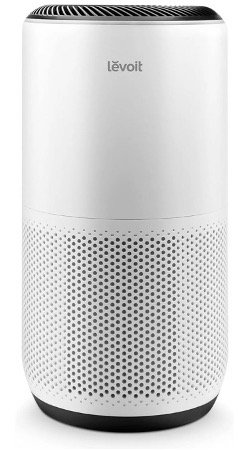
| Specification | Levoit Core 400S |
| Filter type | True HEPA H13 — captures 99.97% of particles ≥0.3 microns |
| CADR | 442 m³/h (dust/smoke/pollen) |
| Coverage (4.8 ACH) | Up to ~37 m² — a large master bedroom or open-plan area |
| Noise level | 24 dB (sleep mode) / 52 dB (max) |
| Power consumption | 38 W (max) |
| Sleep mode | Yes — display off, fan at minimum, 24 dB |
| Auto mode | Yes — laser AirSight Plus sensor |
| App / Wi-Fi | Yes — VeSync app, Alexa and Google Assistant compatible |
| Ioniser | No — 100% ozone-free |
| Filter lifespan | 6–8 months |
| Dimensions | 30 x 30 x 53 cm |
| Best for | Large bedrooms (above 20 m²), master bedrooms, open-plan spaces |
When the Levoit Core 300S is undersized for the room — typically when the bedroom exceeds around 18–20 m², or is a large master bedroom or open-plan space — the Levoit Core 400S steps in. With a CADR of 442 m³/h it covers up to 37 m² at 4.8 ACH, meaning it cycles the air in a large bedroom almost five times per hour.
Sleep mode on the 400S registers at 24 dB — marginally louder than the 300S but still within comfortable sleeping range for most people. The AirSight Plus laser sensor is faster at detecting fine particles than the standard sensor in the 300S, which is meaningful if the bedroom has pets or if one of the occupants has significant allergies.
The trade-off is size and cost — the 400S has a larger footprint (30 x 30 cm base) than the 300S (22 x 22 cm), and a higher purchase price. For most standard UK double bedrooms, the 300S is sufficient and the 400S is overkill. For genuinely large rooms, it earns its place.
| Pros | Cons |
| CADR 442 m³/h — handles large bedrooms at 4.8 ACH24 dB sleep mode — suitable for overnight useAirSight Plus laser sensor — fast detection of fine particlesNo ioniser — 100% ozone-freeVeSync app with scheduling and air quality monitoring | Larger footprint than the Core 300S — takes more bedside spaceHigher purchase price — overkill for standard UK double bedroomsHigher wattage than the 300S (38 W vs 26 W)Louder on higher settings — 52 dB at max is noticeable |
| Our Verdict: The Levoit Core 400S is the correct choice when the bedroom exceeds around 18–20 m². For standard UK double bedrooms, the Levoit Core 300S is the better fit — more compact, quieter at maximum speed, and lower running costs. |
3. Winix 5500-2 — Best for Allergies, Odours, and Pet Owners
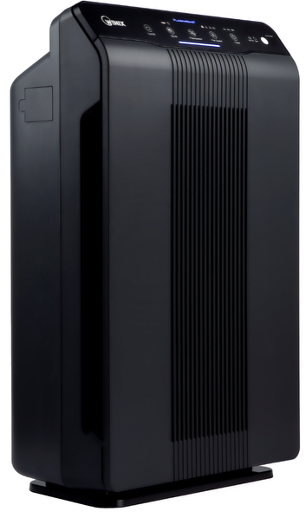
| PlasmaWave Ioniser — Important Note: The Winix 5500-2 includes PlasmaWave technology, which is an air ioniser. We recommend switching this off for continuous bedroom use. Ionisers generate trace ozone, and while Winix’s implementation produces very low levels, the long-term precautionary position for a room where you sleep 7–8 hours per night is to disable it. The unit performs strongly on HEPA filtration with PlasmaWave off — the difference in measured performance is minimal (HouseFresh found just a 1-minute difference in room clean time). Switch off via the dedicated PlasmaWave button on the control panel. |
| Specification | Winix 5500-2 |
| Filter type | True HEPA + Washable AOC Carbon Filter + pre-filter |
| CADR | 232 smoke / 243 dust / 246 pollen (CFM) — ~390 m³/h |
| Coverage (4 ACH) | Up to ~33 m² (360 sq ft at 4 ACH) |
| Noise level | 27.8 dB (min) / 54.8 dB (max) |
| Power consumption | 6 W (min) / 65–70 W (max) |
| Sleep mode | Yes — auto-dims display, lowest fan speed |
| Auto mode | Yes — VOC and air quality sensor |
| PlasmaWave (ioniser) | Yes — switchable off |
| Remote control | Yes — included |
| Carbon filter | Washable — reduces replacement costs |
| Ioniser warning | Switch PlasmaWave off for continuous bedroom use |
| UK availability | Confirmed available; filters confirmed until at least 2032 |
| Best for | Allergies, pet households, odour control, VOCs |
The Winix 5500-2 stands out in the bedroom air purifier market specifically for households dealing with significant allergen loads — pet dander, year-round allergies, or persistent odours. Its CADR figures (232 smoke / 243 dust / 246 pollen CFM) are among the strongest in this price bracket, and the washable AOC carbon filter meaningfully reduces ongoing costs compared to models where the carbon layer must be replaced along with the HEPA.
The VOC smart sensor goes beyond PM2.5 particle detection to respond to chemical vapours and odours — relevant if the bedroom is adjacent to a kitchen, if there is a pet in the room, or if there is any off-gassing from new furniture or bedding. Sleep mode dims the display and drops to minimum fan speed, and the included remote control means you do not need to get out of bed to adjust settings.
A note on availability: the Winix 5500-2 has been discontinued in the US market in favour of the Winix 5510. It remains available in the UK, and Winix has confirmed UK filter support until at least 2032 — a meaningful assurance for a product you may run for several years.
| Pros | Cons |
| Highest CADR in this lineup — strong particle removalWashable carbon filter reduces ongoing running costsVOC sensor as well as particle sensor — responds to odoursRemote control included — adjust without leaving bedPlasmaWave can be switched off for ozone-free operation27.8 dB minimum — suitable for most sleepers | Larger and heavier than the Levoit unitsPlasmaWave must be actively switched off — do not leave on overnightUS-discontinued model — UK stocks finite, though filters confirmed to 2032No app or Wi-Fi connectivityMax noise 54.8 dB — louder than Levoit models at full speed |
| Our Verdict: The Winix 5500-2 is the strongest choice for bedrooms where allergies, pets, or odours are the primary concern. Switch PlasmaWave off, set it to auto mode, and it will maintain excellent air quality through the night. If smart features and app control are important to you, the Levoit Core 400S is the better fit. |
4. Levoit Core 300 — Best Budget Bedroom Air Purifier
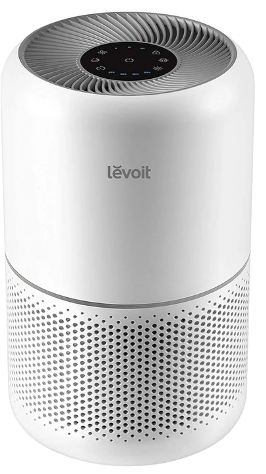
| Specification | Levoit Core 300 |
| Filter type | True HEPA H13 — captures 99.97% of particles ≥0.3 microns |
| CADR | 240 m³/h |
| Coverage (4 ACH) | Up to ~16 m² |
| Noise level | 24–48 dB (low to high) |
| Power consumption | 45 W (max) |
| Sleep mode | Yes — lights off, fan at minimum |
| Auto mode | No — no onboard air quality sensor |
| App / Wi-Fi | No |
| Ioniser | No — 100% ozone-free |
| Filter lifespan | 6–8 months |
| Best for | Budget buyers, smaller bedrooms, simple set-and-leave operation |
The Levoit Core 300 is the predecessor to the 300S and is still available at a lower price. Filtration performance is virtually identical — both use the same H13 True HEPA filter, same CADR range, and the same compact cylindrical form factor. The key differences are the older motor (45 W vs 26 W in the 300S) and the absence of an air quality sensor and auto mode.
Without a sensor, the Core 300 cannot automatically adjust its fan speed in response to changing air quality. You set a speed and it runs at that speed. This is fine for bedrooms where the approach is to set sleep mode at night and a higher speed during the day when the room is unoccupied. It is less convenient for households that want the purifier to respond automatically to particle events — a pet entering the room, someone opening the bedroom door, or morning dusting.
HouseFresh’s independent testing found both the Core 300 and Core 300S reached 24 dB at their lowest settings — so for pure overnight quiet operation, the Core 300 is no louder than its successor. The higher power draw will cost slightly more over a full year of overnight operation, but the difference is unlikely to exceed the price gap between the two models.
| Pros | Cons |
| Lower purchase price than the Core 300SSame True HEPA H13 filtration and near-identical CADR24 dB minimum — as quiet as the 300S at lowest speedSimpler operation — no app, no sensor, no mode confusionSame filter compatibility as the 300S | 45 W motor — higher running costs than the 300S (26 W)No auto mode or air quality sensorNo app or schedulingSlightly louder at max speed (50 dB vs 48 dB for the 300S) |
| Our Verdict: The Levoit Core 300 is a solid budget pick for smaller UK bedrooms where set-and-forget simplicity is the priority. If budget allows, the Levoit Core 300Sis worth the premium — the auto mode and lower running costs justify the difference over a full year of use. |
Bedroom Air Purifier Comparison Table
| Feature | Core 300S | Core 400S | Winix 5500-2 | Core 300 |
| CADR (m³/h) | 258 | 442 | ~390 | 240 |
| Coverage (~4 ACH) | ~18 m² | ~37 m² | ~33 m² | ~16 m² |
| Sleep mode dB | 22–24 dB | 24 dB | 27.8 dB | 24 dB |
| Max dB | 48 dB | 52 dB | 54.8 dB | 50 dB |
| Wattage | 26 W | 38 W | 6–70 W | 45 W |
| Auto mode | Yes | Yes | Yes | No |
| Ioniser | No | No | Yes (switchable) | No |
| Carbon filter | Standard | Standard | Washable | Standard |
| App / Wi-Fi | Yes | Yes | No | No |
| Best for | Most bedrooms | Large rooms | Allergies/pets | Budget pick |
Where to Position an Air Purifier in a Bedroom
Placement has a meaningful effect on how efficiently an air purifier works in a bedroom — and on whether it disturbs your sleep.
- Not directly beside the bed: Positioning the unit within 30 cm of your head amplifies airflow noise and may create a draughty feeling. Place it at least 1–2 metres away, ideally on the opposite side of the room or on a low chest of drawers.
- Away from walls and curtains: Air purifiers need clear airflow on all sides. Tucking them behind curtains or hard against a wall reduces intake airflow and cuts effectiveness significantly.
- Central positioning if possible: A central position in the room improves air circulation and reduces dead zones. For most bedrooms, this means positioning near the foot of the bed or in a corner diagonally opposite to the door.
- Near the floor for dust: Larger particles like pet dander and dust settle near the floor. Positioning the purifier at floor level captures these before they resettle onto bedding and furniture.
- Keep the bedroom door closed: Running a bedroom air purifier with the door open means you are also trying to clean air from the hall, landing, and other rooms. For maximum effectiveness, keep the door closed while the unit runs.
Recommended Settings for Bedroom Use
- During the day (room unoccupied): Run on medium or high speed to bring the room’s air quality down to baseline before you sleep. 2–3 hours of medium-speed operation in the afternoon is effective.
- At bedtime: Switch to sleep mode or set auto mode with the sleep ceiling active. Let the unit maintain air quality at low speed through the night.
- After vacuuming or making the bed: Run on high speed for 30–60 minutes. Disturbing bedding and carpets releases a burst of dust and allergens that benefit from accelerated filtration.
- Pollen season: Keep the bedroom door and windows closed, run the purifier on auto mode, and replace the standard HEPA filter with a pollen-specific variant if available for your model.
Frequently Asked Questions
Should I run my bedroom air purifier all night?
Yes, if the unit is quiet enough — which all four models above are in sleep mode. The bedroom is where you spend the most time in one place, making it the highest-value location for sustained air purification. The Levoit Core 300S at 22–24 dB in sleep mode uses around 26 W, costing approximately 0.6–0.7p per hour at current UK rates — less than £25 per year if left running all night every night.
Does an air purifier help with sleep?
There is emerging research suggesting that cleaner bedroom air is associated with better sleep quality, particularly for people with allergies, asthma, and dust sensitivity. Removing airborne allergens reduces the body’s low-level inflammatory response during sleep. The white-noise effect of a running purifier also helps some people fall asleep more easily. The evidence is not conclusive for the general population, but for allergy sufferers the improvement in nasal breathing alone is often significant.
What CADR do I need for my bedroom?
To calculate: measure your bedroom in m², multiply by ceiling height (typically 2.4 m) to get room volume in m³, then aim for a CADR at least 4x that volume per hour for allergy control. A typical UK double bedroom of 15 m² (volume 36 m³) needs a CADR of at least 144 m³/h for 4 ACH. The Levoit Core 300S at 258 m³/h delivers over 7 ACH in that room, giving substantial headroom.
Can I use an air purifier in a bedroom with a baby or child?
Yes, but choose carefully. The Levoit Core 300S, , and Levoit Core 400S are all 100% ozone-free with no ioniser, making them safe for rooms where children sleep. The Winix 5500-2 is also safe provided the PlasmaWave ioniser is switched off — which we recommend for all overnight bedroom use. Do not use any purifier with an ioniser that cannot be disabled in a nursery or child’s bedroom.
How often should I replace the filter in a bedroom air purifier?
Levoit recommends filter replacement every 6–8 months for the Core 300, 300S, and 400S based on 12 hours of daily use. In a bedroom running 8 hours overnight, you may get closer to 10–12 months before replacement is needed. The unit’s filter indicator light is more reliable than a fixed schedule — replace when it signals rather than by the calendar. For the Winix 5500-2, the washable carbon pre-filter should be rinsed every 3 months; the HEPA requires replacement annually.
Do air purifiers help with dust mites?
Partly. Dust mites themselves live in mattresses, pillows, and carpets — they do not float in the air. An air purifier cannot remove them from bedding. However, dust mite allergens (shed skin and faecal matter) do become airborne when disturbed — when you make the bed, turn over during sleep, or shake pillows. A HEPA air purifier captures these airborne particles before they resettle. Used alongside dust mite-proof mattress and pillow covers, and weekly hot washing of bedding, a bedroom air purifier forms a meaningful part of a dust mite management strategy.
Is a more expensive air purifier always better for a bedroom?
Not necessarily. The most important bedroom variable is noise level, not CADR. An expensive large-room purifier running on low speed in a small bedroom to keep noise down may be no more effective than the Levoit Core 300S properly sized for the room. Choose based on room size first, then noise level, then features.
Summary: Which Bedroom Air Purifier Should You Buy?
| Quick Decision Guide: Most UK bedrooms (up to ~18 m²): Levoit Core 300S — 22–24 dB sleep mode, 26 W, auto mode with PM2.5 sensor. Large master bedroom or open-plan (above 20 m²): Levoit Core 400S — CADR 442 m³/h, 24 dB sleep mode, 38 W. Allergy sufferers, pet owners, or odour concerns: Winix 5500-2 — CADR ~390 m³/h, washable carbon filter, VOC sensor. Switch PlasmaWave off. Budget pick: Levoit Core 300 — same HEPA filtration, 24 dB minimum, no auto mode or sensor. |
Related Reading
Best Air Purifier for Mould UK
Best Air Purifier Under £100 UK
Coway AP-1512HH vs Levoit Air Purifier UK
Can You Run a Dehumidifier and Air Purifier at the Same Time UK
Best Dehumidifier for Mould UK
| About This Article This article was researched using manufacturer specifications, independent test data from HouseFresh and AirPurifierFirst, and UK health guidance. Noise figures for the Levoit Core 300 and 300S are independently verified by HouseFresh testing. Product specifications checked against manufacturer sources as of June 2026. External authority sources include Asthma + Lung UK on indoor air quality and the NHS advice on damp and mould. This site is independently run and is not sponsored by any manufacturer. Affiliate commissions help support the running costs of ukairquality.co.uk. |

7 Comments