
Best Air Purifier for Dust UK 2026: Top Picks for Dust Allergies
| Disclosure: This page contains affiliate links. If you buy through these links, we may earn a small commission at no extra cost to you. See our Affiliate Disclaimer for more information. |
The best air purifier for dust UK homes need is one with a certified True HEPA filter, a CADR high enough for your room size, and — crucially — no ioniser that could irritate already-sensitive airways. Dust is the most common indoor air quality complaint in the UK, and for people with dust mite allergies or asthma triggered by dust, the right air purifier genuinely makes a measurable difference to daily symptoms.
In this guide we cover the top picks for every room size, explain what specs actually matter, and address one important point most dust articles miss: an air purifier alone is only half the solution.
| ✅ Key TakeawaysThe best air purifier for dust needs a True HEPA filter — certified to capture 99.97% of particles at 0.3 microns, including dust, dust mite allergens, and skin flakes.Dust mite allergens thrive above 50% relative humidity. An air purifier tackles airborne particles; a dehumidifier tackles the humidity that lets dust mites multiply. For serious dust allergies, you need both.CADR is the key spec: for a 15m² bedroom, look for a minimum CADR of 100 m³/h. The Levoit Core 300S delivers 141 m³/h and is our top pick for most UK bedrooms. The Coway AP-1512HH (CADR 246 m³/h) is our top pick for living rooms and larger spaces — it includes an air quality indicator that visibly responds to dust levels within minutes. Avoid air purifiers with ionisers if you have asthma or dust allergies — ionisers can produce trace ozone, which is a respiratory irritant. Disable the ioniser if your unit has one. |
Quick Comparison: Best Air Purifiers for Dust UK
| Model | CADR | Room Size | Noise | Wattage | Best For |
| Levoit Core 300S | 141 m³/h | Up to 18m² | 24 dB | 45W | Bedrooms |
| Levoit Core 400S | 230 m³/h | Up to 38m² | 26 dB | 38W | Living rooms |
| Coway AP-1512HH | 246 m³/h | Up to 41m² | 30 dB | 77W | Large rooms |
| Levoit Core 600S | 697 m³/h | Up to 59m² | 28 dB | 47W | Open plan |
| Blueair Blue Pure 211+ | 540 m³/h | Up to 50m² | 31 dB | 30W | Large spaces |
Why Dust Allergies Are Harder to Solve Than People Think
Most people think of dust as visible particles — the layer that settles on shelves. But the reason dust triggers allergies is almost entirely invisible. House dust mite allergens are protein fragments from the faeces and shed skin of dust mites: particles typically 0.5–30 microns in diameter that become airborne when disturbed and remain suspended in the air for hours.
A True HEPA filter captures these particles effectively. But here’s the catch: dust mite allergens don’t stay airborne indefinitely. The majority settle on mattresses, carpets, soft furnishings, and curtains. An air purifier cleans the air — it doesn’t clean surfaces. For dust mite allergies in particular, the most effective approach combines an air purifier for airborne particles with mattress and pillow protectors, regular HEPA-vacuum cleaning, and — critically — humidity control.
According to Asthma + Lung UK, house dust mites thrive at humidity levels above 50% relative humidity and cannot survive below 40–45% RH. Keeping bedroom humidity between 40–50% RH with a dehumidifier eliminates the conditions dust mites need to reproduce, which has a longer-term impact than filtration alone. If you’re serious about dust mite allergy management, our do I need a dehumidifier guide covers this in detail.
| ⚠️ Ioniser Warning: Several popular air purifiers include a built-in ioniser. We strongly recommend disabling the ioniser if you have asthma or dust allergies. Ionisers can produce trace ozone — a respiratory irritant that worsens the very symptoms you’re trying to relieve. The HEPA filter works perfectly well with the ioniser switched off. This applies specifically to the Coway AP-1512HH and Winix 5500-2. |
Levoit Core 300S — Best Air Purifier for Dust in a Bedroom
| 🏆 Top Pick for Bedrooms Up to 18m²The Levoit Core 300S is our top recommendation for most UK bedrooms. With a CADR of 141 m³/h, it cycles the air in an 18m² bedroom around four times per hour — the threshold at which clinical studies show meaningful airborne allergen reduction. At 24dB on its lowest setting, it’s effectively silent for sleeping. |
Key Specifications
- CADR: 141 m³/h
- Room coverage: Up to 18m²
- Noise level: 24 dB (sleep mode)
- Wattage: 45W maximum
- Filter type: True HEPA + activated carbon
- Ioniser: No
The Core 300S uses a 360-degree air intake design, drawing air from all sides rather than just the front. This makes placement more flexible — it works effectively away from walls, in the middle of a room, or on a bedside table. The VeSync app integration allows scheduling, fan speed control, and air quality monitoring from your phone.
For dust specifically, the Core 300S’s combination of True HEPA and activated carbon filtration addresses both particles and any associated odours from older carpets or furnishings. Filter replacement is straightforward and costs around £15–£20 for a genuine Levoit replacement filter, with a recommended replacement interval of 6–8 months under normal use.
If you don’t need the app connectivity, the standard Levoit Core 300 delivers identical filtration performance at a lower price point — the only difference is the absence of Wi-Fi and smart features.
Verdict
The Levoit Core 300S is the best air purifier for dust in most UK bedrooms. It’s quiet enough to run all night, correctly sized for rooms up to 18m², and uses a genuine True HEPA filter. No ioniser means no trade-offs for asthma or allergy sufferers.
Coway AP-1512HH — Best for Living Rooms and Larger Spaces
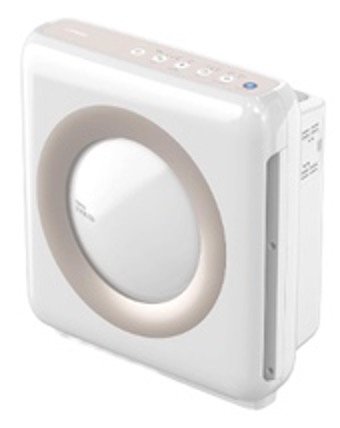
| 🏆 Top Pick for Rooms Up to 41m²The Coway AP-1512HH is a consistently well-reviewed HEPA purifier that punches above its price point. With a CADR of 246 m³/h it handles spaces up to 41m², and its real-time air quality indicator — a coloured ring that shifts from blue to green to red — visibly responds to dust disturbance within minutes of being triggered. |
Key Specifications
- CADR: 246 m³/h
- Room coverage: Up to 41m²
- Noise level: 30 dB (low setting)
- Wattage: 77W maximum
- Filter type: True HEPA + activated carbon + pre-filter
- Ioniser: Yes — disable on first use
The Coway’s air quality sensor is one of the most responsive at this price — it detects PM2.5 particles (fine dust, dander, smoke) and adjusts fan speed automatically in auto mode. This means on days when dust is disturbed — during cleaning, for example — the unit ramps up automatically without any manual intervention.
The washable pre-filter is a practical feature that extends the life of the HEPA filter by catching larger dust particles before they reach the main filter. Washing it monthly and replacing the HEPA filter annually keeps running costs reasonable.
| ⚠️ Ioniser: The Coway AP-1512HH includes a built-in ioniser. Disable it on first setup — press and hold the ioniser button. The unit operates perfectly without it and is safer for asthma and allergy sufferers. |
Verdict
The Coway AP-1512HH is our top pick for living rooms and open-plan spaces. Its air quality sensor makes it particularly well-suited to dust management — it responds automatically to dust events rather than running at a fixed speed. Disable the ioniser on setup.
Levoit Core 400S — Best Mid-Size Option
Key Specifications
- CADR: 230 m³/h
- Room coverage: Up to 38m²
- Noise level: 26 dB (sleep mode)
- Wattage: 38W maximum
- Filter type: True HEPA + activated carbon
- Ioniser: No
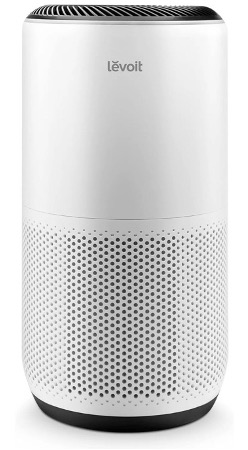
The Levoit Core 400S sits between the 300S and the Coway in both size and price. At 230 m³/h CADR it covers rooms up to 38m², and at 38W it’s one of the most energy-efficient purifiers at this capacity. Like the 300S, it has no ioniser — making it a clean choice for asthma or allergy households without any need to disable features on setup.
The activated carbon layer on the 400S is more substantial than on the 300S, making it a better choice if dust is combined with cooking odours or VOC concerns. The VeSync app integration is identical to the 300S.
Verdict
The Levoit Core 400S is the cleanest upgrade path from the 300S for larger rooms. No ioniser, excellent energy efficiency, and a more capable carbon layer than its smaller sibling.
Levoit Core 600S — Best for Large and Open-Plan Spaces
Key Specifications
- CADR: 697 m³/h
- Room coverage: Up to 59m²
- Noise level: 28 dB (sleep mode)
- Wattage: 47W maximum
- Filter type: True HEPA + activated carbon
- Ioniser: No
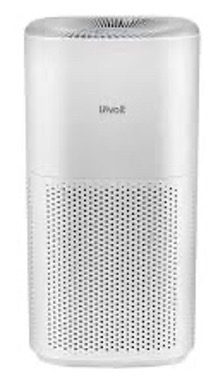
For genuinely large spaces — open-plan kitchen-diners, large sitting rooms, or whole-floor coverage in a flat — the Levoit Core 600S is in a different class. Its CADR of 697 m³/h is the highest in this roundup, and at just 47W it achieves that performance with exceptional energy efficiency.
The 600S is overkill for a standard bedroom but comes into its own in any space above 40m². At 28dB on sleep mode it’s quieter than you’d expect from a unit this powerful.
Verdict
The Levoit Core 600S is the right choice if you need serious coverage in a large open-plan space. No ioniser, class-leading energy efficiency, and genuinely impressive CADR for the price.
How to Choose the Right Air Purifier for Dust
Step 1: Measure your room
Floor area in m² is your starting point. Multiply length by width. Then apply the two-thirds CADR rule: your purifier should deliver a CADR of at least two-thirds of your room’s floor area in m³/h. For a 20m² room, that’s a minimum CADR of around 133 m³/h. The Core 300S at 141 m³/h just qualifies; the Core 400S at 230 m³/h gives you meaningful headroom.
Step 2: Confirm True HEPA
Check the specification sheet for ‘True HEPA’ or ‘H13 HEPA’. Avoid ‘HEPA-type’, ‘HEPA-style’, or ‘HEPA-like’ — these are unregulated marketing terms for filters that don’t meet the 99.97% at 0.3 micron standard. The difference in real-world performance is significant.
Step 3: Check for an ioniser — then disable it
If the model you’re considering has an ioniser, that’s not necessarily a dealbreaker — but disable it before first use. The Coway AP-1512HH is an excellent dust purifier with the ioniser off. The HEPA filter does all the work; the ioniser adds ozone risk with no meaningful benefit for dust management.
Step 4: Consider noise for bedroom use
If the purifier will run overnight in a bedroom, noise matters. As a guide:
- 24–26 dB — near-silent, suitable for light sleepers
- 27–32 dB — quiet background noise, acceptable for most people
- 33–40 dB — noticeable, better suited to daytime use or living areas
Step 5: Factor in filter running costs
A purifier that costs £60 to buy but £40 per year in filters is more expensive long-term than one costing £90 with £15 annual filters. Levoit filters for the Core range cost £15–£25 and last 6–12 months. The Coway AP-1512HH filter costs around £25–£35 annually. Both are reasonable. Avoid off-brand filters — they rarely meet the True HEPA standard even when labelled as such.
Frequently Asked Questions
Will an air purifier help with dust mite allergy?
Partially. A True HEPA purifier captures airborne dust mite allergens effectively — the microscopic particles that become suspended when bedding is disturbed, during cleaning, or with movement. However, most dust mite allergens settle on surfaces rather than remaining airborne. For full dust mite management, combine a HEPA air purifier with allergen-proof mattress and pillow covers, regular HEPA-vacuum cleaning, and keeping bedroom humidity below 50% RH. Tackling humidity is often the most overlooked step — dust mites cannot survive in dry air.
How often should I run my air purifier for dust?
Continuously, on your preferred fan speed. Modern HEPA purifiers are inexpensive to run — the Levoit Core 300S uses around 20W on medium speed, costing approximately 12p per day. Running it intermittently allows airborne particles to accumulate between sessions. The most effective approach is to set it and leave it, letting the unit cycle on and off automatically if it has an auto mode with an air quality sensor.
Where should I put my air purifier for dust?
In the room where you spend the most time, positioned with clear airflow on all sides — ideally away from walls and furniture. For dust mite allergy sufferers, the bedroom is the priority: it’s where you spend 7–8 hours per night, and where dust mite exposure is highest due to bedding. Place the purifier near the head of the bed if possible, at least 30cm from any surface. Running it while you sleep on its lowest setting delivers consistent allergen reduction during your longest exposure period.
Do air purifiers help with dust in old UK houses?
Yes — older UK homes typically have higher dust loads due to older carpets, soft furnishings, and less airtight construction that allows outdoor particulates in. A correctly sized HEPA purifier makes a visible difference in these environments. The Coway AP-1512HH’s air quality indicator is particularly useful in older houses — the sensor makes the dust problem visible and confirms when the purifier is actively working.
Can I use an air purifier instead of a dehumidifier for dust mites?
No — they address different parts of the problem. An air purifier captures airborne dust mite allergens. A dehumidifier reduces the humidity that allows dust mites to live and reproduce. At below 45% relative humidity, dust mites die off within weeks. An air purifier alone, without humidity control, cleans the air but leaves the underlying infestation in place. For serious dust mite allergies, both are needed. For a dust problem without allergy symptoms, an air purifier alone is usually sufficient.
Is the Levoit Core 300S good for dust?
Yes — it’s our top-rated air purifier for dust in bedrooms up to 18m². Its CADR of 141 m³/h delivers approximately four air changes per hour in a standard UK bedroom, it uses a certified True HEPA filter, has no ioniser, and runs at 24dB on its sleep setting. For a room larger than 18m², step up to the Levoit Core 400S(38m² coverage) or the Coway AP-1512HH (41m² coverage).
