Does a Dehumidifier Help with Dust Mites UK? Yes — Here’s How
Last updated: 19 May 2026
This page contains affiliate links. If you buy through these links, we may earn a small commission at no extra cost to you. See our Affiliate Disclaimer for more information.
If you wake up every morning with a blocked nose, itchy eyes, or a tight chest — and you haven’t got a cold — dust mites are a likely culprit. They’re invisible, they’re everywhere, and they absolutely love the inside of a British home.
The good news: humidity is one of the key things that keeps them alive. And a dehumidifier directly attacks that.
The honest answer: yes, a dehumidifier does help with dust mites — but it won’t fix the problem on its own. Here’s exactly what it does, what it doesn’t, and what else you’ll need alongside it.
What Are Dust Mites and Why Do UK Homes Have So Many?
Dust mites are microscopic arachnids — more closely related to spiders than insects. You can’t see them, but they live in your mattress, pillows, carpets, sofas, curtains, and anywhere else that’s warm and holds moisture.
They don’t drink water. Instead, they absorb it directly from the air. That means they depend on humidity to survive. Below around 50% relative humidity (RH), they struggle to thrive. Below 40–45%, their population starts to decline significantly.
UK homes are particularly prone to high humidity — especially in winter when windows stay shut, and in flats where ventilation is poor. Modern double-glazing and insulation trap moisture inside, which is great for warmth but terrible for dust mite levels.
Dust mites don’t directly cause allergy symptoms — their droppings do. Each mite produces around 20 waste particles per day, and those particles are small enough to become airborne and be inhaled. It’s those proteins that trigger sneezing, rhinitis, and asthma flare-ups.
So Does a Dehumidifier Actually Kill Dust Mites?
Yes — but slowly, and not completely.
By keeping indoor humidity consistently below 50% RH, you remove one of the two things dust mites need to survive (the other being dead skin cells, which you can’t eliminate). At that level, mites dehydrate and their population starts to fall. Studies published in peer-reviewed journals have shown that dehumidification measurably reduces both mite counts and allergen levels in UK homes.
Allergy UK recommends using a dehumidifier to keep indoor humidity under 50% — but importantly, they note it should stay above 30%, because air that’s too dry creates its own problems (dry eyes, irritated airways, cracked skin).
The target zone for dust mite control is 40–50% RH.
Humidity Level Quick Reference
| Humidity Level | What It Means for Dust Mites | What It Means for You |
| 60%+ | Ideal — they thrive and breed freely | Muggy, mouldy conditions |
| 50–60% | Still comfortable — population holds steady | Manageable but not ideal |
| 40–50% | Struggle to survive — population declines | Comfortable for humans — target zone |
| Below 40% | Hostile — most cannot reproduce | Getting too dry — watch for side effects |
| Below 30% | Extremely hostile | Too dry — irritates airways and skin |
The Important Caveat: Dead Mites Still Cause Symptoms
This is the part many people miss. Even when a dehumidifier reduces humidity and mites start to die, their dried-out bodies and allergen-laden droppings remain in your mattress, carpets, and soft furnishings. Those particles are still allergenic — and can become airborne when you move around, make the bed, or vacuum without a HEPA filter.
This means a dehumidifier alone won’t make your allergy symptoms disappear overnight. You need to combine it with other measures to actually remove those allergen particles from your home environment.
What to Use Alongside a Dehumidifier for Dust Mites
Think of it as a three-layer approach:
Layer 1 — Kill the colony (dehumidifier)
- Run a dehumidifier in the bedroom to get humidity below 50% RH
- Use a hygrometer to monitor — you want to be between 40–50%
- Desiccant models work better in cooler rooms; compressor models suit heated rooms above 15°C
Layer 2 — Remove the allergen particles (air purifier + cleaning)
- A HEPA air purifier captures the airborne particles — mite droppings, dried bodies, and skin flakes they feed on
- Vacuum weekly with a HEPA-filter vacuum cleaner
- Damp-dust surfaces rather than dry-dusting (dry dusting just redistributes the particles)
- Wash bedding every week at 60°C — this kills mites and removes allergen deposits
Layer 3 — Create a mite-resistant environment
- Allergen-proof barrier covers on mattress, pillows, and duvet — these are recommended by Allergy UK and NHS allergy clinics
- Freeze soft toys (in a bag, for 12 hours) to kill any mites, then wash at 60°C
- Reduce soft furnishings in the bedroom where possible — hard floors are significantly better than carpets
- Keep bedroom well-ventilated — opening windows when weather allows helps exchange humid interior air
Which Dehumidifier Is Best for Dust Mite Control?
For bedrooms — where dust mite exposure is highest and where you spend 7–8 hours each night — you need something quiet enough to run while you sleep. Here’s what works:
Meaco MeacoDry Abc 12L — Best all-rounder
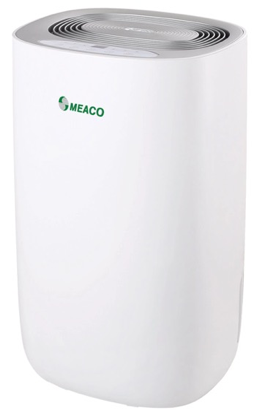
The Abc 12L has a built-in humidistat — you set it to 45% and it turns off automatically when the target is reached. That’s exactly what you want for dust mite control: precision without constant monitoring. It’s also Quiet Mark certified and runs quietly enough for bedroom use. It’s a compressor model, so it’s most effective in rooms above 15°C.
Pro Breeze 12L — Budget option with humidistat
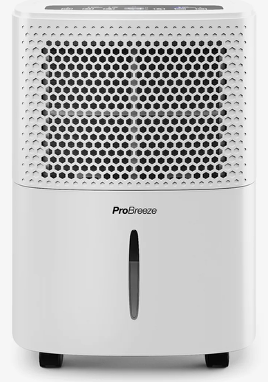
Solid budget pick if you don’t want to spend £200+ on the Meaco. It also includes a humidistat and runs quietly enough for most bedrooms. Good value for a single room. Less energy-efficient than the Meaco in the long run, but effective for the purpose.
Meaco DD8L Junior — For cooler rooms or damp properties
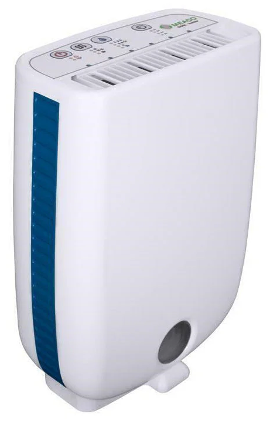
If your bedroom regularly drops below 15°C — common in older UK homes, particularly in winter — a desiccant model like the DD8L Junior is more effective. Desiccant dehumidifiers work independently of temperature, which matters in draughty or poorly insulated rooms. The DD8L Junior also adds a small amount of heat to the room as a side effect, which can be a benefit in winter.
Do You Need an Air Purifier Too?
If your main goal is dust mite allergy relief rather than just mould prevention, then yes — an air purifier with a true HEPA filter adds meaningful value on top of the dehumidifier.
Here’s the reason: a dehumidifier stops the colony from growing, but it doesn’t capture the allergen particles already circulating in the air. A HEPA air purifier does. It catches particles down to 0.3 microns — smaller than a dust mite dropping — and continuously filters them out.
The Levoit Core 300 is a good starting point for a single bedroom, and the Levoit Core 400S covers a larger room with smart controls. Used together with a dehumidifier, you’re addressing both the source (humidity) and the symptom (airborne allergens).
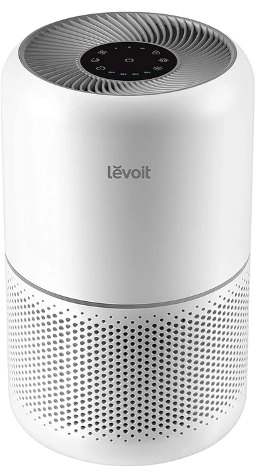
👉 Levoit Core 300 — Check price on Amazon UK
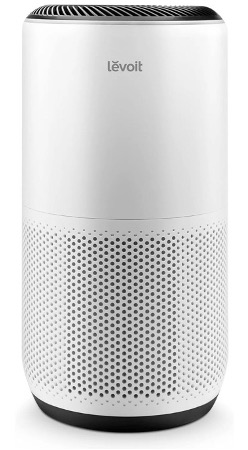
👉 Levoit Core 400S — Check price on Amazon UK
How Long Does It Take to Notice a Difference?
It varies. With consistent dehumidification to below 50% RH, mite populations start to decline within a few weeks. However, you may not feel a significant improvement in allergy symptoms for 4–8 weeks — partly because allergen particles persist even after mites die, and partly because it takes time to clear the reservoir of allergen material in bedding and carpets.
Combining the dehumidifier with weekly 60°C washes, barrier bedding covers, and HEPA vacuuming from day one speeds this up considerably. Don’t just run a dehumidifier and wait — use all three layers together.
What Won’t Work (Common Misconceptions)
| What People Try | Does It Work? |
| Air fresheners and sprays | No — masks odour, does nothing to mites or allergens |
| Standard vacuum (no HEPA) | Limited — can spread fine particles back into the air |
| Steam carpet cleaning (domestic) | No — adds moisture, can worsen mite levels |
| Cold washing bedding | No — 60°C is required to kill mites |
| Dehumidifier alone (no other measures) | Partially — reduces the colony but leaves allergen residue |
| Anti-mite sprays (acaricides) | Can help in combination with other measures — not a standalone fix |
The Bottom Line
A dehumidifier is one of the most effective tools available for reducing dust mite populations in a UK home. By keeping humidity between 40–50% RH, you remove the primary environmental condition that allows mites to survive and reproduce.
But it works best as part of a wider strategy — not as a standalone solution. Pair it with barrier bedding covers, regular 60°C washing, HEPA vacuuming, and if your symptoms are significant, a HEPA air purifier to capture airborne allergens.
The bedroom is where you spend the most time and where mite levels are highest. That’s where to start.
Further reading:
Allergy UK — House Dust Mite Allergy Factsheet — advice from the UK’s leading allergy charity, including full guidance on environmental control measures.
Related articles on ukairquality.co.uk
→ Best Dehumidifier for Mould UK — our top picks for tackling damp and mould across the home
→ Desiccant vs Compressor Dehumidifier UK — which type is right for your home and climate?
→ Dehumidifier vs Air Purifier UK — when you need both and when one is enough

3 Comments