Best Air Purifier for Baby Room UK 2026: Safe, Quiet Nursery Picks
Last updated: 19 May 2026
This page contains affiliate links. If you buy through these links, we may earn a small commission at no extra cost to you. See our Affiliate Disclaimer for more information.
Choosing the best air purifier for a baby room UK parents are setting up is one of the most considered purchases new families make — and rightly so. Babies breathe at nearly twice the rate of adults, their lungs are still developing, and they spend the majority of their early months sleeping in a single room. What’s in the air in that room matters more than almost anywhere else in the home.
This guide focuses specifically on what makes an air purifier suitable for a nursery or baby room — not just effective filtration, but the safety features, noise characteristics, and design considerations that matter when a newborn is sleeping a metre away. We recommend the best options available on Amazon UK from the brands already featured on this site.
Why Air Quality Matters More in a Baby’s Room
Most parents focus on visible cleanliness — vacuuming, washing surfaces, choosing non-toxic paints. But the air in a nursery contains invisible threats that are harder to address without a purifier:
- Fine particles (PM2.5): From outdoor pollution seeping in through windows, dust, pet dander, and pollen. These particles are small enough to penetrate deep into developing lung tissue.
- VOCs from new furniture and decorating: New cots, mattresses, carpets, wardrobes, and freshly painted walls all off-gas volatile organic compounds for weeks to months after installation. These include formaldehyde, benzene, and toluene — compounds with known respiratory effects. A newly decorated nursery can have higher VOC levels than an established room for 3–6 months.
- Dust mite allergen: Warm, slightly humid conditions typical of UK nurseries (babies need warmer rooms) are ideal for dust mite populations. Airborne allergen from dust mite waste is one of the most common triggers of childhood respiratory symptoms.
- Mould spores: UK homes, particularly older properties, can have elevated indoor mould spore counts. Babies have immature immune systems and are more susceptible to respiratory irritation from spore exposure.
- Airborne germs: Bacteria and viruses remain airborne in indoor spaces. While an air purifier is not a substitute for good hygiene, HEPA filtration meaningfully reduces the airborne pathogen load in a room.
What to Look For: Baby Room Specific Requirements
1. Ozone-Free — Non-Negotiable
This is the single most important safety criterion for a nursery. Ozone is a known lung irritant that is particularly harmful to developing respiratory systems. Any air purifier that uses an ioniser, ozone generator, or UV-C lamp that produces ozone must be avoided in a baby’s room.
Ionisers deserve special attention. Some machines allow the ioniser to be disabled — on these, you can simply switch it off and use the machine as a standard HEPA purifier. Others (notably the Blueair Blue Pure 211+ and some cheaper models) have built-in ionisers that cannot be disabled. These should not be used in a nursery.
All Levoit Core series models on this site have no ioniser. The Winix 5500-2 has an optional PlasmaWave ioniser that can be switched off. The Coway AP-1512HH has an optional ioniser that can be disabled. The Blueair Blue Pure 211+ has a built-in ioniser that cannot be disabled — it is not recommended for nursery use.
2. Noise Level — Under 35 dB for Sleep
Babies are sensitive to sudden noise changes, but consistent low-level white noise is not only tolerable — it can actually help them sleep. The key is consistency and low volume. A purifier running at 24–30 dB on sleep mode is ideal for a nursery. Avoid machines that cycle on and off noisily in auto mode, which can cause startle responses.
3. Display Lights — Fully Dimmable
Bright LED displays disrupt sleep — yours and the baby’s. Look for machines where the display can be completely switched off in sleep mode, leaving the room fully dark.
4. Correct Room Size Match
UK nurseries are typically 8–15 m². You do not need a large-room purifier — and a machine that is oversized for the room may run noisier than necessary at the fan speed required to cycle the air adequately. Aim for 4–5 air changes per hour in a nursery, which for a 12 m² room requires a CADR of around 120–150 m³/h — well within the Levoit Core 300 range.
5. Child Lock
As babies become mobile toddlers, the purifier becomes an attractive object to investigate. A child lock that disables the controls prevents accidental settings changes or the unit being switched off.
6. Continuous, Reliable Operation
Run the purifier continuously on auto or a low-medium setting rather than switching it on only for nap times. The goal is to maintain consistently clean air, not to react to pollution spikes. This means looking for a machine with low energy draw and a reliable motor designed for long-term continuous use.
Best Air Purifiers for Baby Rooms UK: Our Picks
1. Levoit Core 300S — Our Top Pick for Nurseries
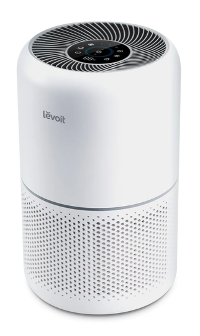
Noise: ~24 dB (sleep mode) | CADR: ~141 m³/h | Room: up to 20 m² | Ioniser: None | Child lock: Yes
The Levoit Core 300S is our top recommendation for UK nurseries. It ticks every baby-room requirement: no ioniser (completely ozone-free), near-silent at 24 dB on sleep mode, a display that dims fully in sleep mode, child lock, and a CADR of 141 m³/h that delivers 4–5 air changes per hour in a typical UK nursery. The H13 True HEPA filter removes 99.97% of airborne particles including dust, pollen, pet dander, mould spores, and PM2.5 — and the activated carbon layer handles VOC off-gassing from new nursery furniture.
The VeSync app lets you set schedules — useful for running at slightly higher speed during nap-time setup and dropping to sleep mode once the baby is down. Auto mode with the built-in air quality sensor means it responds to changes (nappy changes, when someone enters the room) without you needing to adjust settings manually. Reviewers consistently describe it as inaudible on sleep mode — several noting they had to check it was actually running.
It is compact enough to sit safely on a chest of drawers out of reach, uses minimal energy (~22W), and the filter replacement reminder means you’ll never accidentally run it past the point of effectiveness.
Best for: Most UK nurseries up to 20 m². The consensus top pick for baby rooms across independent review sites.
2. Levoit Core 300 — Best Budget Nursery Pick
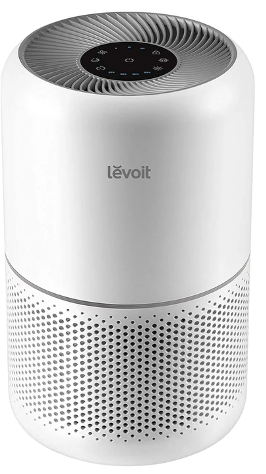
Noise: ~24–25 dB (low) | CADR: ~141 m³/h | Room: up to 20 m² | Ioniser: None | Child lock: No
The standard Levoit Core 300 delivers the same ozone-free H13 HEPA filtration and near-silent low speed as the 300S — without the smart features or child lock. If you want a straightforward, affordable nursery purifier that you set manually, this is excellent value. The absence of a child lock means you will want to position it out of reach once the baby becomes mobile, but for the newborn months it is a practical and proven choice.
It is also worth considering if you want purifiers in multiple rooms — a nursery and a living room, for example — at a total cost below a single premium model.
Best for: Budget-conscious parents, nurseries up to 20 m², households where smart features are not a priority.
3. Coway AP-1512HH — Best for Larger Nurseries or Shared Rooms
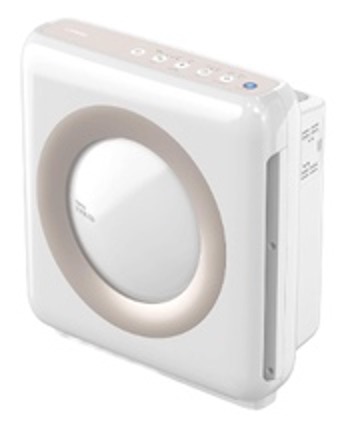
Noise: 24 dB (low) / 21 dB (eco mode) | CADR: ~418 m³/h | Room: up to 33 m² | Ioniser: Optional (can be disabled)
If your nursery is on the larger side, or if the baby is sharing a room with a parent, the Coway AP-1512HH offers a significantly higher CADR in a quiet, compact machine. Its eco mode at just 21 dB is the quietest setting of any machine on this list — the fan cuts completely when no pollution is detected, making it virtually silent during clean periods at night. The ioniser must be switched off for nursery use, which is straightforward — there is a dedicated ioniser button that disables it completely.
The colour-coded air quality indicator (blue, purple, red) gives a gentle visual reference without being intrusive, and the energy efficiency of this machine means running costs are low for continuous use. Its AHAM-verified performance figures are among the most trusted in the category.
Best for: Larger nurseries or parent-baby shared bedrooms up to 33 m², those who want maximum verified filtration performance.
4. Winix 5500-2 — Best if You Have Pets as Well as a Baby
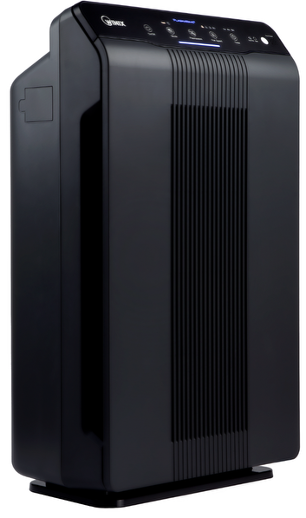
Noise: ~27–40 dB (low) | CADR: ~394 m³/h | Room: up to 33 m² | Ioniser: Optional (can be disabled)
Households with pets face a combined challenge: pet dander is one of the most potent allergens for infants, and pet hair fills pre-filters quickly. The Winix 5500-2 combines a strong CADR with a washable pre-filter (easy to clean frequently without buying replacements) and pellet-based carbon that handles pet odours effectively. PlasmaWave must be switched off for nursery use — there is a dedicated button to do this.
The light sensor auto-sleep feature is particularly practical for a nursery: the machine automatically drops to quiet mode when the room darkens at bedtime, with no manual intervention required. This removes a common friction point — the risk of forgetting to switch modes and having the fan ramp up at 2am.
Best for: Pet-owning households with a baby, nurseries up to 33 m², parents who want automatic quiet-mode at bedtime.
What Not to Use in a Baby Room
The Blueair Blue Pure 211+ is not recommended for nurseries. While it is an excellent air purifier for living rooms and large spaces, its HEPASilent technology uses a built-in ioniser that cannot be disabled. For general adult use the low ozone output is within safe certified limits, but for a baby’s developing respiratory system, an ioniser-free machine is strongly preferable. Use the Blueair in your living room and one of the Levoit options in the nursery.
Quick Comparison: Best Air Purifiers for Baby Rooms UK
| Model | Noise (low) | CADR | Ioniser | Child Lock | Best For |
| Levoit Core 300S | 24 dB | ~141 m³/h | None | Yes | Most nurseries — top pick |
| Levoit Core 300 | ~24–25 dB | ~141 m³/h | None | No | Budget nurseries |
| Coway AP-1512HH | 24 dB / 21 dB (eco) | ~418 m³/h | Optional (disable) | No | Larger rooms, shared bedrooms |
| Winix 5500-2 | ~27–40 dB | ~394 m³/h | Optional (disable) | No | Pet households with baby |
Where to Position an Air Purifier in a Nursery
- Keep it at least 1 metre away from the cot. You do not want airflow directed at the baby’s face, and the machine should never be within reach of a mobile infant or toddler.
- Position it near the main pollution source if identifiable — near the door (where air comes in from the rest of the house), near a window if you open it for ventilation, or in a corner with good clearance on all sides.
- Do not place it on the floor directly under the cot. Elevated placement — on a chest of drawers or shelf — keeps it out of reach and allows better air circulation.
- Give it 30–40 cm of clearance on all sides. Restricting airflow makes the fan work harder and louder.
Frequently Asked Questions
Are air purifiers safe for babies?
Yes, provided you choose an ozone-free model. Air purifiers with True HEPA filtration and no ioniser are safe to run continuously in a baby’s room. The key exclusion is any machine that produces ozone — ionisers, ozone generators, and some UV-C models. All four machines recommended in this guide can be used ozone-free.
Can I run an air purifier all night in my baby’s room?
Yes — and continuous overnight operation is recommended. Babies breathe deeply and consistently during sleep. Running an air purifier on sleep or low mode throughout the night maintains a low particle and allergen load in their breathing zone. On sleep mode, the Levoit Core 300S at 24 dB will not disturb sleep.
Will an air purifier help with VOCs from new nursery furniture?
Yes, partially. The activated carbon layer in all recommended models adsorbs VOC molecules from off-gassing furniture, paints, and carpets. This is not a substitute for adequate ventilation — air the nursery out thoroughly before the baby uses it, and ventilate regularly during the first few months. But running a purifier with carbon filtration continuously in a newly furnished nursery meaningfully reduces peak VOC exposure.
What humidity level should I maintain in a nursery?
The NHS recommends keeping a baby’s room at around 16–20°C. Aim for a relative humidity of 40–60% — low enough to discourage dust mite proliferation, but not so dry that it irritates airways. If your nursery is prone to condensation or feels damp, a dehumidifier alongside the air purifier may help. See: How to Reduce Humidity in a Flat UK.
Does an air purifier make noise that could wake a baby?
On sleep mode, the Levoit Core 300S and Core 300 run at approximately 24 dB — essentially inaudible and comparable to a very quiet whisper. Many parents report that the gentle consistent white noise actually helps their baby sleep. Sudden changes in fan speed (from auto mode adjusting) are more likely to cause waking than steady low-level operation.
Related Guides
Concerned about hay fever and pollen in the baby’s room this summer? Read: Best Air Purifier for Hay Fever UK.
Dealing with damp or condensation in the nursery? Start here: Best Dehumidifier for Mould UK.
Not sure whether you need an air purifier or dehumidifier? Read: Dehumidifier vs Air Purifier UK.
For NHS guidance on baby room temperature and sleep environment, see NHS: How to keep your baby safe while they sleep.

2 Comments