Best Air Purifier for Cooking Smells UK 2026: Banish Kitchen Odours
Last updated: 19 May 2026
This page contains affiliate links. If you buy through these links, we may earn a small commission at no extra cost to you. See our Affiliate Disclaimer for more information.
The best air purifier for cooking smells UK homes struggle with needs to do something most standard purifiers are not optimised for. Fish, curry, garlic, frying oil, and high-heat cooking all produce volatile organic compounds (VOCs) — gas-phase molecules that carry smell through the air and linger in soft furnishings long after the meal is finished. A HEPA filter, on its own, does almost nothing for these.
The good news is that the right machine clears cooking odours reliably and quickly. The key is understanding what to look for — and specifically, why the type and quality of activated carbon in a purifier matters far more than HEPA grade when it comes to kitchen smells.
Why Most Air Purifiers Struggle with Cooking Smells
This is the most important thing to understand before buying:
HEPA filters remove particles. They do not remove gases or odours. Cooking smells are VOCs — volatile organic compounds in gas phase. These molecules are too small to be captured by a HEPA filter and pass straight through it. An air purifier that is excellent at removing dust, pollen, and allergens may do very little for the smell of last night’s curry.
Activated carbon removes gases and odours. Carbon adsorbs VOC molecules by binding them to its surface. The more surface area the carbon has, the more odour it can capture before becoming saturated. This is why carbon quality and quantity matters enormously for cooking smell removal.
The two types of carbon filter commonly found in air purifiers are not equally effective:
| Carbon Type | Description | Cooking Smell Performance |
| Mesh/fabric coated with carbon | Thin layer of carbon coating on a fibrous substrate. Low surface area. | Basic — handles light odours, saturates quickly with daily cooking use |
| Pellet/granular carbon | Actual carbon pellets or granules in a honeycomb grid. High surface area. | Significantly better — more adsorption capacity, lasts longer, handles strong cooking smells |
The practical difference: independent testing has shown pellet-based carbon filters outperforming mesh carbon filters at VOC removal in back-to-back comparisons. One reviewer testing both after cooking bacon found the Winix 5500-2 (pellet carbon) cleared the smell in roughly half the time of the Coway AP-1512HH (mesh carbon). For daily cooking use, this gap compounds over time — mesh carbon saturates faster and needs more frequent replacement.
What UK Cooking Actually Puts Into Your Air
Understanding the pollutants from your cooking style helps you match the right purifier. UK kitchens typically deal with:
- Frying and grilling: produces PM2.5 particulate matter (smoke and grease aerosols), acrolein (a sharp-smelling aldehyde and lung irritant), and PAHs (polycyclic aromatic hydrocarbons) at high temperatures.
- Curries and spiced dishes: aromatic VOCs from spices linger for hours in soft furnishings. These are purely gaseous and require carbon, not HEPA.
- Fish: trimethylamine and other amines produce particularly persistent fishy odour molecules. Pellet carbon handles these better than mesh carbon.
- Gas hobs: produce nitrogen dioxide (NO₂) as a combustion byproduct. NO₂ is a respiratory irritant — particularly relevant for asthma sufferers. Activated carbon provides some reduction, and ventilation is important when cooking on gas.
- Burnt food: acrolein and other aldehydes spike sharply. A high-CADR machine on maximum removes these quickly.
For most UK households, the combination of HEPA (for grease particles and PM2.5) and quality activated carbon (for odours and VOCs) covers all of these effectively.
What to Look For in an Air Purifier for Cooking Smells
1. Pellet or Granular Activated Carbon — Not Mesh
As explained above, this is the most important criterion. Check the product listing or filter description for pellet-based or granular carbon. The Winix 5500-2 uses pellet carbon. The Levoit Core 400S and Core 300S use a carbon layer. The Coway AP-1512HH uses mesh carbon coated with activated carbon. For serious cooking odour removal, the Winix has the clearest advantage.
2. High CADR for Your Room Size
Cooking smells spread quickly. The faster your purifier can cycle the air in the room, the faster odours are cleared. For a typical UK kitchen-diner or open-plan living space (25–50 m²), aim for a CADR of at least 350–400 m³/h. For a separate kitchen of 10–15 m², a CADR of 150–200 m³/h is adequate.
3. Auto Mode with a Sensor
A purifier with an air quality sensor that detects cooking-related particle spikes will ramp up automatically when you start cooking and drop back down when the air clears. This is more practical than manually adjusting settings during meal preparation. Note: some sensors detect particles (PM2.5) more than gases — the machine will respond to frying smoke but may be slower to detect pure odour without visible smoke.
4. Placement Flexibility
Most air purifiers perform best with 30–40 cm of clearance on all sides. In a kitchen this can be a challenge. Compact cylindrical models (Levoit Core series) are easier to position on a worktop or in a corner without obstructing flow. The Winix 5500-2 is larger and better suited to an adjacent room or open dining area.
5. Cooker Hood First
An air purifier is a complement to, not a replacement for, a cooker hood. A good hood captures grease, steam, and combustion gases at source before they spread through the room. If your cooker hood is ineffective or absent, that is the first thing to address. An air purifier then handles the residual odours and particles that spread into adjacent living areas.
Best Air Purifiers for Cooking Smells UK: Our Picks
1. Winix 5500-2 — Best Air Purifier for Cooking Smells
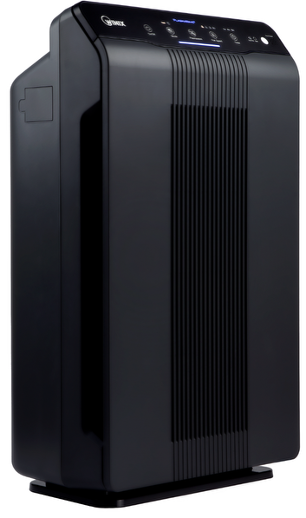
Carbon type: Pellet-based (AOC filter) | CADR: ~394 m³/h | Room: up to 33 m² | Noise: ~27–40 dB (low)
The Winix 5500-2 is the clear top pick for cooking smell removal from the models on this site, and this verdict is backed by independent comparative testing. Its pellet-based AOC (Advanced Odour Control) carbon filter provides significantly more adsorption surface area than mesh carbon, which translates directly to faster, longer-lasting odour removal during and after cooking. Multiple independent reviewers have tested it specifically against cooking odours (fish, bacon, spiced dishes) and confirmed it outperforms comparable machines at VOC clearance.
The auto mode uses both a particle sensor and an odour sensor — the combination means it responds to both visible cooking smoke (PM2.5) and the gas-phase odour compounds that HEPA alone misses. When you start frying, the fan ramps up. When the air clears, it drops back to quiet running. The light sensor auto-sleep feature is a practical bonus: when the kitchen-diner goes dark at night, the machine automatically drops to its quietest mode.
The pre-filter is washable — important in a cooking environment where grease particles accumulate on the pre-filter surface. Regular cleaning (every 2–4 weeks in a busy kitchen) keeps the HEPA and carbon filters from loading faster than necessary.
Best for: Open-plan kitchen-diners and living spaces up to 33 m², households that cook fish, spiced dishes, or fry regularly. The top choice for odour removal from the models on this site.
2. Levoit Core 400S — Best Smart Option for Cooking Smells in Larger Spaces
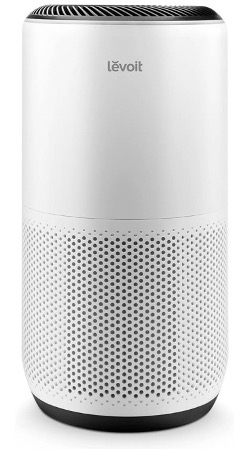
Carbon type: Activated carbon layer | CADR: ~442 m³/h | Room: up to 37 m² | Noise: 24 dB (sleep mode)
The Levoit Core 400S offers the highest CADR of the models on this site and adds smart scheduling that makes it particularly practical for cooking use. You can set it to run at high speed automatically at mealtimes — say, 6pm to 8pm — and drop back to auto mode overnight. The laser particle sensor responds quickly to PM2.5 from cooking smoke, and the VeSync app lets you monitor what the machine is seeing in real time.
Its carbon layer is not pellet-based, so for pure odour removal the Winix has a technical edge. However, the Core 400S’s higher CADR means it moves more air through its carbon faster, which partially compensates — and for lighter cooking smells (herbs, onions, moderate frying) independent reviewers find it highly effective. For households with open-plan spaces above 33 m², or those who prioritise smart features alongside odour control, this is the strongest option.
Best for: Larger open-plan spaces up to 37 m², smart home households, those who want scheduled cooking-time air quality management.
3. Coway AP-1512HH — Best for Light Cooking Odours and All-Round Performance
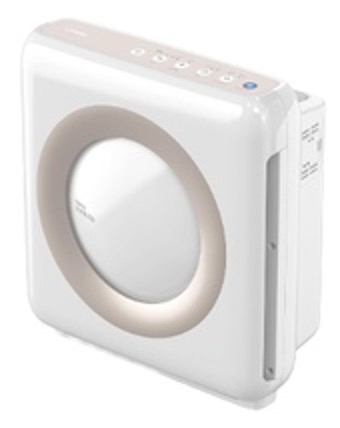
Carbon type: Mesh coated with activated carbon | CADR: ~418 m³/h | Room: up to 33 m² | Noise: 24 dB (low) / 21 dB (eco)
The Coway AP-1512HH is not the strongest performer for sustained heavy cooking odours — its mesh carbon filter saturates faster than the Winix’s pellet system. But for households where cooking is moderate (grilling, pasta, stir fries without strong spices) it handles odours effectively, and it remains one of the fastest particle removers in its class thanks to its impressive CADR.
Its eco mode at 21 dB — the quietest setting of any machine on this list — makes it ideal for running overnight in an open-plan space after an evening of cooking, without disturbing sleep. The colour-coded air quality indicator gives real-time feedback on when cooking-related PM2.5 has cleared. For households where all-round performance (dust, pollen, pet dander, light cooking) matters more than specialist odour removal, it remains an excellent choice.
Best for: Moderate cooking households, those who want strong particle removal alongside light odour control, quietest overnight operation.
4. Levoit Core 300S — Best for Small Kitchens and Single Rooms
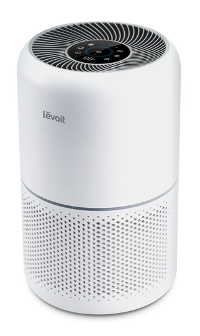
Carbon type: Activated carbon layer | CADR: ~141 m³/h | Room: up to 20 m² | Noise: 24 dB (sleep mode)
For a separate kitchen of 10–15 m², or a small studio flat where kitchen and living space are combined, the Levoit Core 300S is the right scale. Its CADR of 141 m³/h delivers multiple air changes per hour in a small room, and the smart app lets you ramp it to maximum during cooking and drop to quiet mode afterwards. For light to moderate cooking smells in a compact space, it is effective and economical to run.
Best for: Small separate kitchens up to 20 m², studio flats, single-room cooking environments.
What About the Blueair Blue Pure 211+?
The Blueair Blue Pure 211+ has an excellent CADR for smoke particle removal and handles light cooking odours. However, its carbon layer uses a thin carbon mesh rather than pellets, which limits its performance for strong or sustained cooking smells. It is the strongest machine on this site for wildfire smoke and large-room particle removal, but for cooking odour removal specifically, the Winix 5500-2 or Levoit Core 400S are better choices.
Quick Comparison: Best Air Purifiers for Cooking Smells UK
| Model | Carbon Type | Odour Performance | CADR | Best For |
| Winix 5500-2 | Pellet-based | Excellent | ~394 m³/h | Heavy/strong cooking smells |
| Levoit Core 400S | Carbon layer | Very good | ~442 m³/h | Large rooms, smart scheduling |
| Coway AP-1512HH | Mesh carbon | Good | ~418 m³/h | Light odours + particle removal |
| Levoit Core 300S | Carbon layer | Good (small rooms) | ~141 m³/h | Small kitchens, studios |
| Blueair Blue Pure 211+ | Carbon mesh | Moderate | ~595 m³/h | Large rooms, particle priority |
Getting the Best Results: Practical Tips
- Run the purifier during cooking, not just after. Starting it 10 minutes before you begin cooking means the air is already being cycled when VOC levels start to rise.
- Position it as close to the cooking area as practical — but not directly over the hob. An adjacent worktop or dining table is ideal. Distance reduces effectiveness significantly.
- Use your cooker hood simultaneously. The hood captures grease and moisture at source; the air purifier handles what escapes into the room.
- Run it on high for 20–30 minutes after cooking, then drop to auto. By 30 minutes post-cooking on high, most VOC levels will have returned close to baseline in a matched room size.
- Clean the pre-filter every 2–4 weeks in a cooking environment. Grease particles coat the pre-filter and reduce airflow if not cleaned regularly.
- Replace the carbon filter promptly when odour performance drops. Carbon saturation is gradual — you may not notice until the machine stops removing smells effectively. If yesterday’s dinner smell lingers in the morning, the carbon filter likely needs replacing.
Frequently Asked Questions
Do air purifiers actually remove cooking smells?
Yes — provided they have adequate activated carbon filtration. HEPA alone does not remove smells. An air purifier with a quality activated carbon filter (pellet-based for best results) combined with a high CADR for your room size will clear most cooking odours within 20–40 minutes of post-cooking operation on a medium-to-high setting.
Why does my air purifier not remove cooking smells?
The most likely reasons are: the carbon filter is saturated and needs replacing; the machine has a thin mesh carbon filter rather than pellet carbon; or the machine is undersized for the room it is working in. Check the filter condition first, then consider whether the CADR is adequate for your space.
Is the Winix 5500-2 good for cooking smells?
Yes — it is the best option on this site specifically for cooking odour removal, due to its pellet-based AOC carbon filter. Independent testing consistently shows it outperforming mesh-carbon competitors at VOC and odour removal, including after cooking fish, bacon, and spiced dishes.
How often should I replace the carbon filter in a kitchen air purifier?
In a kitchen environment with daily cooking, carbon filters typically need replacing every 4–6 months — more frequently than in a bedroom or living room where the machine is mainly handling dust and pollen. Monitor performance: if cooking smells persist longer than usual, the carbon is saturating. The Winix 5500-2’s AOC carbon filter is washable, which extends its life between replacements.
Can an air purifier remove the smell of fish?
Yes, effectively. Fish odour is caused by trimethylamine and related amine compounds — gases that activated carbon adsorbs well. The Winix 5500-2 and Levoit Core 400S both handle fish smells effectively. Run the machine on high during and for 30 minutes after cooking fish for best results.
Will an air purifier help with gas hob NO₂?
Partially. Activated carbon provides some reduction of nitrogen dioxide (NO₂) from gas hob combustion, and HEPA handles any particulate combustion byproducts. However, the most effective protection against gas hob NO₂ is ventilation — open a window while cooking, and use the cooker hood. An air purifier running simultaneously provides an additional layer of protection but should not be relied upon as the sole intervention for gas combustion pollutants.
Related Guides
Dealing with smoke from BBQs or wildfires as well as cooking smells? Read: Best Air Purifier for Smoke UK.
Looking for an all-round air purifier comparison? Read: Dehumidifier vs Air Purifier UK.
Concerned about mould as well as cooking smells? Start here: Best Dehumidifier for Mould UK.
For guidance on gas hob NO₂ and indoor air quality, see UK Health Security Agency: Indoor Air Quality.

One Comment