
Best Dehumidifier for Garage UK 2026
This page contains affiliate links. If you buy through these links, we may earn a small commission at no extra cost to you. See our Affiliate Disclaimer for more information.
A damp garage is more than an inconvenience. Excess humidity corrodes car bodywork, rusts tools, warps wood, and turns stored items into a mouldy mess. In the UK, where temperatures frequently dip below 10°C for months at a time, most garages are unheated cold spaces — and that makes choosing the right dehumidifier critically important.
This guide covers the best dehumidifiers for garages in the UK in 2026, with clear recommendations for unheated and heated spaces, single and double garages, and those used as workshops or for classic car storage.
Quick Picks: Best Dehumidifier for Garage UK
| Model | Best For | Type |
| Meaco DD8L Junior | Unheated garages — our top pick | Desiccant |
| Meaco MeacoDry Abc 12L | Heated garages and workshops | Compressor |
| Meaco 20L Low Energy | Double garages with serious damp | Compressor |
| Pro Breeze 12L | Budget pick for warmer garages | Compressor |
Why Garages Are So Prone to Damp
Garages are built for function, not comfort. Most have single-skin brick or concrete block walls, an uninsulated up-and-over metal door, a concrete floor, and no heating. That combination creates ideal conditions for condensation: warm, moist outside air enters through gaps in the door or roof, cools rapidly on the cold walls and floor, and deposits moisture on every surface it touches.
UK relative humidity averages between 80% and 90% during autumn and winter. When that air is trapped inside a cold, poorly ventilated garage, the results are predictable: rust on tools and car bodywork, mould on cardboard boxes and fabric items, warped wood, and a persistent damp smell.
Common signs your garage needs a dehumidifier:
- Surface rust appearing on tools, bicycle frames, or car brake discs
- Condensation on the bonnet or windows of a stored vehicle
- Musty smell when you open the garage door
- Mould growing on stored cardboard, fabric, or timber
- Damp patches on walls, floor, or the ceiling of a converted space
Desiccant or Compressor Dehumidifier for a Garage?
For most UK garages, the answer is clear: you need a desiccant dehumidifier. Here is why.
Compressor (refrigerant) dehumidifiers are excellent in warm, heated spaces. They work by cooling a coil to condense moisture, which means their performance falls sharply as temperatures drop. Below 15°C, extraction rates decline significantly. Below 10°C — the temperature of most unheated UK garages from October to April — many compressor models barely extract any moisture at all. Some enter continuous defrost cycles, consuming energy while doing almost nothing useful.
Desiccant dehumidifiers use a moisture-absorbing rotor that works independently of temperature. They remain effective from 1°C upwards, making them the only reliable choice for a cold, unheated garage in a UK winter. As a useful bonus, desiccant units emit air that is 10–12°C warmer than room temperature, providing a modest heating effect.
The exception: if your garage is insulated, heated, and consistently above 15°C — for example, a workshop with a heater or a converted garage used as a gym — a compressor model like the Meaco MeacoDry Abc 12Loffers lower running costs and is perfectly capable. For a cold, unheated single or double garage, a desiccant model is the right tool for the job. See our full guide to desiccant vs compressor dehumidifiers UK for a detailed breakdown.
Best Dehumidifiers for Garages UK — Reviews
1. Meaco DD8L Junior — Best Overall for Garages
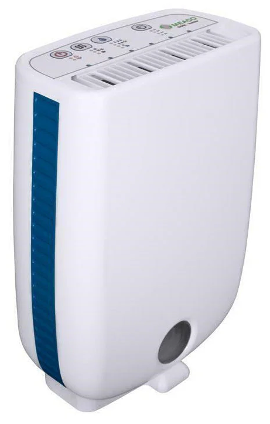
The Meaco DD8L Junior is the most widely recommended dehumidifier for UK garages, and its reputation is well-deserved. As a desiccant unit, it operates from 1°C to 37°C — meaning it keeps working through the coldest British winters when compressor models grind to a halt.
The Meaco DD8L Junior extracts up to 8 litres of moisture per day. In real UK garage conditions — cold and moderately damp — this rivals many compressor models rated at 16–20 litres, which overstate their performance at warm-weather test conditions that garages never reach. Real-world users on forums from PistonHeads to Detailing World consistently report that the Meaco DD8L Junior keeps their garages below 50% RH year-round, preventing rust on brake discs, tools, and car bodywork.
Meaco’s Control Logic system samples the air every 30 minutes and only runs the unit when humidity exceeds the target — saving energy compared to always-on models. The continuous drain option means you can connect a hose and never touch the tank, making the Meaco DD8L Junior ideal for a garage where you visit infrequently. It also has auto-restart after power failure, which is useful if you want to put it on a timer or leave it unattended.
Pros:
- Works from 1°C — the only reliable choice for a cold, unheated UK garage
- 8L/day extraction that matches 16–20L compressor models in cold conditions
- Emits warm air as a by-product — a modest bonus in a cold space
- Continuous drain option and auto-restart after power failure
- Quiet, lightweight, and compact at just 6kg
- Control Logic reduces energy use — only runs when needed
Cons:
- Higher wattage than compressor models in warm conditions
- No built-in ioniser (standard DD8L has one at higher cost)
Verdict: The Meaco DD8L Junior is the definitive answer for the vast majority of UK garage owners. If your garage is cold and unheated, this is the dehumidifier to buy.
2. Meaco MeacoDry Abc 12L — Best for Heated Garages and Workshops
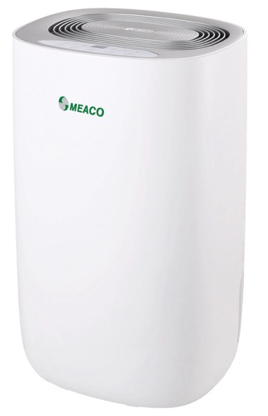
If your garage is insulated and heated — a workshop with a space heater, a converted home gym, or a south-facing unit that stays warm — the Meaco MeacoDry Abc 12L is an excellent choice. As a compressor unit, it is far cheaper to run at room temperature, costing just 4p per hour, and it is one of the quietest compressor dehumidifiers available, operating at just 36–40dB.
The Meaco MeacoDry Abc 12L operates between 5°C and 35°C with auto-defrost for occasional cold snaps. It extracts up to 12 litres per day, handles laundry mode, and has a continuous drain connection and a 2.6-litre tank. Its slim, modern design takes up minimal floor space in a workshop or converted garage.
Pros:
- Very low running costs at 4p per hour
- Quiet Mark certified — one of the quietest compressor models on the market
- Compact and modern, ideal for a tidy workshop
- 12L/day extraction with adjustable humidistat and laundry mode
- Auto-defrost for cool but above-freezing conditions
Cons:
- Not suitable for cold, unheated garages in autumn and winter
- Performance drops significantly below 10°C
Verdict: The Meaco MeacoDry Abc 12L is the right choice only if your garage stays reliably warm. For a cold, unheated space, choose the Meaco DD8L Junior instead.
3. Meaco 20L Low Energy — Best for Large Double Garages
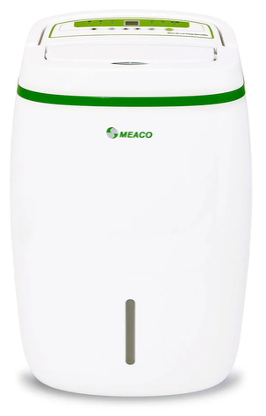
For a large double garage — particularly one over 40 square metres with a serious damp problem — the Meaco 20L Low Energy brings the extraction capacity to bring humidity under control quickly. It removes up to 20 litres of moisture per day and uses Meaco’s Control Logic to cut running time and costs. If you need to dehumidify a large space fast and then maintain it on a continuous drain, this is the model to choose.
The Meaco 20L Low Energy is a compressor unit, so it performs best in a heated garage or workshop. In an unheated double garage in winter, a desiccant model remains a better choice — but for a large, heated commercial-style garage or a converted unit with insulation and heating, the Meaco 20L Low Energy‘s higher capacity makes it the most powerful option in this lineup.
Pros:
- High 20L/day extraction rate for large, damp spaces
- Control Logic energy saving — only runs when humidity requires it
- Continuous drain connection for permanent placement
- Reliable Meaco build quality with solid UK warranty support
Cons:
- Compressor — less effective in cold, unheated garages
- Larger and heavier than the other models in this guide
Verdict: The Meaco 20L Low Energy is ideal for a large, heated double garage or workshop with a persistent damp problem. If your space is unheated, the Meaco DD8L Junior remains the better year-round option.
4. Pro Breeze 12L — Best Budget Pick for Heated Garages
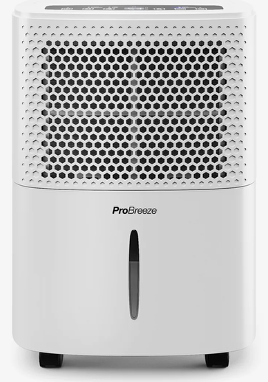
For a budget-conscious buyer with a heated garage, the Pro Breeze 12L offers solid performance at a lower price point. It extracts up to 12 litres per day, includes a continuous drain connection, adjustable humidistat, laundry mode, and auto-shutoff when the tank is full. It is a straightforward, no-frills unit that does the job reliably in a warm environment.
Like all compressor units, the Pro Breeze 12L is not suitable for a cold, unheated garage in winter. Its performance drops below 15°C and becomes unreliable below 10°C. For a south-facing, heated garage or one in a milder part of the UK, it provides adequate humidity control at a competitive price. Do not use it as a year-round solution in a standard unheated UK garage.
Pros:
- Affordable entry point for a full-featured 12L dehumidifier
- Continuous drain, laundry mode, and auto-shutoff included
- Compact and easy to move around the garage
Cons:
- Compressor — not suited to cold garages in autumn and winter
- Less refined than equivalent Meaco models
Verdict: The Pro Breeze 12L is a sensible budget choice for a heated garage or workshop used mainly in spring and summer. For year-round protection in an unheated space, the Meaco DD8L Junior is the correct choice.
Garage Dehumidifier Comparison Table
| Model | Type | Extraction | Min Temp | Best For |
| Meaco DD8L Junior | Desiccant | 8L/day | 1°C | Cold/unheated garages |
| Meaco MeacoDry Abc 12L | Compressor | 12L/day | 5°C | Heated garages/workshops |
| Meaco 20L Low Energy | Compressor | 20L/day | 5°C | Large double garages |
| Pro Breeze 12L | Compressor | 12L/day | 5°C | Budget, heated use |
What to Look for in a Garage Dehumidifier
Temperature range: The single most important factor. For an unheated garage, you need a desiccant dehumidifier that works from 1°C. If in doubt, buy desiccant.
Continuous drain: Garages are often left unattended for days at a time. A continuous drain hose connection means the unit empties itself directly to a drain or outside, so you never have to worry about the tank filling up and the machine switching off.
Auto-restart after power failure: If you put the dehumidifier on a timer or the power goes off, auto-restart ensures the unit resumes operation automatically. The Meaco DD8L Junior includes this feature.
Extraction capacity: For a single garage (up to 25 sq m), an 8–12L/day capacity is sufficient. For a large double garage, a 20L model gives you more headroom for tackling a significant damp problem quickly.
Durability: Garages are harsher environments than living rooms. Stick with established brands — Meaco in particular has a strong track record for long-term reliability, as evidenced by the volume of real-world user reports across automotive and DIY forums.
What Humidity Level Should a Garage Be?
Aim to keep relative humidity in your garage between 45% and 55% RH. Steel begins to corrode more rapidly above 60% RH. For classic car or tool storage, 45–50% is the target most enthusiasts aim for. Set your dehumidifier’s humidistat accordingly and let it cycle automatically.
In an unheated UK garage in winter, ambient humidity can exceed 80–90% RH without active dehumidification. Even a well-sealed garage accumulates moisture over time as outside air enters whenever the door is opened. A desiccant dehumidifier running on a continuous drain will maintain your target humidity indefinitely without any manual intervention.
Tips for Using a Dehumidifier in a Garage
- Seal the garage first: Check door seals, fix any roof leaks, and close any large gaps before running the dehumidifier. Trying to dehumidify a garage with major air leaks is like leaving the window open.
- Use continuous drain: Run an 8mm internal diameter hose from the unit to a floor drain or outside. You can then set the target humidity and forget about it entirely.
- Position centrally: Place the dehumidifier where it gets good airflow — avoid corners and directly against walls. Leave at least 30cm clearance on all sides.
- Use a timer if you visit regularly: If you work in the garage daily, you may not need the unit running 24/7. Set it to run overnight when temperatures are lowest and humidity is highest.
- Clean the filter regularly: Garage air tends to be dustier than indoor living spaces. Clean or vacuum the air filter every few weeks to maintain extraction performance.
Frequently Asked Questions
Can I use a normal household dehumidifier in my garage?
You can, but most standard household dehumidifiers are compressor models that lose effectiveness below 15°C. In a typical unheated UK garage, this makes them near-useless in winter. For year-round use, you need a desiccant model like the Meaco DD8L Junior that works from 1°C.
How long should I run a dehumidifier in a garage?
If your garage is significantly damp, run the dehumidifier continuously until it reaches the target humidity (45–55% RH). After that, Meaco’s Control Logic system on the Meaco DD8L Junior and Meaco MeacoDry Abc 12Lwill cycle the unit on and off automatically to maintain your target, minimising energy use.
Will a dehumidifier stop rust in my garage?
Yes, if you maintain humidity below 50–55% RH. Steel begins to corrode noticeably above 60% RH. By keeping garage humidity in the 45–55% range, you will significantly reduce surface rust on tools, brake discs, car bodywork, and bicycle frames.
What size dehumidifier do I need for a single garage?
For a standard single garage of up to 25 square metres, an 8–12 litre per day model is sufficient. The Meaco DD8L Junior is rated for homes of up to 4–5 bedrooms, making it more than adequate for a single garage. For a double garage or larger, consider the Meaco 20L Low Energy for faster initial dehumidification.
Do I need a desiccant dehumidifier for an unheated garage?
Yes. Compressor dehumidifiers lose most of their effectiveness below 10°C — the temperature of a typical unheated UK garage in winter. A desiccant model like the Meaco DD8L Junior works from 1°C and maintains consistent extraction performance regardless of the temperature inside the garage. See our guide to desiccant vs compressor dehumidifiers UK for more detail.
Where is the best place to put a dehumidifier in a garage?
Position the unit centrally in the garage where it can draw air from the entire space. Avoid corners and areas directly next to the garage door, where humidity levels fluctuate as the door opens. Leave at least 30cm of clearance around the unit and ensure the air inlet filter is not blocked.
Our Verdict
For the vast majority of UK garage owners, the Meaco DD8L Junior is the correct choice. It is a desiccant dehumidifier that works from 1°C, operates quietly, costs around 8p per hour on the lower fan setting, and can be left running indefinitely on a continuous drain. Real-world users report consistently excellent results for preventing rust on cars, tools, and stored equipment.
If your garage is heated and insulated, the Meaco MeacoDry Abc 12L is a quieter, cheaper-to-run compressor option. For a large double garage with serious damp, the Meaco 20L Low Energy offers the extraction capacity to bring a very damp space under control quickly. Budget buyers with a warm, insulated garage will find the Pro Breeze 12L a capable, affordable option — but only if the space stays above 10°C year-round.
For further information on the health risks of damp and mould, the NHS provides clear guidance on damp and mould in the home.

One Comment