
How to Vent a Portable Air Conditioner Without a Window — 5 Methods That Work
Affiliate Disclosure: This page contains affiliate links. If you buy through these links, we may earn a small commission at no extra cost to you. See our Affiliate Disclaimer for more information.
How to vent a portable air conditioner without a window is one of the most common questions from flat dwellers and renters — and the good news is there are several practical options, most of which require no drilling and no landlord permission.
| ✅ Key Takeaways Every portable AC must vent hot air outside — without proper venting the unit heats the room rather than cools it. A sliding door is the best window-free option for renters — door vent kits are cheap, drill-free, and fully reversible. A hinged door with a DIY plexiglass panel is the next best option — no permanent fixing required. Through-wall venting is the most efficient permanent solution, but requires landlord permission in rented properties. Venting into another room is not a solution — it just moves the hot air, it does not remove it. Never extend the exhaust hose beyond manufacturer spec — back pressure damages the compressor. |
Why Venting Is Non-Negotiable
A portable air conditioner works by pulling warm air from the room, cooling it using a refrigerant cycle, and recirculating the cool air. In doing so it generates hot exhaust air from the condenser — and that heat has to go somewhere outside the room you are trying to cool.
Without proper venting, the hot exhaust simply blows back into the room. The unit ends up working against itself: cooling air on one side while heating it on the other. In practice an unvented portable AC makes the room hotter, not cooler, and runs the compressor into the ground doing it.
| ⚠ A badly sealed vent is almost as bad as no ventGaps around the exhaust hose — whether at the window, door, or wall — allow warm outside air to flood back in continuously. The unit then works flat out trying to overcome the constant warm air ingress, driving up running costs and reducing effectiveness. Seal every gap with foam tape or weatherstripping. A properly sealed vent is as important as having one at all. |
The 5 Methods, Ranked by Practicality for UK Renters
| Method | Renter-friendly? | Drilling required? | Verdict |
| 1. Sliding door kit | Yes | No | Best option |
| 2. Hinged door + DIY panel | Yes | No | Good option |
| 3. Through-wall vent | Owner only | Yes | Most efficient |
| 4. Drop ceiling | Rarely | Minimal | Office/utility only |
| 5. Into another room | N/A | No | Avoid — does not work |
Method 1: Sliding Door Vent Kit (Best for Renters)
If your windowless room has access to a balcony, garden, or exterior space via a sliding patio door, a sliding door vent kit is the closest equivalent to a standard window kit — and it requires zero drilling or permanent modification.
How it works: a purpose-made panel slots into the door track and fills the gap above the open door, with a port for the exhaust hose. You slide the door open slightly, slot the panel in, feed the hose through, and seal any remaining gaps with foam tape.
- Cost: £20–£50 for a purpose-made sliding door kit, or free if you DIY with foam board cut to size.
- Setup time: 15–30 minutes.
- Reversible: Completely — remove the panel and the door is back to normal.
- Renter risk: None — no modification to the property.
This is the method to try first. Most UK flats with a balcony can be set up this way in under half an hour.
Method 2: Hinged or Casement Door With a DIY Panel
Standard hinged doors are trickier than sliding doors because they swing open at an angle, making a straight panel harder to seal. The solution is a plexiglass or foam board panel cut to fit the door aperture when held in place, with a hole cut for the exhaust hose.
- Measure the door frame opening (width and height) when the door is held open at roughly 90 degrees.
- Cut a plexiglass or thick foam board sheet to those dimensions.
- Mark and cut a circular hole to match your exhaust hose diameter — typically 12.5–15 cm.
- Hold or clamp the panel in the door frame and feed the hose through.
- Seal the panel edges with foam weatherstripping or gaffer tape.
- Cost: £10–£30 for materials.
- Reversible: Fully — remove the panel and no trace remains.
- Limitation: The door cannot be used while the AC is running. Best for rooms with a secondary exit or a door you can afford to block temporarily.
| 💡 Tip: Use the exterior door, not an interior oneThe exhaust must vent to outside the building — not into a hallway, stairwell, or adjacent room. If the only door available leads to an interior space, this method will not work effectively. The hot air needs a clear path to the exterior. |
Method 3: Through-Wall Vent (Owner-Occupiers Only)
A purpose-drilled wall vent is the neatest and most efficient permanent solution for a room without a window. A hole is bored through an external wall to the outside, a vent sleeve is fitted, and the exhaust hose connects directly — no window or door needed at all.
- Cost: £100–£300 depending on wall construction and whether you hire a professional.
- Efficiency: Best of all methods — a short, straight hose run with a tight seal and no light or air bleed-through.
- Renter suitability: Requires landlord written permission and likely a professional installer. Not suitable for most renters.
- Wall type matters: Brick and block walls are straightforward; solid stone or concrete may require specialist equipment.
| ⚠ Renters: always get written permission before any wall penetrationIn the UK, any structural modification to a rented property — including drilling through an external wall — requires the landlord’s written consent. Doing this without permission risks losing your deposit and potential liability for reinstatement costs. For most renters, methods 1 or 2 are the correct approach. |
Method 4: Drop Ceiling (Commercial and Utility Spaces)
In rooms with a suspended or drop ceiling — common in converted offices, utility rooms, or older commercial-to-residential conversions — you can remove a ceiling tile and vent the exhaust hose into the void above.
This only works if the ceiling void leads to an adequately ventilated space — typically the roof void or a ventilated loft. It is not suitable for small, sealed ceiling voids.
| ⚠ Drop ceiling venting and UK damp: read this firstPortable AC exhaust carries moisture as well as heat. Venting into a loft or ceiling void in the UK’s damp climate risks condensation, mould growth, and structural damage to roof timbers. Unless the void has active ventilation and you are confident about moisture management, this method carries meaningful risk. It is most appropriate for purpose-built commercial drop ceiling installations, not domestic lofts. |
Method 5: Venting Into Another Room — Why This Does Not Work
Several guides online suggest venting into an adjacent room, a hallway, or a large cupboard as a workaround when no external vent is available. This is not a real solution and we are flagging it here specifically because it wastes time and money.
The hot exhaust air does not disappear — it moves into the adjacent space and raises the temperature there. If that room connects to the room you are trying to cool, the heat cycles back within minutes. If it is an isolated utility room or storage space, you are simply heating that instead, which may cause its own damp and condensation problems.
| ❌ Venting into another room: the bottom lineHot air must exit the building. Venting into another internal space — a hallway, cupboard, or adjacent room — is not a substitute. It simply redistributes heat within the property rather than removing it. Do not attempt this as a workaround; use method 1 or 2 instead. |
Extending the Exhaust Hose: What You Need to Know
Many people in rooms without a conveniently placed opening consider extending the exhaust hose to reach further. This is possible in principle but comes with real risks:
- Back pressure damages the compressor. The longer and narrower the hose, the harder the unit works to push air through it. Excessive back pressure causes the compressor to overheat and shortens its lifespan significantly.
- Heat gain along the hose. A longer hose radiates more heat back into the room before the air exits. A kinked or poorly routed hose makes this worse.
- If you must extend: increase the diameter. If there is no alternative, use a hose with a larger diameter than the original — this reduces back pressure. Never extend with a narrower hose.
- Keep it straight and short. The manufacturer’s supplied hose length exists for a reason. Aim to use the unit as close to the vent point as possible rather than extending the hose to reach a distant opening.
Recommended Units for Windowless Rooms
The venting method matters, but so does choosing a unit with the right hose length and positioning for your setup. These are our picks for UK buyers dealing with awkward venting situations:
Best overall: Meaco MeacoCool MC Series
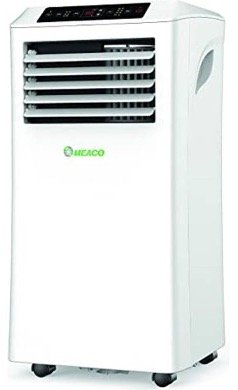
The Meaco MeacoCool MC Series is our top recommendation for UK buyers. It has a well-designed exhaust connection that sits close to floor level, making it easier to route the hose through a door panel without the hose kinking at an awkward angle. Sleep mode reduces fan noise for overnight use, and it’s among the quieter portable AC units available.
| Specification | Detail |
| Cooling output | 9,000 BTU |
| Noise level | 52–55 dB |
| Room size | Up to ~25 m² |
| Hose type | Single hose, rear exhaust port |
| Sleep mode | Yes |
| Wi-Fi control | Yes (app control) |
| 🔵 VerdictThe Meaco MeacoCool MC Series is the most practical choice for UK renters setting up a door-vent configuration. The rear hose port keeps routing clean, and the sleep mode makes it usable in a bedroom with a door vent panel in place overnight. |
Best for tight spaces: De’Longhi Pinguino PACEX100
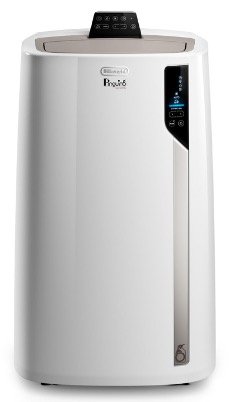
The De’Longhi Pinguino PACEX100 has a slim footprint and a top-mounted exhaust port, which can simplify hose routing in narrow rooms or tight door configurations where floor-level routing is awkward. It is a reliable, well-built unit from a long-established brand.
| ⚠ Pro Breeze 9000 BTU — noise noteThe Pro Breeze 9000 BTU 4-in-1 is a popular budget option but is rated at approximately 65 dB — significantly louder than the Meaco or De’Longhi. It is not suitable for overnight bedroom use. Fine for a daytime home office or living room, but factor the noise in before buying. |
What About the Dreo AC515S?
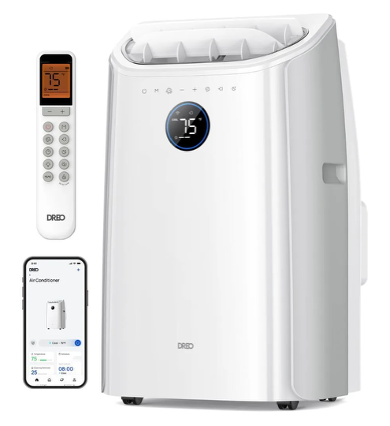
The Dreo AC515S is worth a mention here because buyers often compare its BTU rating with other models and find conflicting figures. The Dreo is listed at 10,000 BTU under the UK SACC testing standard — not the 12,000 BTU figure used in the US ASHRAE standard. This is the same hardware tested under a different methodology, not a different product. For a typical UK room without a window, 10,000 BTU (SACC) is appropriate for spaces up to around 28 m².
| ⚠ Dreo AC515S: BTU figures explainedUK listings show 10,000 BTU (SACC standard). US listings show 12,000 BTU (ASHRAE standard). This is the same unit — the difference is the testing methodology, not the hardware. Use the UK SACC figure when sizing for a UK room. |
Renter’s Quick Reference: What Needs Permission
| What you can do without landlord permission Use a sliding door vent kit — fully reversible, no modification to the property Use a hinged door with a DIY panel — fully reversible, no modification to the property Use any portable AC unit that does not require permanent installation What requires landlord written permission Drilling through any wall — external or internal Permanently modifying a door, window, or door frameInstalling any fixed or semi-permanent fixture to the building fabric When in doubt, check your tenancy agreement and ask in writing. A portable unit with a door kit is the safest approach for the vast majority of UK renters. |
Frequently Asked Questions
Can you use a portable air conditioner without any venting at all?
No. A portable AC without venting will heat the room rather than cool it. The hot exhaust from the condenser has to exit the space — without this the unit is simply converting electricity into heat inside your room. There is no such thing as a truly ventless portable AC that cools effectively.
How long can the exhaust hose be?
Most manufacturers supply a hose of 1.2–1.5 metres and recommend not exceeding this. If extension is unavoidable, use a wider-diameter hose to reduce back pressure, keep the run as straight as possible, and never exceed double the manufacturer’s supplied length. Excessive hose length voids many warranties and risks compressor damage.
Can I vent through a letterbox or cat flap?
No — the opening is too small and the seal will be inadequate. The exhaust hose on a portable AC is typically 12.5–15 cm in diameter. A letterbox gap is far too narrow and will not seal properly, meaning warm air will flood back in around the hose.
Does a dual-hose portable AC need a different venting setup?
Yes — a dual-hose unit has one exhaust hose and one intake hose, both of which need to pass through the vent point. Most window kits supplied with dual-hose units accommodate both. If building your own door panel, cut two holes at the correct diameter and space them apart to avoid intake recirculating hot exhaust air.
Will venting through a door let insects in?
A well-sealed vent panel should not. Foam weatherstripping around the panel edges and a snug-fitting hose port are usually sufficient. If your door leads to an outdoor area with significant insect pressure, consider adding fine mesh around the hose port exit on the outside.
Can I vent into a chimney breast?
Only if the chimney is open, unblocked, and leads directly to outside — and only with professional advice. Many UK chimney breasts are capped, partially blocked, or shared with neighbouring properties. Venting into a capped or blocked chimney is dangerous and ineffective. This is not a recommended method for most homes.
Related Articles
| Keep Reading Best Portable Air Conditioner for Flat UK — our top renter-friendly picks with full noise and running cost figures. Best Portable Air Conditioner for Bedroom UK — quiet-first picks rated for overnight use. Best Portable Air Conditioner UK — our full category roundup across all use cases. Do Portable Air Conditioners Work in the UK? — an honest look at effectiveness, efficiency, and when they are and are not worth it. |
