
Best Portable Air Conditioner UK (2026): Honest Picks for Every Room
Last updated: 21 July 2026
This page contains affiliate links. If you buy through these links, we may earn a small commission at no extra cost to you. See our Affiliate Disclaimer for more information.
Best portable air conditioner UK options get a lot of attention once June arrives and a Victorian terrace or modern flat turns genuinely uninhabitable. Portable units are not perfect — they are noisier, less efficient, and bulkier than wall-mounted split systems — but they are the only realistic option for renters, listed buildings, and anyone who cannot drill through an external wall. Used correctly in the right room, they genuinely work. This guide covers the five worth buying in 2026, with honest assessments of noise, running cost, room coverage, and the BTU claims you should actually believe.
Key Takeaways
| At a glance: The Meaco MeacoCool MC Series is the best overall pick for most UK homes — 9,000 BTU, 52–53 dB, Wi-Fi, and a solid 2-year warranty. The De’Longhi Pinguino PACEX100 is the most energy-efficient at just 700W (A++ rated) — running costs of ~17p/hr, the lowest on this list. ⚠️ Stock note (July 2026): Portable air conditioners are in exceptionally high demand this summer, and stock is fluctuating fast across retailers — including Meaco direct. If the De’Longhi Pinguino PACEX100 shows as unavailable when you check, it’s worth trying again in a day or two rather than assuming it’s discontinued. You can also check availability directly from Meaco or see our other picks below in the meantime. The Dreo AC515S is the quietest at 46 dB — drainage-free and smart-enabled, ideal if overnight noise is your main concern. The Olimpia Splendid Dolceclima Compact 8P has the smallest footprint at 345mm wide — the best fit for smaller UK flats and tight spaces. All portable ACs need a window for the exhaust hose. Running costs are calculated at 24p/kWh. |
Why a Portable Air Conditioner in the UK?
Most UK homes have no built-in air conditioning. Fixed split systems are the gold standard but require drilling through an external wall, landlord permission, and professional installation — none of which are options for most renters. A portable unit with a window-vented exhaust hose is the practical alternative: no installation, no permission required, and you take it with you when you move.
The physics have real limitations — covered below — but in a properly managed room during a UK heatwave, a portable unit can drop temperature by 4–8 °C and make an otherwise uninhabitable room liveable. That is worth the trade-offs for most people.
Before You Buy: The Single-Hose Problem
Every portable air conditioner on UK sale is a single-hose unit. It draws air from inside the room, runs it over a refrigerant-cooled coil to extract heat, and then uses that same indoor air to push the heat out through the exhaust hose. This creates a slight negative pressure inside the room — drawing warm air back in through door gaps, window frames, and any unsealed gaps — which partially undermines the cooling effect.
This is not a flaw unique to budget units. It is how single-hose portable air conditioners work. The practical fix: keep all doors and windows closed while it runs, seal around the window kit as well as you can, and pre-cool the room before peak heat. Do not expect a 9,000 BTU portable unit to match a fixed 9,000 BTU split system — it will not. It will, however, still make a meaningful difference during a UK heatwave.
| ⚠️ BTU figures — ASHRAE vs SACC: Some manufacturers (particularly US brands sold on Amazon UK) quote ASHRAE BTU figures, measured in controlled lab conditions that consistently overstate real-world performance. A unit quoted as 12,000 BTU ASHRAE may only deliver 8,000 BTU in real conditions (the DOE/SACC figure). Where this discrepancy exists, we flag it specifically. All five picks below include BTU notes where relevant. |
What Size Portable Air Conditioner Do You Need?
Matching the BTU rating to your room size is the most important buying decision. An undersized unit will run flat out and never cool the room. An oversized unit is unnecessary expense.
| Room size | Recommended BTU | Best pick | Notes |
| Up to 15 m² | 7,000 BTU | Any 8,000 BTU unit | Small bedroom, home office |
| 15–22 m² | 9,000 BTU | Meaco MeacoCool MC /Pro Breeze 9000 | Standard bedroom, small living room |
| 20–28 m² | 10,000 BTU | Dreo AC515S / De’Longhi PACEX100 | Medium living room, open-plan bedroom |
| Up to 20 m² (compact) | 8,000 BTU | Olimpia Compact 8P | Flat / small bedroom — smallest footprint |
| 35 m²+ | 12,000+ BTU | Fixed split system recommended | A single portable unit is unlikely to cope |
Add one step up if your room has large south-facing windows, high ceilings, or multiple heat sources such as computers, TVs, or appliances. Rooms above 35 m² are better served by a fixed split system — a single portable unit will struggle.
Our Picks: Best Portable Air Conditioners in the UK (2026)
1. Meaco MeacoCool MC Series — Best Overall
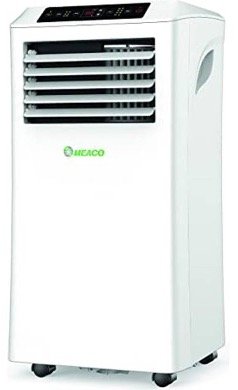
The Meaco MeacoCool MC Series is the portable air conditioner most UK heating and cooling professionals reach for when someone asks for a reliable recommendation. It is not the cheapest or the quietest on this list, but it balances cooling performance, noise, smart features, and UK brand support better than anything else at this price. Meaco is a UK-based company with genuine after-sales support — that matters when something goes wrong mid-heatwave.
At 52–53 dB on low fan speed, it is liveable overnight in most bedrooms without being the quietest option available. The two included window kits — a sliding bracket and a flexible casement kit — mean it fits the widest range of UK window types of any unit on this list.
| Specification | Detail |
| Cooling capacity | 9,000 BTU (2.6 kW) |
| Room size | 16–26 m² |
| Noise level | 52–53 dB (sound pressure, low fan) |
| Power consumption | ~1,080W |
| Running cost | ~26p/hr at 24p/kWh |
| Energy rating | A |
| Modes | Cool, dehumidify, fan, sleep |
| Smart control | Wi-Fi, Meaco app, 24-hr timer |
| Window kits | Sliding bracket + flexible casement kit included |
| Warranty | 2 years |
Pros
- 52–53 dB on low — among the quieter 9,000 BTU units
- Wi-Fi app control — pre-cool before you arrive home
- Two window kit types included — fits most UK windows
- Sleep mode dims display and reduces fan speed
- 2-year warranty — longest on this list alongside De’Longhi
- Meaco UK support — genuine after-sales help when you need it
Cons
- ~26p/hr — not the cheapest to run
- 1,080W draw — higher than the De’Longhi
- Display cannot be fully switched off
- Fan-only mode is notably louder than cooling mode
| Verdict: The safest all-round buy for most UK homes. Strong cooling for its size, two window kit types, genuine UK support, and a 2-year warranty. Not the most efficient or the quietest — but the most balanced package on this list. |
2. De’Longhi Pinguino PACEX100 — Best for Running Costs
⚠️ Stock note (July 2026): Portable air conditioners are in exceptionally high demand this summer, and stock is fluctuating fast across retailers — including Meaco direct. If the De’Longhi Pinguino PACEX100 shows as unavailable when you check, it’s worth trying again in a day or two rather than assuming it’s discontinued. You can also check availability directly from Meaco or see our other picks below in the meantime.
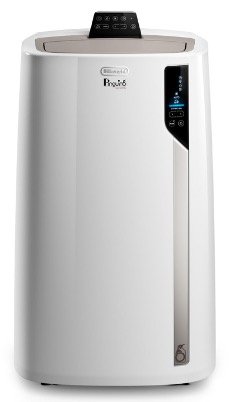
The De’Longhi Pinguino PACEX100 is the most energy-efficient portable air conditioner on this list by a significant margin. At A++ rated and just 700W, it costs around 17p per hour to run — roughly a third less than most 9,000 BTU rivals. If you plan to run a portable AC for four to six hours a day across a UK summer, that difference adds up to a meaningful saving.
It also delivers 10,000 BTU — more cooling capacity than the Meaco — and runs at 49–53 dB across fan speeds. The lack of Wi-Fi is a genuine limitation, but for buyers who prioritise efficiency over smart features, nothing on this list comes close.
| Specification | Detail |
| Cooling capacity | 10,000 BTU (2.9 kW) |
| Room size | Up to ~25–35 m² |
| Noise level | 49–53 dB (sound pressure, fan-speed dependent) |
| Power consumption | 700W |
| Running cost | ~17p/hr at 24p/kWh — lowest on this list |
| Energy rating | A++ — most efficient on this list |
| Modes | Cool, dehumidify, fan |
| Smart control | Remote control + 24-hour timer (no Wi-Fi) |
| Refrigerant | R290 (low GWP, eco-friendly) |
| Warranty | 2 years |
Pros
- A++ energy rating — ~17p/hr, the lowest running cost on this list
- 700W input — significantly more efficient than rivals at similar BTU
- 10,000 BTU — more cooling power than most rivals
- 49–53 dB — quiet across all fan speeds
- R290 refrigerant — environmentally responsible low-GWP option
- 2-year warranty
Cons
- No Wi-Fi — remote control only, no app or smart home integration
- Larger and heavier than most rivals (~80 cm tall, ~30 kg)
- Premium price point
| Verdict: The running cost leader, and it is not close. At 700W and A++, anyone planning extended daily use should seriously consider this over the alternatives — the savings over a full summer are real. The absence of Wi-Fi is the one genuine limitation. |
3. Olimpia Splendid Dolceclima Compact 8P — Best for Smaller Spaces
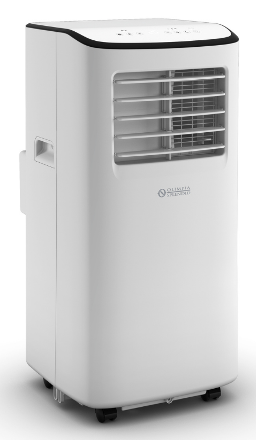
The Olimpia Splendid Dolceclima Compact 8P is Italian-designed and built for compact living. At just 345mm wide and 703mm tall, it has the smallest footprint of any unit on this list — an important consideration in a UK flat where floor space is genuinely at a premium. The 8,000 BTU output suits rooms up to around 20 m², making it ideal for a standard single bedroom or small home office.
The automatic condensation disposal system is a practical advantage — in normal UK ambient humidity conditions, there is no tank to empty. The unit evaporates condensation through the exhaust hose automatically, removing one of the more tedious daily chores of portable AC ownership.
| ⚠️ Noise methodology: Olimpia Splendid publishes the 63 dB figure as sound power level (Lw) — a laboratory measurement that is not directly comparable to the sound pressure (Lp) figures quoted by other brands on this list. Sound pressure at 1 metre distance will be lower in practice. Direct dB comparisons with other units on this list are not valid — the Olimpia is broadly in line with other 8,000 BTU portable ACs in real-world use. |
| Specification | Detail |
| Cooling capacity | 8,000 BTU (2.1 kW) |
| Room size | Up to 20 m² |
| Noise level | 63 dB sound power (Lw) — see note above |
| Power consumption | ~760W |
| Running cost | ~18p/hr at 24p/kWh |
| Energy rating | A |
| Modes | Cool, dehumidify, fan, sleep, turbo |
| Smart control | Remote control + 12-hour timer |
| Drainage | Automatic condensation disposal — no tank |
| Dimensions | 345mm wide × 703mm tall — smallest on this list |
| Warranty | 1 year |
Pros
- Smallest footprint on this list — 345mm wide, ideal for flats
- ~18p/hr — second cheapest to run
- Automatic condensation disposal — no tank to empty
- Turbo mode for rapid cooling on hot days
- Sleep mode for quieter overnight use
Cons
- 8,000 BTU only — not suitable for rooms above 20 m²
- 1-year warranty — shortest on this list
- No Wi-Fi or app control
- 12-hour timer only (rivals offer 24-hour)
- 63 dB is sound power, not sound pressure — harder to compare directly
| Verdict: The right choice for UK flat dwellers and anyone cooling a bedroom up to 20 m² where floor space is tight. The compact footprint and no-drain condensation system make daily use genuinely low-hassle. Upgrade to the 10P variant if your room is larger than 20 m². |
4. Pro Breeze 9000 BTU 4-in-1 — Best Value with Smart Controls
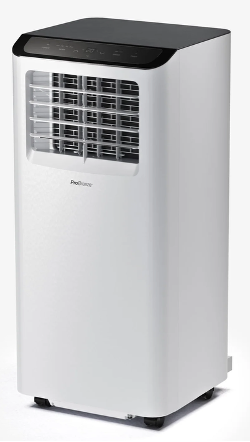
The Pro Breeze 9000 BTU 4-in-1 is the budget-conscious smart pick. A Which? Best Buy winner, it packs Wi-Fi, Alexa and Google Home integration, and covers rooms up to 22 m² — all at a price point noticeably below the Meaco and De’Longhi. The trade-off is noise, and it is a significant one.
| ⚠️ Noise warning: The Pro Breeze 9000 BTU runs at approximately 65 dB — noticeably louder than the Meaco (52–53 dB) and measurably louder than the De’Longhi (49–53 dB). Independent reviews describe it as comparable to a loud fridge on low speed. Sleep mode reduces fan speed over time but the compressor remains audible. If overnight noise sensitivity is a priority, the Meaco or Dreo are the better choices. |
| Specification | Detail |
| Cooling capacity | 9,000 BTU |
| Room size | Up to 22 m² |
| Noise level | ~65 dB — loudest on this list |
| Power consumption | ~900W |
| Running cost | ~22p/hr at 24p/kWh |
| Energy rating | A |
| Modes | Cool, dehumidify, fan, sleep |
| Smart control | Wi-Fi, Pro Breeze app, Alexa, Google Home, 24-hr timer |
| Award | Which? Best Buy — Air Conditioners |
| Warranty | 1 year |
Pros
- Which? Best Buy — independently verified performance
- Wi-Fi, Alexa and Google Home at a budget price point
- ~22p/hr — competitive running cost
- Cools rooms up to 22 m²
Cons
- ~65 dB — loudest unit on this list, not suitable for noise-sensitive overnight use
- ~900W draw — mid-range efficiency
- 1-year warranty only
- Rigid exhaust hose — placement can be awkward
| Verdict: Excellent value for smart features at a budget price. The right choice for daytime use in a living room or home office where background noise is not a problem. Not the right choice for light sleepers or overnight bedroom use — the noise level is a genuine limitation. |
5. Dreo AC515S — Quietest on the List
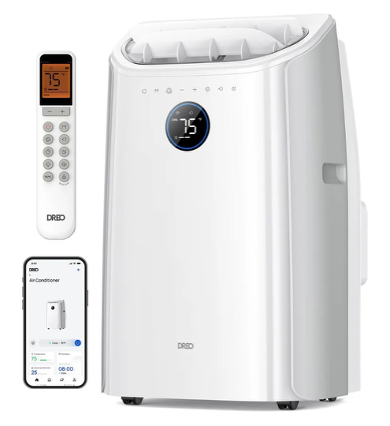
The Dreo AC515S is the quietest portable air conditioner on this list at 46 dB — a meaningful 6–7 dB quieter than the Meaco and roughly comparable to a quiet electric fan. It is also the only fully drainage-free unit here: its self-evaporating system recycles condensation through the exhaust in normal UK humidity conditions, so there is no tank to empty. Dreo is a newer UK entrant with fewer reviews than the established brands, but the spec sheet is genuinely strong.
| ⚠️ BTU rating note: The Dreo AC515S is listed at 10,000 BTU on Amazon UK. The same product is marketed at 12,000 BTU ASHRAE in the US — a different measurement standard that consistently overstates real-world performance. The UK 10,000 BTU figure is the relevant one. Do not compare the US ASHRAE figure against UK BTU ratings from other brands — they are not equivalent. |
| Specification | Detail |
| Cooling capacity | 10,000 BTU (UK listing — see note above) |
| Room size | Up to ~28 m² |
| Noise level | 46 dB — quietest on this list |
| Power consumption | 1,125W |
| Running cost | ~27p/hr at 24p/kWh |
| Energy rating | A |
| Modes | Cool, dehumidify, fan, sleep curve |
| Smart control | App, Alexa, Google Home, remote, 24-hr timer |
| Drainage | Self-evaporating — no tank in normal UK conditions |
| Warranty | 1 year |
Pros
- 46 dB — quietest portable AC on this list by a meaningful margin
- Drainage-free in normal UK conditions — no tank to empty
- Customisable sleep curve — unique feature for overnight comfort
- Smart controls: app, Alexa, Google Home
- 10,000 BTU — strong coverage up to ~28 m²
Cons
- ~27p/hr — highest running cost on this list
- 1,125W draw — the most power-hungry unit here
- 1-year warranty — shorter than Meaco and De’Longhi
- Newer UK brand — fewer verified UK reviews than rivals
| Verdict: The right choice if overnight noise is your deciding factor. At 46 dB it is genuinely quiet for a compressor-based portable unit, and the drainage-free system removes one of the most common daily irritants of portable AC ownership. The higher running cost is the trade-off you make for the larger compressor and quieter operation. |
Full Comparison Table
| Model | BTU | Noise | Cost/hr | Room size | Energy | Wi-Fi |
| Meaco MC Series | 9,000 | 52–53 dB | ~26p | 16–26 m² | A | ✅ |
| De’Longhi PACEX100 | 10,000 | 49–53 dB | ~17p ⭐ | 25–35 m² | A++ ⭐ | ❌ |
| Olimpia Compact 8P | 8,000 | 63 dB Lw* | ~18p | Up to 20 m² | A | ❌ |
| Pro Breeze 9000 | 9,000 | ~65 dB | ~22p | Up to 22 m² | A | ✅ |
| Dreo AC515S | 10,000 | 46 dB ⭐ | ~27p | Up to 28 m² | A | ✅ |
* Olimpia 63 dB is sound power (Lw); all other figures are sound pressure (Lp) at 1m. These are not directly comparable. ⭐ = best in category.
Running Cost Comparison at 24p/kWh
All figures at 24p/kWh (Ofgem unit rate). Actual costs vary with ambient temperature and how often the compressor cycles.
| Model | Wattage | Per hour | Per day (4 hrs) | 4 hrs/day × 60 days | 8 hrs/day × 30 days |
| Meaco MC Series | 1,080W | ~26p | ~£1.04 | ~£62 | ~£62 |
| De’Longhi PACEX100 | 700W | ~17p | ~68p | ~£41 | ~£41 |
| Olimpia Compact 8P | ~760W | ~18p | ~73p | ~£44 | ~£44 |
| Pro Breeze 9000 | ~900W | ~22p | ~86p | ~£53 | ~£53 |
| Dreo AC515S | 1,125W | ~27p | ~£1.08 | ~£65 | ~£65 |
Honest Limitations of Portable Air Conditioners
Portable air conditioners work, but they come with real trade-offs that fixed systems do not. Understanding these before you spend £300 or more saves disappointment:
- Single-hose inefficiency. Every single-hose unit partially undermines its own cooling by depressurising the room. The effect is manageable with good sealing, but real-world performance is lower than the BTU rating implies.
- Noise. Even the quietest portable AC (the Dreo at 46 dB) is audible in a quiet bedroom. Most units run at 52–65 dB. Light sleepers should use sleep mode from the start or choose the Dreo specifically.
- Exhaust hose. Every unit on this list requires a window for the exhaust hose — there is no workaround. Without external venting, the unit simply recirculates heat within the room. Evaporative coolers do not require venting but are not true air conditioners and are significantly less effective in humid UK conditions.
- Sash windows. Many older UK homes have sash windows that do not accommodate standard sliding window kits cleanly. The Meaco includes a flexible casement kit for this reason; universal seal strips sold separately also work.
- Weight. Most units weigh 22–31 kg. Moving them between floors requires effort. If you plan to share one unit across rooms, factor this in.
Quick Decision Guide
| Your situation | Recommended pick |
| Best overall — most UK homes | Meaco MeacoCool MC Series Buy Direct from Meaco |
| Lowest running costs / extended daily use | De’Longhi Pinguino PACEX100 |
| Small flat or bedroom up to 20 m² | Olimpia Splendid Dolceclima Compact 8P |
| Smart controls on a budget | Pro Breeze 9000 BTU 4-in-1 |
| Light sleeper / noise is the priority | Dreo AC515S |
Frequently Asked Questions
Do portable air conditioners actually work in the UK?
Yes — with realistic expectations. A portable air conditioner will meaningfully reduce room temperature during a UK heatwave, typically by 4–8 °C in a well-insulated, properly sealed room. They are significantly more effective than fans alone. They are less efficient than wall-mounted split systems, but for renters and those who cannot install fixed AC, they are the practical alternative.
Do I need a window to use a portable air conditioner?
Yes. Every compressor-based portable air conditioner requires external venting through a window or a hole in an external wall. Without it, the heat extracted from the room has nowhere to go and the room will not cool down. Products sold as “ventless portable AC” are evaporative coolers — a different, less effective technology, especially in humid UK summer conditions.
How much does a portable air conditioner cost to run?
At 24p/kWh: the De’Longhi PACEX100 (700W) costs ~17p/hr — the cheapest on this list. The Meaco MC Series (1,080W) costs ~26p/hr. The Dreo AC515S (1,125W) costs ~27p/hr. Run for 4 hours a day across a 60-day UK summer, the De’Longhi costs around £41; the Dreo around £65. Full figures are in the running cost table above.
Do portable air conditioners work with sash windows?
Yes, with the right kit. Sash windows do not accommodate standard sliding window panels cleanly, but flexible adhesive window kits create a workable seal around the exhaust hose. The Meaco MeacoCool MC Series includes both a sliding bracket and a flexible casement kit — the most versatile window kit arrangement of any unit on this list.
Which portable air conditioner is quietest?
The Dreo AC515S at 46 dB is the quietest on this list — approximately 6–7 dB quieter than the Meaco (52–53 dB) and measurably quieter than the Pro Breeze (~65 dB). For context, 46 dB is comparable to a quiet office; 65 dB is comparable to a normal conversation. If overnight noise is your main concern, the Dreo is the correct choice.
What is the difference between a portable air conditioner and an evaporative cooler?
A portable air conditioner uses a compressor and refrigerant to extract heat from the room and expel it outside via an exhaust hose — it reduces both temperature and humidity. An evaporative cooler blows air over a wet pad to produce a cooling effect — no external venting required, but it adds humidity to the air and is significantly less effective in humid UK summer conditions. The five products on this page are all true portable air conditioners.
Can I use a portable air conditioner in a room without a window?
No. A portable air conditioner must vent hot exhaust air outside. Without a window or external vent, the unit will pump hot air back into the room and may actually increase room temperature. A windowless room requires a through-wall installation kit or a different cooling solution entirely.

7 Comments