
Best Dehumidifier for Bedroom UK (2026): Quiet, Safe, and Effective
Last updated: 6 June 2026
| Affiliate DisclosureThis page contains affiliate links. If you buy through these links, we may earn a small commission at no extra cost to you. See our Affiliate Disclaimer for more information. |
🥇 Best overall: Meaco MeacoDry Abc 12L
🥈 Best budget: Pro Breeze 12L
🥉 For larger bedrooms: Meaco 20L Low Energy
❄️ For cold spare rooms: Meaco DD8L Junior
| ✅ Key Takeaways The best dehumidifier for bedroom UK needs a noise level below 40 dB on its lowest setting — light sleepers should target 36–38 dB or lower. The Meaco MeacoDry Abc 12L runs at 36–40 dB (Quiet Mark accredited), draws 160W, and costs around 4p/hour at 24p/kWh — ideal for heated UK bedrooms. The Pro Breeze 12L runs at ≤38 dB, draws ~200W, and holds a Which? Best Buy award (2025) — the top budget choice for bedroom use. The Meaco 20L Low Energy draws 219W and runs at 44–46 dB — efficient for larger bedrooms but audible; set to 50–55% RH and let the humidistat manage it. Any unheated spare room dropping below 15°C needs a desiccant model: the Meaco DD8L Junior works down to 1°C at 39 dB and costs 8p/hour on low speed. Set your target humidity to 50–55% RH — this inhibits mould growth and dust mite activity while remaining comfortable for overnight breathing. According to Asthma + Lung UK, damp indoor air is a leading trigger of asthma and allergic respiratory disease. |
The best dehumidifier for bedroom UK buyers actually need is one that solves a specific problem: the bedroom is the most humid room in most UK homes, and almost nobody wants a noisy machine running next to them while they sleep. A sleeping person produces around one litre of moisture overnight through breathing and perspiration alone — add a partner and that is two litres being released into a closed room every single night. In winter, with windows shut and cold external walls, that moisture has nowhere to go except onto your glass, walls, and window frames.
Bedrooms are where condensation and mould problems most commonly take hold in UK homes — and where the consequences are most serious, since we spend roughly a third of our lives in them. Choosing the right dehumidifier and running it consistently is one of the most effective preventive steps available.
Why Bedrooms Need a Different Approach
A dehumidifier for a bedroom has different priorities to one for a kitchen, cellar, or utility room. In those spaces, extraction capacity and speed matter most. In a bedroom, the priorities shift:
- Noise — the unit will be running while you sleep. Anything above 40 dB on its lowest setting will be noticeable in a quiet bedroom at night. The best bedroom dehumidifiers run at 36–38 dB or lower on their quiet or night mode.
- Auto-humidistat — a unit that switches off once the target humidity is reached is far more practical overnight than one that runs continuously. It also saves energy and means the unit is not creating unnecessary noise once the air is already dry enough.
- Tank size vs continuous drainage — a bedroom unit running overnight will fill its tank faster than you might expect, particularly in winter. Either choose a model with a reasonably large tank (2L+) or one with a continuous drainage outlet so it can run unattended.
- Right-sizing — most UK bedrooms are between 10 m² and 20 m². An oversized unit runs at unnecessarily high speed (and noise) to maintain the target humidity. A correctly sized 12L/day refrigerant model is almost always sufficient.
- Temperature of the room — a heated master bedroom at 18–20°C overnight is fine for a standard refrigerant dehumidifier. An unheated spare room or box room that drops below 15°C in winter needs a desiccant model — refrigerant units perform poorly and inefficiently in the cold.
🥇 Meaco MeacoDry Abc 12L — Best Overall Bedroom Dehumidifier
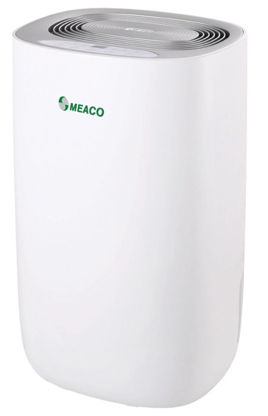
The Meaco MeacoDry Abc 12L is our top pick for UK bedrooms and has been consistently one of the best-reviewed dehumidifiers on the market. It holds Quiet Mark accreditation — an independent, evidence-based certification confirming genuinely low noise — and its auto-humidistat manages overnight operation without you needing to touch it. At 12L/day extraction it is perfectly matched to a standard UK bedroom.
| Specification | Detail |
| Extraction | 12L/day (at 30°C, 80% RH) |
| Tank capacity | 2.6L |
| Noise | 36–40 dB — Quiet Mark accredited |
| Power | ~160W |
| Running cost | ~4p/hour at 24p/kWh |
| Auto-humidistat | Yes — switches off when target RH reached |
| Laundry mode | Yes — runs at full speed for 6 hours |
| Cont. drainage | Yes — garden hose connector included |
| Min. temp | ~15°C — suited to heated bedrooms |
| Warranty | 3 years (2-year standard + 1-year free extension) |
| Pros | Cons |
| Quiet Mark accredited — 36–40 dB independently verified, not just a marketing claim Auto-humidistat shuts off when target is reached — genuinely set-and-forget overnight Compact and lightweight at ~10.4 kg — easy to move between rooms~160W power draw — one of the most efficient 12L refrigerant models available 2.6L tank — larger than most budget 12L competitors Continuous drainage means it can run indefinitely on heavily damp nights 3-year warranty offers excellent peace of mind | Not suitable for unheated rooms below 15°C — use a desiccant model for cold spare rooms 2.6L tank still needs daily emptying in very humid conditions without drainage No app control or Wi-Fi — physical controls only Higher upfront cost than the Pro Breeze 12L |
| 🟦 Verdict: Meaco MeacoDry Abc 12L For a heated master bedroom, double bedroom, or standard UK single bedroom, the Meaco MeacoDry Abc 12L is the clear first choice. It does exactly what a bedroom dehumidifier needs to do — quietly at 36–40 dB, efficiently at ~160W, and without interrupting sleep. The 3-year warranty and genuine Quiet Mark certification set it apart from cheaper alternatives. |
🥈 Pro Breeze 12L — Best Budget Bedroom Pick
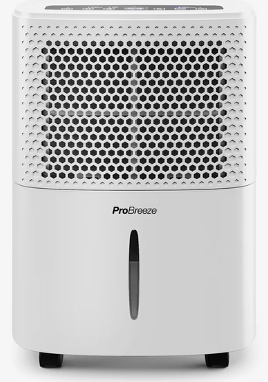
If the Meaco sits above your budget, the Pro Breeze 12L delivers reliable bedroom dehumidification at a meaningfully lower price. It earned the Which? Best Buy award in 2025, runs at ≤38 dB on its lowest setting, and its auto-humidistat manages overnight operation effectively. A slightly smaller 1.8L tank and higher 200W power draw are the honest trade-offs versus the Meaco.
| Specification | Detail |
| Extraction | 12L/day (at 30°C, 80% RH) |
| Tank capacity | 1.8L |
| Noise | ≤38 dB |
| Power | ~200W |
| Running cost | ~5p/hour at 24p/kWh |
| Auto-humidistat | Yes |
| Laundry mode | Yes |
| Cont. drainage | Yes — drainage hose included |
| Min. temp | ~15°C |
| Awards | Which? Best Buy Dehumidifier 2025 |
| Warranty | 2 years |
| Pros | Cons |
| Which? Best Buy 2025 — independently reviewed and rated outstanding value ≤38 dB noise — quiet enough for bedroom overnight use Same 12L/day extraction as the Meaco — right-sized for standard UK bedrooms Auto-humidistat manages overnight operation without intervention Continuous drainage included as standard Lower upfront cost than the Meaco Abc 12L | 1.8L tank is smaller than the Meaco 2.6L — more frequent emptying without drainage ~200W vs 160W — slightly higher running costs over a full winter season No Quiet Mark accreditation 2-year warranty vs 3-year on the Meaco |
🟦 Verdict: Pro Breeze 12LThe Pro Breeze 12L is the right choice if budget is the primary constraint. The Which? Best Buy award is a meaningful endorsement, and ≤38 dB is quiet enough for most sleepers. If you are a particularly light sleeper, or the dehumidifier will run in a child’s bedroom, invest in the Meaco MeacoDry Abc 12L instead. |
For Larger Bedrooms: Meaco 20L Low Energy
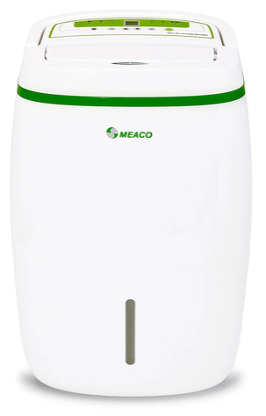
If your bedroom is on the larger side — above 25 m², or a master bedroom with an en-suite adding to the moisture load — the Meaco 20L Low Energy is the step-up worth considering. At 219W maximum it is one of the most energy-efficient 20L refrigerant dehumidifiers available. Its 6L tank means far less frequent emptying than a 12L model, and the auto-humidistat prevents unnecessary running. The trade-off is noise: it runs at 44–46 dB, which is audible in a quiet bedroom but tolerable once it cycles down to fan-only mode.
| Specification | Detail |
| Extraction | 20L/day (at 30°C, 80% RH) |
| Tank capacity | 6L |
| Noise | 44–46 dB |
| Power | 219W maximum |
| Running cost | ~5p/hour at 24p/kWh |
| Auto-humidistat | Yes — cycles to fan-only mode at target RH |
| Cont. drainage | Yes |
| HEPA filter | Included — 2-in-1 dehumidifier/air purifier |
| Min. temp | ~15°C |
| Warranty | 3 years |
| Pros | Cons |
| Outstanding energy efficiency at 219W for a 20L refrigerant model 6L tank needs far less frequent emptying than a 12L model Auto-humidistat prevents over-drying and reduces noise by stopping when target is reached HEPA filter included — doubles as an air purifier in summer 3-year warranty Suited to larger master bedrooms, en-suite bedrooms, or persistent heavy damp | 44–46 dB — noticeably louder than the 12L models; overkill noise-wise for a standard bedroom Bulkier than the 12L models — takes up more floor space Overkill for a standard-sized heated bedroom — the 12L is sufficient for most |
🟦 Verdict: Meaco 20L Low EnergyThe Meaco 20L Low Energy earns its place for larger bedrooms above 25 m² or rooms with persistent heavy moisture loads. It is not the quietest option at 44–46 dB, but once the auto-humidistat kicks in and the unit drops to fan-only mode, the noise reduces significantly. For a standard UK bedroom, stick with the 12L. |
⚠️ Cold Room Warning: Compressor Models Lose Effectiveness Below 15°CIf your spare bedroom, box room, or guest room drops below 15°C in winter — which is common in UK homes with unheated rooms — a standard refrigerant dehumidifier will perform poorly. Compressor efficiency falls sharply in the cold, and frost build-up on the coils causes the unit to spend most of its time in defrost mode rather than extracting moisture. For these rooms, a desiccant model is the only right choice. |
❄️ For Cold Spare Bedrooms: Meaco DD8L Junior
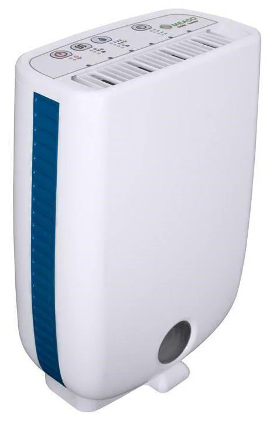
The Meaco DD8L Junior is our recommended desiccant model for cold spare bedrooms. It operates effectively down to around 1°C, is compact for a desiccant unit, and runs at 39 dB on its lowest setting — quiet enough for use in an occupied room. It does produce slightly warmer air than a refrigerant model, since desiccants use a heated rotor. In a cold spare room in winter, this is actually a mild comfort benefit.
| Specification | Detail |
| Extraction | 8L/day (equivalent to a 16–20L compressor in real-world UK conditions) |
| Tank capacity | 2L |
| Noise | 39 dB (low speed); 43 dB (medium); 48 dB (high) |
| Power | 330W (medium speed) |
| Running cost | ~8p/hour at 24p/kWh (fan speed 1) |
| Type | Desiccant — unaffected by low temperatures, no frost build-up |
| Min. temp | ~1°C — reliable in unheated rooms year-round |
| Auto-humidistat | Yes |
| Cont. drainage | Yes |
| Ioniser | No — DD8L Junior does not have an ioniser (unlike the DD8L) |
| Warranty | 3 years |
| Pros | Cons |
| Works reliably in cold unheated rooms where refrigerant models fail 39 dB on low speed — quiet enough for an occupied spare room Compact and light at ~6.4 kg for a desiccant unit Produces slightly warm air — a mild comfort benefit in a cold room in winter No ioniser — safe for nurseries and allergy sufferers 3-year warranty | Higher energy use than a refrigerant model in a warm room — not efficient in heated bedrooms 2L tank is small — drainage recommended for unattended operation Lower raw extraction figure (8L/day) than the refrigerant models above, though comparable in real cold-room conditions |
🟦 Verdict: Meaco DD8L JuniorIf your spare bedroom or box room drops below 15°C in winter, the Meaco DD8L Junior is the only model on this page that will actually perform reliably. Do not be misled by the lower extraction figure — 8L/day from a desiccant in a cold room consistently outperforms a 20L refrigerant struggling in the cold. |
Quick Comparison: Best Dehumidifiers for Bedrooms UK
| Feature | Meaco Abc 12L | Pro Breeze 12L | Meaco 20L Low Energy | Meaco DD8L Junior |
| Type | Refrigerant | Refrigerant | Refrigerant | Desiccant |
| Extraction | 12L/day | 12L/day | 20L/day | 8L/day |
| Best for | Most UK bedrooms | Budget pick | Large bedrooms | Cold spare rooms |
| Noise | 36–40 dB (Quiet Mark) | ≤38 dB | 44–46 dB | 39 dB (low speed) |
| Tank | 2.6L | 1.8L | 6L | 2L |
| Power | ~160W | ~200W | 219W | 330W (medium) |
| Min. temp | ~15°C | ~15°C | ~15°C | ~1°C |
| Auto-humidistat | Yes | Yes | Yes | Yes |
| Cont. drainage | Yes | Yes | Yes | Yes |
| Warranty | 3 years | 2 years | 3 years | 3 years |
| Buy | Abc 12L → | Pro Breeze → | 20L Low Energy → | DD8L Junior → |
How to Use a Dehumidifier Effectively in a Bedroom
1. Set the target humidity to 50–55%
This is the sweet spot for UK bedrooms — low enough to inhibit mould growth and reduce dust mite populations, but not so dry that it causes discomfort or dry throat overnight. Below 40% is too dry for comfortable overnight breathing. Most auto-humidistats on the models above allow you to set this precisely.
2. Position it away from the bed and wall
Place the dehumidifier at least one metre from the bed and at least 30 cm from any wall or furniture. It needs clear airflow on all sides to draw in and expel air effectively. Avoid positioning it in a corner or behind a door — restricted airflow makes the unit work harder, run louder, and extract less moisture per hour.
3. Run it overnight consistently, not occasionally
One night of dehumidification in a persistently damp bedroom makes minimal difference. The benefit accumulates over weeks of consistent overnight operation — moisture in walls, fabric, and soft furnishings gradually reduces, mould risk decreases, and the auto-humidistat means the unit eventually runs for shorter periods as the room reaches equilibrium.
4. Keep the bedroom door closed while it runs
A dehumidifier works most efficiently on a closed volume of air. Running it with the door open means it is drawing moisture from the rest of the house rather than focusing on the bedroom. Close the door overnight and let it work on the room it is in.
5. Empty or drain consistently
A full tank stops the unit working — the most common reason people find their dehumidifier not working is a full tank triggering the auto-shutoff. Check the tank each morning, or set up continuous drainage via the drain outlet on the Meaco MeacoDry Abc 12L, Meaco 20L Low Energy, or Pro Breeze 12L if you want it to run unattended for extended periods.
6. Aim for a winter running schedule
UK bedrooms are at their most humid between October and March when windows stay closed overnight and cold external walls cause condensation. Running your dehumidifier from late September through to April covers the full risk window. In summer you can scale back unless you notice condensation or humidity above 60% on warm, humid nights.
What Size Dehumidifier Do I Need for My Bedroom?
Choosing the right extraction capacity avoids the two most common mistakes: undersizing (the unit runs continuously and never reaches the target humidity) and oversizing (higher noise, cost, and bulk than the room needs).
| Bedroom size | Typical room | Recommended model | Reason |
| Up to 15 m² | Small single or box room | Meaco MeacoDry Abc 12L | Perfectly sized; quietest option |
| 15–20 m² | Standard double bedroom | Meaco MeacoDry Abc 12L or Pro Breeze 12L | 12L/day handles this moisture load comfortably |
| 20–30 m² | Large master bedroom | Meaco 20L Low Energy | Greater extraction for larger air volume |
| Any size, unheated | Cold spare room / box room | Meaco DD8L Junior | Only desiccant works reliably below 15°C |
Frequently Asked Questions
Is it safe to run a dehumidifier in a bedroom overnight?
Yes — modern dehumidifiers are designed for extended continuous use and are safe to run overnight. All four models recommended on this page have auto-shutoff when the tank is full, preventing overflow. They produce no harmful gases or by-products. The auto-humidistat on each model means they switch off once the target humidity is reached rather than running continuously all night.
What is the best dehumidifier for a bedroom in the UK?
For a standard heated UK bedroom, the Meaco MeacoDry Abc 12L is our top recommendation. Its Quiet Mark accreditation confirms genuinely low noise at 36–40 dB, its auto-humidistat manages overnight operation without intervention, and 12L/day is well-matched to the moisture load of a typical UK bedroom. For a cold, unheated spare room, switch to the Meaco DD8L Junior desiccant model.
How loud is a dehumidifier in a bedroom?
It depends heavily on the model. The Meaco MeacoDry Abc 12L runs at 36–40 dB and holds Quiet Mark accreditation — most users describe it as a low, unobtrusive background hum. The Pro Breeze 12L runs at ≤38 dB and is also quiet enough for most sleepers. The Meaco 20L Low Energy runs at 44–46 dB — audible but manageable once the humidistat cycles down. As a general rule, look for models rated below 40 dB on their lowest setting for bedroom use.
How much does it cost to run a bedroom dehumidifier overnight?
Based on the Ofgem unit rate of 24p/kWh: the Meaco Abc 12L at 160W costs around 4p/hour, or roughly 32p for an 8-hour night. The Pro Breeze 12L at ~200W costs around 5p/hour, or 40p per night. With auto-humidistat operation, real-world costs are lower because the unit runs only until target humidity is reached, then cycles on briefly to check conditions rather than running continuously.
How much water should a bedroom dehumidifier collect overnight?
This varies considerably depending on room humidity, the number of occupants, and the time of year. In a typical UK winter, a bedroom dehumidifier running overnight might collect 0.5–1.5 litres from a standard double bedroom. In very humid conditions — a damp older property, significant condensation problems — it may collect more. If the tank is consistently full in the morning, set up continuous drainage.
Should I run a dehumidifier in the bedroom in summer?
Potentially, yes — particularly during UK heatwaves when humidity rises and windows are kept closed to manage heat. Running the Meaco MeacoDry Abc 12L at a target of 50–55% in summer reduces the sticky, heavy feeling of humid air and makes sleeping considerably more comfortable, even if the air temperature itself does not change. See our guide on whether a dehumidifier makes your home cooler for the full explanation.
Can a dehumidifier help with mould in a bedroom?
Yes — by maintaining relative humidity below 55–60%, a dehumidifier removes the conditions mould needs to grow. It will not kill existing mould — established growth needs to be cleaned and treated separately — but it reliably prevents new growth in a room consistently kept below the 60% threshold. In bedrooms where mould has appeared on window frames, in corners, or behind furniture, running a dehumidifier consistently throughout winter is the single most effective preventive step available.
What is the difference between the Meaco DD8L and the DD8L Junior?
The main difference is that the DD8L includes an ioniser and antibacterial filter, while the DD8L Junior does not. Both have identical extraction rates and desiccant performance. For a bedroom, the DD8L Junior is actually preferable — its lack of ioniser means no ozone output, making it a straightforwardly safe choice for any sleeping environment.
Do I need a dehumidifier in every bedroom?
Not necessarily. A single unit — such as the Meaco MeacoDry Abc 12L — can be moved between rooms on a rotation if damp is not severe. For persistent mould or condensation in a specific bedroom, a dedicated unit running overnight in that room will be far more effective than a single unit shared across multiple rooms.
The Verdict
For most UK bedrooms, the Meaco MeacoDry Abc 12L is the clear recommendation — 36–40 dB Quiet Mark certified noise, 160W power draw at around 4p/hour, and 12L/day extraction that is perfectly matched to a standard bedroom. The 3-year warranty and 2.6L tank are meaningful advantages over cheaper 12L alternatives.
For budget-conscious buyers, the Pro Breeze 12L delivers the same core functionality at a lower upfront cost. The Which? Best Buy 2025 award is a genuine endorsement, and ≤38 dB is quiet enough for most sleepers. The trade-offs — a smaller 1.8L tank and slightly higher ~200W power draw — are honest and manageable.
For a larger master bedroom above 25 m² or a room with persistent heavy moisture, step up to the Meaco 20L Low Energy. It is audible at 44–46 dB but runs at just 219W, and its 6L tank and HEPA filter make it a capable year-round tool.
And for any unheated spare room or cold box room that drops below 15°C in winter, the Meaco DD8L Junior is the only model on this list that will actually perform reliably in those conditions. Do not attempt to run a refrigerant model in a cold room and wonder why it is not working — physics, not the machine, is the problem.
Related Reading
For more on managing humidity and air quality in your home, see our guides on what humidity level is too high in a house UK, desiccant vs compressor dehumidifiers, best dehumidifier for a small flat UK, best whole house dehumidifier UK, and does a dehumidifier make your home cooler UK.
| About This ArticleWritten by the editorial team at UK Air Quality, a specialist site covering dehumidifiers, air purifiers, and home climate products for UK buyers. All product specs are verified against manufacturer data and independent test sources before publication.External sources: Asthma + Lung UK — damp air and respiratory health | Energy Saving Trust — home moisture and ventilation | Quiet Mark accreditation scheme |

19 Comments