
Best Dehumidifier for a Cellar UK (2026)
Last updated: 13 September 2026
This page contains affiliate links. If you buy through these links, we may earn a small commission at no extra cost to you. See our Affiliate Disclaimer for more information.
Best dehumidifier for a cellar — choosing the right one matters more here than almost anywhere else in the home. Cellars are cold, poorly ventilated, and often unheated, and most consumer dehumidifiers are compressor models designed for warm rooms: they perform poorly — or stop extracting entirely — when temperatures drop below 15°C. This guide explains exactly why desiccant dehumidifiers are the right choice for cold UK cellars, recommends the best models for different situations, and tells you what to look for before you buy.
Quick Picks: Best Dehumidifiers for Cellars
| Pick | Product | Best For | Running Cost/hr |
| Best for most cellars | Meaco DD8L Junior | Cold/unheated cellars — works from 1°C | ~9p |
| Best for large/warm cellars | Meaco 20L Low Energy | Heated cellars above 10°C, high capacity | ~5p |
| Budget / warm cellar only | Pro Breeze 12L | Mild damp, consistently warm (>15°C) | ~6p |
| Compact / warm cellar only | Meaco MeacoDry Abc 12L | Small warm cellar, minor damp | ~4p |
Running Costs at 24p/kWh
All figures based on the Ofgem rate of 26.11p/kWh (Q3 2026). Cellar dehumidifiers often run continuously for the first few days — the continuous-run column reflects that scenario.
| Product | Wattage | Cost/hr | 4 hrs/day × 30 days | 8 hrs/day × 30 days | Continuous (24 hrs × 30 days) |
| Meaco DD8L Junior | 330W (auto) | ~9p | ~£10 | ~£21 | ~£62 |
| Meaco 20L Low Energy | 205W | ~5p | ~£6 | ~£13 | ~£38 |
| Pro Breeze 12L | 220W | ~6p | ~£7 | ~£14 | ~£41 |
| Meaco MeacoDry Abc 12L | 165W | ~4p | ~£5 | ~£10 | ~£31 |
⚠️ The Meaco DD8L Junior draws more power (330W on auto) than the compressor models because it is a desiccant unit. However, it is the only model on this list that delivers its full rated capacity in a cold cellar. The compressor models’ lower wattage figures are largely irrelevant if the cellar is cold — they simply will not extract moisture effectively. Running cost comparisons are only meaningful if both units are actually working.
Why Your Cellar Needs a Desiccant Dehumidifier
The single most important thing to understand about cellars is that they are cold. Even in summer, an unheated cellar in a typical UK home will sit well below 15°C for much of the year — and in winter it can be closer to 5°C or 8°C.
This matters enormously when choosing a dehumidifier, because there are two fundamentally different types:
Compressor (Refrigerant) Dehumidifiers
These work by drawing air over a cold coil — like a miniature fridge — causing moisture to condense. They are the most common type sold in the UK and they work well in warm living spaces. But their performance drops sharply as temperatures fall. A compressor unit rated at 10 litres per day at 30°C may extract as little as 3 litres at 21°C — and at cellar temperatures it can fall so low as to be almost useless. Below around 5°C, the coils ice over and the machine switches into defrost mode rather than extracting moisture.
Desiccant Dehumidifiers
Desiccant models work entirely differently. They pass air over a rotating absorbent wheel (similar to silica gel) that physically soaks up moisture. Temperature has almost no effect on this process. A desiccant dehumidifier will extract its full rated capacity whether the room is 5°C or 25°C, making it the right choice for any cold, unheated space — including cellars, garages, conservatories, and boats.
Desiccant units also emit slightly warmer air as a by-product of the process — a welcome bonus in a cold cellar. The trade-off is that they typically use a little more electricity than compressor models in warm conditions, but since your cellar is not warm, this is not a meaningful disadvantage.
| 💧 The Simple RuleIf your cellar temperature falls below 15°C at any point during the year, choose a desiccant dehumidifier. For most UK cellars, that means choosing desiccant — full stop. |
Why Cellars Get Damp: Understanding the Problem
Before picking a dehumidifier, it helps to understand what is causing the damp. UK cellars face several distinct sources of moisture:
- Condensation: Cold underground walls cause warm, humid air to shed moisture on contact — the same effect as a cold glass of water sweating on a warm day. This is the most common cause in UK cellars.
- Penetrating damp: Water from saturated soil around the foundations working through brickwork or cracks. More common in older properties without a damp-proof course.
- Rising damp: Groundwater drawn upward through masonry by capillary action. Identifiable by a tide mark on walls, often with a salty crust.
- Poor ventilation: Cellars are often sealed spaces with little or no airflow, allowing moisture-laden air to become trapped and humidity to climb.
Important: A dehumidifier is very effective at managing condensation and humidity, but it cannot fix structural damp from rising or penetrating moisture. If you have water actively seeping through your cellar walls, you need a damp-proofing specialist first. A dehumidifier will help maintain the improved conditions afterwards.
Best for Most Cellars: Meaco DD8L Junior
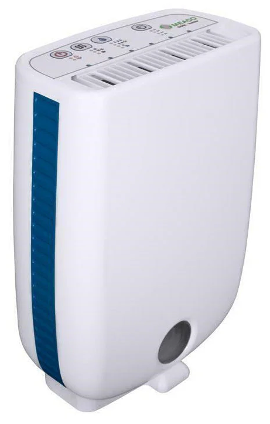
The Meaco DD8L Junior is our top recommendation for the majority of UK cellars. It is a desiccant dehumidifier that works effectively regardless of temperature, is compact enough to fit in tight spaces, and is quiet enough not to be intrusive — even if your cellar is beneath a living room.
| Specification | Detail |
| Type | Desiccant — works from 1°C, no temperature limitation |
| Extraction rate | 8 litres per day (consistent at all temperatures) |
| Water tank | 2 litres (continuous drainage strongly recommended for cellars) |
| Power consumption | 330W on auto/speed 1 (8p/hr at 24p/kWh) — 650W on high/laundry mode only |
| Noise level | 39 dB on low — very quiet |
| Weight | 6 kg — lightweight and easy to carry |
| Humidistat | Yes — 4 preset levels plus Meaco Control Logic auto-cycling |
| Continuous drain | Yes — gravity drain via hose (8 mm internal / 11 mm external diameter) |
| Hose supplied? | No — drainage hose must be purchased separately (standard garden hose fits) |
| Warranty | 3 years (free, registered with Meaco) |
| NOTE ON WATTAGE: The DD8L Junior has three speed settings: 30W (speed 1 standby fan), 330W (normal/auto operation), and 650W (high/laundry mode only). The 650W figure that appeared in the original article is the laundry mode maximum — not what the unit draws in normal cellar use. Auto mode at 330W = ~8p/hr at 24p/kWh. |
Why It Works So Well in Cellars
Most cellars in the UK are consistently cold — often well below the 15°C threshold at which compressor dehumidifiers start to struggle. The Meaco DD8L Junior‘s desiccant technology means it extracts moisture just as efficiently in a 6°C cellar as it does in a heated room. You set the target humidity, and the intelligent Meaco Control Logic checks conditions every 30 minutes and only runs the machine when needed — keeping energy use low.
The continuous drain option is particularly useful for cellars, where you may not want to be regularly descending to empty a small tank. Simply run a gravity drain hose to the nearest drain or sump, and the Meaco DD8L Junior can be left to run unattended for weeks at a time.
Pros and Cons
| ✅ Pros | ❌ Cons |
| Works at any temperature — even freezingConsistent 8L/day extractionVery quiet at 39dBLightweight (6kg) and easy to moveContinuous drain — no tank-emptying needed3-year free warrantyMeaco Control Logic saves energy | Small 2L tank fills quickly in a very damp cellarSlightly higher wattage than compressor in warm conditions (less relevant in a cold cellar)No HEPA filter (Junior model — standard dust filter only) |
| ⭐ Our VerdictThe Meaco DD8L Junior is the best dehumidifier for most UK cellars. It is the only model on this list guaranteed to work properly year-round in a cold, unheated space — and that matters more than any other specification. |
Best for Larger or Warmer Cellars: Meaco 20L Low Energy
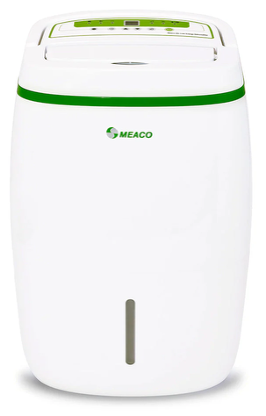
If your cellar is larger (over 20 m²), connects to adjacent damp spaces, or stays above 10°C year-round — perhaps because it is beneath a heated ground floor or has its own heating — the Meaco 20L Low Energy is worth considering. It is a compressor dehumidifier, so the temperature limitation is real: below 10°C it loses effectiveness, and below 5°C the coils will ice over. In a consistently cold UK cellar, the DD8L Junior remains the safer default. But for the right conditions — heated basement, utility room, or cellar used as a laundry space — the 20L Low Energy is excellent.
| Specification | Detail |
| Type | Compressor — suitable only if cellar stays above 10°C |
| Extraction rate | Up to 20 litres per day (at rated conditions: 30°C / 80% RH) |
| Real-world rate | Expect 8–12 litres/day in a cellar at 15–18°C |
| Water tank | 6 litres — less frequent emptying than smaller models |
| Power consumption | 205W (~5p/hr at 24p/kWh) |
| Energy rating | A++ — among the most efficient compressor units available |
| HEPA filter | Yes — useful if cellar doubles as utility or storage space |
| Continuous drain | Yes — gravity drain included |
| Humidistat | Yes — variable, with auto-restart after power cut |
| Warranty | 3 years (free) |
| ✅ Pros | ❌ Cons |
| 20L/day capacity — highest extraction on this list | Compressor — performance drops sharply below 10°C |
| 205W / ~5p/hr — very cheap to run when conditions suit it | Not suitable for consistently cold cellars |
| A++ energy rating | Bulkier and heavier than the DD8L Junior |
| 6L tank — longer intervals between emptying | Higher upfront cost than budget alternatives |
| HEPA filter for improved air quality | |
| Continuous drain included |
| 🔵 Verdict: The Meaco 20L Low Energy is outstanding for the right conditions — a heated basement, utility cellar, or any space that stays reliably above 10°C. Its A++ efficiency and 20L/day capacity make it one of the best compressor dehumidifiers available. But if there is any doubt about your cellar temperature dropping, choose the DD8L Junior instead. |
Budget Pick (Warm Cellars Only): Pro Breeze 12L
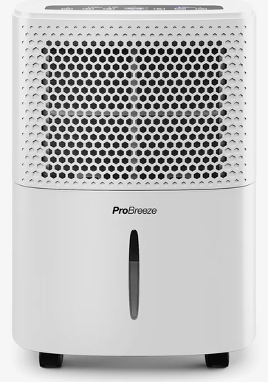
The Pro Breeze 12L is the most affordable compressor dehumidifier on this list and works well for smaller warm spaces. If your cellar is genuinely heated — connected to the central heating zone or consistently above 15°C — and the damp is mild rather than severe, it is a reasonable budget entry point. The caveat is the same as every compressor unit: take it below 15°C and performance falls off quickly; below 10°C it is largely ineffective.
| Specification | Detail |
| Type | Compressor — suitable only if cellar stays above 15°C |
| Extraction rate | Up to 12 litres per day (at rated conditions) |
| Water tank | 2 litres — requires frequent emptying in damp conditions |
| Power consumption | ~220W (~5p/hr at 24p/kWh) |
| Continuous drain | Yes — gravity drain option |
| Humidistat | Yes |
| Warranty | 2 years |
| ✅ Pros | ❌ Cons |
| Lowest upfront cost on this list | Compressor — ineffective below 10–15°C |
| Compact and easy to position | Small 2L tank requires frequent emptying |
| Continuous drain option available | Lower extraction capacity than Meaco 20L |
| Adequate for mild damp in warm spaces | Not suitable for cold or unheated cellars |
Compact Budget Option: Meaco MeacoDry Abc 12L
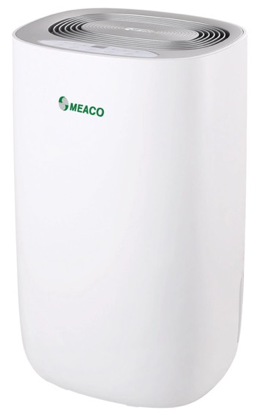
The Meaco MeacoDry Abc 12L is Meaco’s compact compressor entry, and at 165W it is the cheapest to run on this list in suitable conditions. It is well-suited to a small heated cellar or utility room with minor condensation — somewhere that stays reliably above 15°C and does not have a serious ongoing damp problem. Like the Pro Breeze, it is a compressor unit and will not perform in a cold cellar.
| Specification | Detail |
| Type | Compressor — suitable only if cellar stays above 15°C |
| Extraction rate | Up to 12 litres per day (at rated conditions) |
| Water tank | 2.5 litres |
| Power consumption | ~165W (~4p/hr at 24p/kWh) — lowest running cost on this list |
| Continuous drain | Yes |
| Humidistat | Yes |
| Award | Which? Best Buy |
| Warranty | 3 years (free) |
| ✅ Pros | ❌ Cons |
| ~4p/hr — cheapest to run when conditions suit it | Compressor — performance drops sharply below 15°C |
| Compact footprint — fits tight spaces | Not suitable for cold or unheated cellars |
| Meaco 3-year warranty | Lower capacity than Meaco 20L for larger spaces |
| Which? Best Buy |
Full Comparison: Best Dehumidifiers for Cellars UK
| Product | Type | Capacity | Min Temp | Running Cost/hr |
| Meaco DD8L Junior | Desiccant | 8L/day | 1°C | ~8p |
| Meaco 20L Low Energy | Compressor | 20L/day | 10°C | ~5p |
| Pro Breeze 12L | Compressor | 12L/day | 15°C | ~5p |
| Meaco MeacoDry Abc 12L | Compressor | 12L/day | 15°C | ~4p |
What Capacity Do You Need for a Cellar?
Dehumidifier capacity (measured in litres extracted per day) is often overstated in marketing, because manufacturers test at warm temperatures that bear no resemblance to a real cellar. Here is a practical guide:
| Cellar Size | Damp Level | Recommended Model |
| Small (up to 15m²) | Mild to moderate | Meaco DD8L Junior |
| Medium (15–30m²) | Moderate to heavy | Meaco DD8L Junior or two units |
| Large (30m²+) | Severe or commercial | Meaco 20L Low Energy (if above 10°C) |
What to Look For in a Cellar Dehumidifier
1. Desiccant Technology
As detailed above, desiccant is the right technology for cold cellars. Do not be swayed by a high litre-per-day rating on a compressor model — those numbers are measured in warm conditions and will not be replicated in your cellar.
2. Continuous Drain Option
A cellar with significant damp will fill a small tank very quickly — sometimes within a day or two. A continuous drain option (gravity hose) allows you to connect the machine to a nearby drain or sump pit so it can run without supervision. This is near-essential for cellar use.
3. Humidistat Control
A built-in humidistat lets you set a target relative humidity (around 50–55% is ideal for storage spaces) and the machine will only run when needed. This prevents both over-drying (which can damage stored items) and energy waste.
4. Auto-Defrost
Less critical for desiccant models (which do not use coils and therefore do not ice up), but essential if you opt for a compressor unit in a borderline-cool space. Without auto-defrost, a compressor machine in cool conditions will ice over and stop working.
5. Tank Size vs. Continuous Drain
If you cannot route a drain hose, choose a model with the largest tank you can find. A 2-litre tank can fill within a day in a severe damp cellar. A 6-litre tank (as on the Meaco 20L Low Energy) buys you more time between emptying sessions. But for most cellar installations, a gravity drain hose is the cleanest solution.
What Humidity Level Should a Cellar Be?
For a cellar used for general storage, aim to keep relative humidity between 50% and 60%. Above 60% and mould spores will begin to multiply; above 70–80% and you will see active mould growth and structural damage over time. Below 40% is unnecessarily dry and can cause wooden items to crack or warp.
A digital hygrometer (a simple, inexpensive device available for a few pounds) is well worth placing in your cellar so you can monitor conditions and see whether your dehumidifier is maintaining the right level. Set your dehumidifier humidistat to 50–55% and check the actual readings after a week or two.
Where to Place a Dehumidifier in a Cellar
Placement affects how efficiently a dehumidifier works. Follow these guidelines:
- Central position: Place the unit in the centre of the cellar (or as close as possible), away from walls, to allow air to circulate freely through it.
- Keep clearance: Leave at least 30cm of space around the unit on all sides. Do not push it into a corner or against shelving.
- Route the drain hose downward: Gravity drainage only works if the hose runs continuously downhill to a drain. No uphill kinks.
- Close doors and windows: The dehumidifier will work harder — and use more energy — if you leave cellar doors or vents open to the outside, especially in summer when warm outdoor air can introduce significant moisture.
- Avoid corners: Corners often have the worst air circulation and the highest surface damp. Placing the machine centrally draws air from across the whole space.
Frequently Asked Questions
Can I use a normal dehumidifier in a cellar?
You can, but a standard compressor dehumidifier is likely to perform very poorly in a cold cellar. Most UK cellars sit below the temperature at which compressor models work effectively. A desiccant model — specifically the Meaco DD8L Junior — is the right tool for this environment.
How long should I run a dehumidifier in a cellar?
Initially, run the dehumidifier continuously until humidity drops to your target range (50–55%). This can take several days in a very damp cellar — you may be surprised how much water is extracted. Once at target, the humidistat will cycle the machine on and off automatically to maintain that level. In a well-sealed cellar, you may find it only needs to run for a few hours a day.
Will a dehumidifier fix rising damp?
No. A dehumidifier manages airborne moisture (humidity and condensation), but it cannot stop water that is physically wicking through masonry from the ground. If you have rising damp, a specialist damp-proofing treatment is needed first. A dehumidifier is excellent for maintaining conditions after treatment.
Is it safe to leave a dehumidifier running unattended in a cellar?
Yes, provided you use the continuous drain option. If you rely on the water tank, the machine will automatically shut off when the tank is full. Modern dehumidifiers like the Meaco DD8L Junior have automatic shut-off and overheat protection. Always ensure the power cable and hose connections are secure before leaving unattended.
Should I worry about my dehumidifier during a cold snap?
If you are using a desiccant model — not at all. The Meaco DD8L Junior will continue working effectively regardless of how cold the cellar gets. If you are using a compressor model, be aware that it will stop extracting moisture efficiently below about 10°C and may switch to defrost mode.
Further Reading
For authoritative guidance on managing damp and condensation in UK homes, see the NHS cold weather advice, which covers the health risks associated with damp and mould in the home.
Related Articles
→ Desiccant vs Compressor Dehumidifier UK — full technical guide to choosing the right type for your space
→ Best Dehumidifier for Mould UK — if damp is already causing visible mould growth
→ Best Dehumidifier for Bedroom UK — quieter options for living spaces
→ Dehumidifier vs Air Purifier UK — understanding which appliance solves which problem

One Comment