
Best Desiccant Dehumidifier UK (2026): Meaco vs EcoAir Compared
This page contains affiliate links. If you buy through these links, we may earn a small commission at no extra cost to you. See our Affiliate Disclaimer for more information.
A desiccant dehumidifier is the right choice for UK homes with spaces that stay below 15°C — garages, unheated conservatories, caravans, and static homes — where compressor dehumidifiers lose effectiveness or stop working altogether.
Unlike compressor units, desiccant technology keeps pulling moisture from the air even in near-freezing conditions, and it does so quietly.
This guide compares the UK’s two leading budget-to-mid-range desiccant dehumidifiers head to head — the Meaco DD8L Junior and the EcoAir DD1 Simple MK3 — with honest running costs, noise levels, and a clear view of who each one suits best.
| Key Takeaways• Desiccant dehumidifiers work from as low as 1°C — compressor units should never be used in unheated spaces below 15°C. The Meaco DD8L Junior extracts up to 8L of moisture a day, runs on just 330W on speed 1 (around 8p/hr), and operates at approximately 39dB. The EcoAir DD1 Simple MK3 extracts up to 7.5L a day, uses 300–580W depending on mode (roughly 7–14p/hr), and is the quieter of the two at 34dB. Neither model includes an ioniser or antibacterial filter — both are genuinely no-frills, budget-focused desiccant units. Running costs below are calculated at 24p/kWh (Ofgem unit rate). At the Q3 2026 rate of 26.11p/kWh, costs are roughly 5–8% higher. |
Why Choose a Desiccant Dehumidifier?
Desiccant dehumidifiers use a rotating wheel coated in a moisture-absorbing material (zeolite) rather than a refrigerant-cooled coil. A small heater regenerates the wheel continuously, which means performance does not drop as the room gets colder — a desiccant unit works just as well at 5°C as it does at 20°C. This also means the exhaust air is slightly warm, which is a genuine bonus in an unheated space during winter.
| ⚠️ Compressor units should never be used below 15°C: Compressor dehumidifiers rely on a refrigerant coil, and their extraction rate drops sharply as ambient temperature falls — most stop working altogether below 5°C, and many struggle noticeably below 15°C. For garages, unheated conservatories, caravans, cellars, and static homes, a desiccant unit like either model on this page is the only sensible choice. |
Desiccant units do trade off some efficiency for this cold-weather performance — they typically cost a little more to run per litre extracted than a compressor unit in a warm room. For a full breakdown of when to choose each type, see our desiccant vs compressor comparison linked at the end of this guide.
1. Meaco DD8L Junior — Best Overall for Cold Spaces
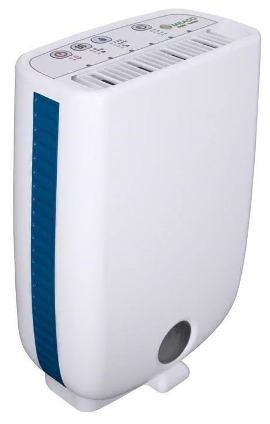
The Meaco DD8L Junior is the entry-level model in Meaco’s desiccant range, and it is built specifically to hit a lower price point by stripping out the ioniser and antibacterial filter found on the standard DD8L. What is left is a genuinely capable 8-litre-a-day desiccant dehumidifier with Meaco’s intelligent control logic, which runs the fan for just five minutes every 30 minutes once target humidity is reached — using roughly a sixth of the power of a unit that runs continuously.
At 330W on speed 1, running costs work out to around 8p per hour at current Ofgem rates — genuinely cheap for a unit that extracts as much moisture as a 16–20 litre compressor dehumidifier. Note that Meaco’s laundry mode draws significantly more power (up to 650W) for faster drying, so day-to-day running costs will typically sit closer to the 8p/hr figure than the laundry-mode maximum.
| Specification | Detail |
| Extraction rate | 8 litres/day |
| Power consumption | 330W (speed 1) — up to 650W in laundry mode |
| Running cost | ~8p/hr at 24p/kWh (speed 1) |
| Noise level | ~39dB |
| Tank capacity | 2 litres, with continuous drain option |
| Operating range | Works from 1°C |
| Modes | Normal, laundry, quiet fan speed |
| Ioniser / filter | None — omitted from this model to reduce cost |
| Wall-mountable | Yes — bracket sold separately |
| Warranty | 2 years standard, extendable to 5 (some retailers include 3 years free — check at checkout) |
Pros
- 8 litres/day extraction — rivals much larger compressor units
- Just ~8p/hr on speed 1 — genuinely cheap to run
- Intelligent control logic cuts fan run-time to roughly a sixth of a standard desiccant unit
- Works from 1°C — ideal for garages, caravans, and unheated rooms
- Wall-mounting option for permanent installation in a garage or workshop
Cons
- No ioniser or antibacterial filter (deliberately omitted vs. the standard DD8L)
- Laundry mode draws up to 650W — noticeably pricier to run than speed 1
- 2-litre tank needs emptying more often than larger compressor models
- Slightly louder than the EcoAir at comparable settings
| Verdict: The Meaco DD8L Junior is the stronger all-round pick if extraction rate and low running cost matter most to you — 8 litres a day at 8p/hr is hard to beat, and the wall-mounting option makes it a genuinely permanent fixture in a garage or workshop. |
2. EcoAir DD1 Simple MK3 — Quietest and Simplest to Use
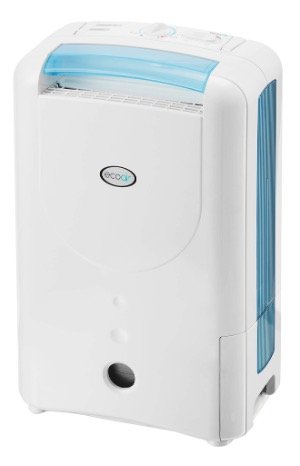
The EcoAir DD1 Simple MK3 takes a different approach: a straightforward rotary dial control (no digital display, no app) and a simple Economy/Turbo/Laundry slider. For anyone who wants a dehumidifier that just works without a learning curve — including elderly relatives or a spare-room unit you rarely touch — the simplicity is a genuine selling point.
At 34dB, it is the quieter of the two units here, and its 2-litre tank includes the same continuous-drain option as the Meaco. Power draw ranges from around 300W in Economy mode up to 580W in Turbo, giving a running cost of roughly 7p/hr on the low end and up to 14p/hr flat out.
| Specification | Detail |
| Extraction rate | 7.5 litres/day |
| Power consumption | 300W (Economy) – 580W (Turbo) |
| Running cost | ~7p/hr (Economy) – ~14p/hr (Turbo) at 24p/kWh |
| Noise level | 34dB — quietest of the two |
| Tank capacity | 2 litres, with continuous drain option |
| Operating range | 1°C to 35°C |
| Modes | Economy, Turbo, Laundry (rotary dial control) |
| Ioniser / filter | None — antibacterial nano silver filter only; no ioniser (that’s a DD1 Classic feature) |
| Dimensions | 290 × 475 × 175mm |
| Warranty | 3 years |
Pros
- 34dB — the quieter of the two units, good for a bedroom or study
- Simple rotary dial control — no app, no learning curve
- 3-year warranty as standard
- Anti-tilt safety cutoff
- Compact footprint at 290mm wide
Cons
- Lower extraction rate than the Meaco (7.5L vs 8L per day)
- Turbo mode running cost (~14p/hr) is noticeably higher than the Meaco’s speed 1
- No wall-mounting option
- No digital display or app control
| Verdict: The EcoAir DD1 Simple MK3 is the better choice if quiet running and simplicity matter more than outright extraction rate — it’s the easier unit to just switch on and forget, and the 3-year warranty is a genuine value point. |
Full Comparison Table
| Model | Extraction | Noise | Cost/hr | Tank | Warranty |
| Meaco DD8L Junior | 8L/day | ~39dB | ~8p (speed 1) | 2L | 2yr (ext. 5) |
| EcoAir DD1 Simple | 7.5L/day | 34dB ⭐ | ~7–14p | 2L | 3yr ⭐ |
⭐ = best in category
Running Cost Comparison at 24p/kWh
All figures at 24p/kWh (Ofgem unit rate). At the Q3 2026 rate of 26.11p/kWh, expect costs roughly 5–8% higher than shown below.
| Model | Wattage | Per hour | Per day (4hrs) | 60 days (4hrs/day) |
| Meaco DD8L Junior (speed 1) | 330W | ~8p | ~32p | ~£19.20 |
| EcoAir DD1 Simple (Economy) | 300W | ~7p | ~28p | ~£16.80 |
| EcoAir DD1 Simple (Turbo) | 580W | ~14p | ~56p | ~£33.60 |
Honest Limitations of Desiccant Dehumidifiers
Both units on this page are genuinely good at their job, but desiccant technology comes with real trade-offs worth knowing before you buy:
- Warm exhaust air. Both units release air 10–12°C warmer than room temperature as a by-product of the drying process — a bonus in winter, less welcome in a warm room.
- New-unit smell. The zeolite desiccant material absorbs household odours (cosmetics, hairspray, new furniture) and releases a faint burning or sour smell the first few times you run it. This is normal and fades with use.
- Cost per litre. Desiccant units generally cost a little more to run per litre of moisture extracted than a compressor unit in a warm room — the trade-off you make for reliable cold-weather performance.
- Smaller tanks. Both units here hold 2 litres, so heavy condensation problems mean more frequent emptying unless you fit the continuous drain hose.
Quick Decision Guide
| Your situation | Recommended pick |
| Maximum extraction and lowest running cost | Meaco DD8L Junior |
| Permanent garage or workshop installation | Meaco DD8L Junior |
| Quiet operation for a bedroom or study | EcoAir DD1 Simple MK3 |
| Simple dial control, no app or display needed | EcoAir DD1 Simple MK3 |
| Longest warranty out of the box | EcoAir DD1 Simple MK3 |
Frequently Asked Questions
What is the best desiccant dehumidifier in the UK?
For most UK homes, the Meaco DD8L Junior is the best overall desiccant dehumidifier — it extracts up to 8 litres a day for around 8p an hour, and works reliably from 1°C. If quiet running matters more than outright extraction rate, the EcoAir DD1 Simple MK3 is the better choice at 34dB.
Do desiccant dehumidifiers work in cold garages?
Yes — this is precisely where desiccant technology excels. Both the Meaco DD8L Junior and EcoAir DD1 Simple MK3 continue extracting moisture effectively down to 1°C, unlike compressor dehumidifiers, which lose effectiveness sharply below 15°C and typically stop working altogether below 5°C.
How much does it cost to run a desiccant dehumidifier?
At 24p/kWh, the Meaco DD8L Junior costs around 8p/hr on speed 1. The EcoAir DD1 Simple MK3 costs around 7p/hr in Economy mode and up to 14p/hr in Turbo mode. Run for 4 hours a day across 60 days, that works out to roughly £16.80–£19.20 for the Meaco or EcoAir on Economy, or up to £33.60 for the EcoAir on Turbo.
Do the Meaco DD8L Junior or EcoAir DD1 Simple have an ioniser?
No — neither model includes an ioniser. The Meaco DD8L Junior omits both the ioniser and antibacterial filter found on the standard Meaco DD8L to hit a lower price point. The EcoAir DD1 Simple includes only an antibacterial nano silver filter; the ioniser is a feature reserved for EcoAir’s Classic range (DD1 Classic MK5/MK6), not the Simple.
Is a desiccant dehumidifier better than a compressor dehumidifier?
Neither is universally better — it depends on the room. Desiccant units like these two work well in any temperature, including near-freezing spaces, and run quietly. Compressor units are typically more efficient (cheaper to run per litre extracted) in a warm room above 15°C, but should not be used in cold, unheated spaces. See our full desiccant vs compressor comparison for a detailed breakdown.
Which is quieter, the Meaco DD8L Junior or the EcoAir DD1 Simple?
The EcoAir DD1 Simple MK3 is quieter at 34dB, compared to approximately 39dB for the Meaco DD8L Junior. Both are quiet enough for daytime use in most rooms; the EcoAir’s lower noise level makes it the better choice for a bedroom or study.
| Related Articles Desiccant vs Compressor Dehumidifier UK Best Dehumidifier for a Cellar UK Best Dehumidifier for Caravan UK Best Dehumidifier Under £100 UK Meaco vs Ebac Dehumidifier UK |
