
Best Dehumidifier for Caravan UK (2026): Keep Damp and Mould at Bay
Last updated: 28 September 2026
This page contains affiliate links. If you buy through these links, we may earn a small commission at no extra cost to you. See our Affiliate Disclaimer for more information.
Best dehumidifier for caravan UK: choosing the wrong type can leave you with a machine that barely works in the cold, drains your EHU faster than a heater, or runs out of tank space before you’ve had breakfast. This guide cuts through the noise with two clear scenarios — active touring and winter storage/lay-up — and matches the right technology to each.
Key Takeaways
| At a glance: Desiccant dehumidifiers are the only reliable choice for caravans in unheated or cold conditions. Compressor models lose effectiveness below 15 °C and ice up below 5 °C. For active touring above 15 °C, a Peltier mini unit saves battery and runs silently. For winter storage and lay-up, only a desiccant will do the job. |
Two Very Different Jobs
Most caravan dehumidifier guides treat the job as one problem. It isn’t. There are two distinct scenarios, and they call for completely different machines.
| Scenario | Typical temp | Priority | Best type | Our pick |
| Active touring (in use, occupied) | 15–25 °C | Silent, low power draw | Peltier mini | Pro Breeze 500ml Mini |
| Winter storage / lay-up (unoccupied) | 1–12 °C | Works in the cold, continuous drain option | Desiccant | Meaco DD8L Junior |
| ⚠️ Warning: Compressor dehumidifiers lose effectiveness below 15 °C and their coils ice over below 5 °C. Most UK caravan storage sites run well below this in autumn and winter. Never use a compressor dehumidifier for winter lay-up or in an unheated caravan. |
EHU Wattage: What Can Your Pitch Handle?
Electric hook-up (EHU) ratings determine how much total wattage you can run before tripping the circuit breaker. Different sites offer different amp ratings. Adding a dehumidifier on top of a kettle, heater, or TV can tip you over the limit.
| EHU rating | Max wattage | DD8L Junior (330W auto) fits? | EcoAir DD1 Simple (650W) fits? |
| 6A | ~1,380W | ✅ Yes — 330W leaves plenty of headroom | ⚠️ Caution — 650W alongside a heater will trip the breaker |
| 10A | ~2,300W | ✅ Yes — comfortable | ✅ Yes — sufficient headroom |
| 16A | ~3,680W | ✅ Yes — no problem | ✅ Yes — no problem |
The Meaco DD8L Junior draws just 330W on auto mode — comfortable on even the tightest 6A pitch. The EcoAir DD1 Simple draws 650W, which is manageable at 10A or 16A but worth watching on a 6A supply if you’re running anything else at the same time.
The Best Dehumidifiers for Caravans: Our Top Picks
1. Meaco DD8L Junior — Best Overall (Winter Storage & Lay-Up)
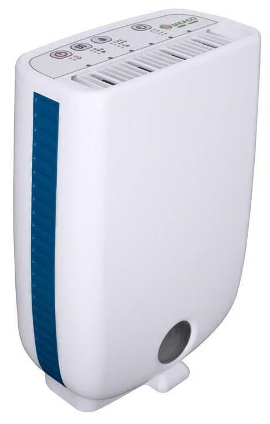
The Meaco DD8L Junior is our top pick for anyone leaving their caravan in storage over autumn and winter, or using it in cold weather. It’s a desiccant machine, which means it works from 1 °C — long after compressor dehumidifiers have given up.
| Specification | Detail |
| Type | Desiccant |
| Extraction rate | 8L/day (at 20 °C / 60% RH) |
| Tank capacity | 2L (plus continuous drain option) |
| Power draw (auto) | 330W (~8p/hr at 24p/kWh) |
| Power draw (laundry mode) | 650W (laundry/high speed only) |
| Noise level | 34 dB (low) / 42 dB (high) |
| Min operating temp | 1 °C |
| Auto-restart | Yes — resumes after power cut |
| Continuous drain | Yes — gravity hose |
| Dimensions (H×W×D) | 394 × 202 × 285 mm |
| Castors | No — stable base for pitched ground |
What makes the DD8L Junior ideal for caravan use is not just its cold-weather capability. The auto-restart function is essential for storage use — if your caravan site has a power cut or you’re on a timer, the machine resumes automatically when power returns without you needing to intervene. The continuous drain option means you can route the hose to a drain and forget about emptying the tank for weeks at a time.
The 330W draw on auto mode is the normal running figure. The 650W figure sometimes quoted in reviews refers to laundry/maximum speed mode only — do not use that number for EHU planning.
No castors might sound like a downside, but for a pitched or uneven surface it’s actually an advantage — the unit sits stable rather than rolling.
Pros
- Works from 1 °C — effective all winter
- 330W auto draw — safe on 6A EHU
- Auto-restart after power cuts
- Continuous drain for unattended use
- Quiet at 34 dB on low speed
Cons
- Desiccant runs warmer than compressor (heats the room slightly)
- 2L tank is small — continuous drain connection recommended for storage
- Higher running cost per day than Peltier, but far more effective in cold
| Verdict: The Meaco DD8L Junior is the definitive choice for UK caravan winter storage and lay-up. Desiccant technology, a 1 °C operating range, auto-restart, and continuous drain make it purpose-built for this exact job. It’s also the safest bet for EHU-limited pitches at just 330W on auto. |
2. Pro Breeze 500ml Mini — Best for Active Touring
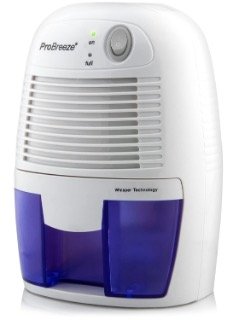
The Pro Breeze 500ml Mini is a Peltier-technology dehumidifier — not a desiccant, not a compressor. Peltier units use a thermoelectric cooling chip that consumes very little power and produces virtually no noise. That makes this an excellent companion for nights in the caravan when you’re actually sleeping in it.
| Specification | Detail |
| Type | Peltier (thermoelectric) |
| Extraction rate | ~250ml/day (at 20 °C / 60% RH) |
| Tank capacity | 500ml |
| Power draw | 23W (~0.6p/hr at 24p/kWh) |
| Noise level | ≤33 dB |
| Min operating temp | ~15 °C (ineffective below this) |
| Continuous drain | No |
| Weight | ~1 kg |
| Dimensions | Compact — fits on a shelf or worktop |
| ⚠️ Important: The Pro Breeze 500ml Mini becomes ineffective below approximately 15 °C. It is not a storage or winterising solution. Use it only during active touring when your caravan is warm enough to be occupied comfortably. |
At 23W and under 33 dB, this unit will barely register on your electricity meter and won’t disturb your sleep. The 500ml tank will need emptying every day or two depending on humidity levels — there is no continuous drain option, so this is not suitable for unattended use.
What it does brilliantly is keep condensation off windows overnight, reduce that clammy morning feeling in a small space, and do so at a fraction of the running cost of a desiccant unit. At 24p/kWh, running it for 8 hours costs under 5 pence.
Pros
- 23W draw — negligible EHU and running cost impact
- ≤33 dB — virtually silent overnight
- ~1 kg and compact — easy to carry and store
- Ideal for reducing condensation in an occupied caravan
Cons
- Ineffective below ~15 °C — not for cold or storage use
- Only ~250ml/day extraction — not suited to very damp spaces
- No continuous drain — must empty tank manually
- 500ml tank fills quickly in high humidity
| Verdict: The Pro Breeze 500ml Mini earns its place as the active-touring companion. If you’re sleeping in your caravan in spring, summer, or early autumn, this is the most cost-effective, least intrusive way to manage condensation. Just don’t expect it to work once temperatures drop below 15 °C. |
3. EcoAir DD1 Simple MK3 — Mid-Range Desiccant Alternative
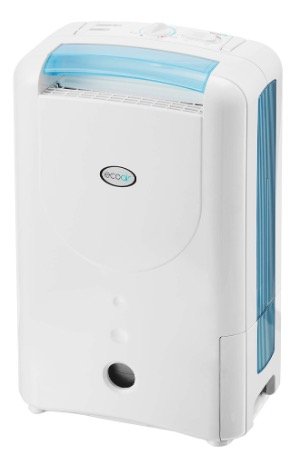
The EcoAir DD1 Simple MK3 is a desiccant dehumidifier that covers similar cold-weather ground to the Meaco DD8L Junior. It’s worth considering if the DD8L Junior is unavailable, or if you need a higher extraction rate for a particularly damp caravan.
| Specification | Detail |
| Type | Desiccant |
| Extraction rate | 7L/day (at 20 °C / 60% RH) |
| Tank capacity | 2L |
| Power draw | 650W (~16p/hr at 24p/kWh) |
| Noise level | 35–44 dB |
| Min operating temp | 1 °C |
| Continuous drain | Yes |
| Ioniser | Yes (see warning below) |
| ⚠️ Ioniser notice: The EcoAir DD1 Simple MK3 has a built-in ioniser. In small, enclosed spaces like caravans — particularly when sleeping — we recommend switching the ioniser off. Some users are sensitive to the ozone trace that ionisers can produce. |
The main drawback compared to the DD8L Junior is power consumption. At 650W, it draws double the wattage — fine on a 10A or 16A pitch, but more constraining on a 6A supply. It has 7L/day extraction (slightly less than the DD8L Junior’s 8L/day) and lacks the auto-restart feature that makes the DD8L Junior ideal for unattended storage use.
If the DD8L Junior is your first choice and it is out of stock, the EcoAir DD1 Simple is a competent desiccant alternative — just factor in the higher running cost and switch off the ioniser.
Pros
- Works from 1 °C — cold-weather capable
- Continuous drain option for unattended use
- 7L/day extraction — capable for persistent damp
Cons
- 650W draw — double the DD8L Junior on auto; watch on 6A EHU
- No auto-restart — needs manual reset after power cuts
- Built-in ioniser — switch off in sleeping/enclosed spaces
| Verdict: A solid mid-range desiccant pick. It does the job in the cold and drains continuously, but the DD8L Junior beats it on EHU efficiency, auto-restart, and value. Recommended as an alternative if the DD8L Junior is unavailable. |
No EHU? Off-Grid and Passive Options
If your caravan is stored without electricity, or you’re on a non-electric pitch, passive moisture absorbers are your only option. They won’t match the extraction rate of an electric dehumidifier, but for a sealed, unoccupied caravan they provide a useful baseline of protection.
Calcium chloride traps
Products like UniBond Aero 360 use calcium chloride crystals that absorb moisture from the air and dissolve into a liquid compartment. They’re cheap, require no power, and are widely available. A 360ml unit absorbs up to 3× its weight in moisture — replace when the crystals are gone, typically every 4–8 weeks depending on humidity levels. Position one at each end of the caravan for best coverage.
Silica gel absorbers
Rechargeable silica gel packets and tubs are a reusable alternative. They absorb moisture until saturated, then can be dried out in an oven and reused. Suitable for small enclosed spaces like storage lockers, wardrobes, and under-seat compartments rather than whole-van humidity control.
Damp rods / electric damp sticks
Damp rods are low-wattage (typically 15–25W) heating elements that gently warm the air inside the caravan to prevent condensation. They don’t extract moisture — they prevent it from forming by keeping surface temperatures above the dew point. Useful for winter storage if you have a mains connection but don’t want to run a full dehumidifier continuously.
Full Comparison: All Three Electric Models
| Model | Type | Works below 15°C? | Wattage | Extraction | Noise | Continuous drain | Auto-restart |
| Meaco DD8L Junior | Desiccant | ✅ From 1 °C | 330W (auto) | 8L/day | 34–42 dB | ✅ Yes | ✅ Yes |
| Pro Breeze 500ml Mini | Peltier | ❌ Above 15 °C only | 23W | 250ml/day | ≤33 dB | ❌ No | N/A |
| EcoAir DD1 Simple | Desiccant | ✅ From 1 °C | 650W | 7L/day | 35–44 dB | ✅ Yes | ❌ No |
Running Costs at 24p/kWh
All figures calculated at 24p/kWh (Ofgem unit rate). Continuous-run column assumes the unit runs 24 hours per day — relevant for winter storage scenarios.
| Model | Cost per hour | Cost per 8 hrs | Cost per day (24 hrs) | Cost per week (continuous) |
| Meaco DD8L Junior (330W) | ~8p | ~64p | ~£1.90 | ~£13.30 |
| Pro Breeze 500ml Mini (23W) | ~0.6p | ~4.4p | ~13p | ~£0.91 |
| EcoAir DD1 Simple (650W) | ~16p | ~£1.28 | ~£3.74 | ~£26.18 |
For winter storage, the Meaco DD8L Junior running continuously costs around £13–14 per week — and in practice, it will cycle off once target humidity is reached, so actual spend will be lower. The EcoAir DD1 Simple costs approximately double for the same job.
Which One Is Right for You?
| Your situation | Our recommendation |
| Leaving caravan in storage over winter | Meaco DD8L Junior |
| Winterising — unattended, mains connected | Meaco DD8L Junior |
| Active touring in spring/summer (above 15 °C) | Pro Breeze 500ml Mini |
| Overnight condensation control when occupied | Pro Breeze 500ml Mini |
| On a tight 6A EHU pitch in cold weather | Meaco DD8L Junior |
| DD8L Junior out of stock — need desiccant alternative | EcoAir DD1 Simple MK3 |
| No EHU / off-grid storage | Calcium chloride traps (e.g. UniBond Aero 360) |
Frequently Asked Questions
Can I use a normal household dehumidifier in my caravan?
Technically yes, but most household dehumidifiers are compressor-based and too large for a caravan’s confined space. More importantly, compressor units fail below 15 °C — making them useless for winter storage. Stick to desiccant for cold-weather use and a Peltier mini for in-season condensation control.
How long does a dehumidifier last in a caravan?
A desiccant dehumidifier like the Meaco DD8L Junior will typically last 5–8 years with normal use. In a storage context, it cycles on and off rather than running continuously, which extends component life. The desiccant wheel itself is the main wear component — it doesn’t need replacing under normal residential or caravan use.
What humidity level should I aim for in a stored caravan?
Between 45% and 55% relative humidity (RH) is the target range. Below 45% is unnecessarily dry and can cause soft furnishings and seals to crack over time. Above 60% for extended periods promotes mould growth, musty odours, and potential damage to upholstery and woodwork.
Can I run a dehumidifier in a caravan with the gas heating on?
Yes — in fact, a dehumidifier pairs well with heating because warm air holds more moisture, and the dehumidifier then extracts it more efficiently. The combination is effective for drying out a damp caravan quickly. Just ensure there is adequate ventilation when using gas appliances.
Is a desiccant dehumidifier safe to leave on unattended in a caravan?
Yes, provided it has a continuous drain connection (to avoid tank overflow) and auto-restart (to resume after power interruptions). The Meaco DD8L Junior has both. Without continuous drain, you risk the tank overflowing if you’re not there to empty it.
Will a dehumidifier help with caravan mould?
Yes. Mould requires sustained humidity above around 70% RH to establish and spread. Maintaining humidity below 55–60% will prevent new mould growth and stop existing mould from spreading. You’ll still need to physically remove existing mould with an appropriate cleaner — a dehumidifier prevents recurrence, it doesn’t undo existing damage.
What is the best caravan dehumidifier for the money?
For winter storage, the Meaco DD8L Junior offers the best value — it works in the cold, has auto-restart and continuous drain, and draws only 330W. For active touring on a budget, the Pro Breeze 500ml Mini is under £50 and costs under 1p per hour to run.

One Comment