
Does a Dehumidifier Help in a Heatwave? UK Guide
Last updated: 8 September 2026
| Affiliate Disclosure: This page contains affiliate links. If you buy through these links, we may earn a small commission at no extra cost to you. See our Affiliate Disclaimer for more information. |
| Key Takeaways |
✅ Dry air can feel more comfortable than humid air at the same temperature. ✅ During UK heatwaves, humidity is usually lower than in summer storms — a dehumidifier may offer limited comfort benefit. ✅ If your home feels sticky and humid during a heatwave, a dehumidifier can help. ✅ Running a dehumidifier adds a small amount of heat to the room — worth knowing in hot weather. ✅ For genuine cooling, consider a portable AC. Best Portable Air Conditioner UK |
Just want to cool down fast?
If your home feels unbearably hot — not sticky or humid — a dehumidifier isn’t the right tool. Skip straight to a portable air conditioner: our top pick is the De’Longhi Pinguino PACEX100, the most energy-efficient unit we’ve tested. Prefer whisper-quiet operation? The Dreo AC515S is the quietest option at this size. Not sure whether you need an AC or a dehumidifier? Keep reading — the two-minute check below will tell you.
Does a dehumidifier help in a heatwave is a question searched thousands of times every summer in the UK — and the honest answer is: it depends on why you feel uncomfortable.
If the heat feels humid and sticky, a dehumidifier can make a real difference to how bearable your home feels. But if the air is simply hot and dry, a dehumidifier won’t help — and may make things slightly worse.
This guide explains exactly how dehumidifiers interact with heat, when they’re worth running during a heatwave, and when you’d be better off looking at an air conditioner instead.
What Does a Dehumidifier Actually Do?
A dehumidifier pulls air in, passes it over a cold coil or desiccant material to extract moisture, and then pushes the now-drier air back into the room. The result is lower relative humidity — but the air temperature itself is largely unchanged.
In fact, dehumidifiers produce a small amount of waste heat as a byproduct of the process. This is usually negligible in a cool or normal room, but worth bearing in mind during a heatwave.
| A dehumidifier is a humidity-control device, not a cooling device. It makes the air drier — not colder. |
Why Humidity Makes Heat Feel Worse
Your body cools itself through sweat. When sweat evaporates from your skin, it takes heat with it — lowering your body temperature. This process only works properly when the air around you can absorb moisture.
When humidity is high, the air is already close to saturation. Sweat evaporates slowly or not at all, leaving you feeling hot, sticky, and uncomfortable — even at temperatures that wouldn’t bother you in dry conditions.
This is why a humid 26°C can feel far more oppressive than a dry 30°C. The temperature is higher, but the cooling mechanism works properly.
If you can reduce the humidity in your home — by running a dehumidifier — the air becomes better at absorbing sweat, and the heat feels more manageable.
Does a Dehumidifier Help in a UK Heatwave?
The UK’s relationship with humidity during heatwaves is nuanced. Classic UK heatwaves — particularly those driven by high pressure from the south — can bring surprisingly dry air. In these conditions, indoor humidity may not be especially high, and a dehumidifier will have little comfort impact.
However, humidity in UK homes varies significantly depending on:
• Building type: Older solid-brick or stone homes often retain more moisture and can feel sticky during warm spells.
• Ventilation: Homes kept closed to block out heat can trap humidity from cooking, showering, and breathing.
• Location: Coastal and low-lying properties tend to have higher ambient humidity.
• Recent rain: Heatwaves following wet periods can combine heat with elevated humidity — the worst of both worlds.
| How to Tell if a Dehumidifier Will Help |
| Quick check: if your home feels sticky and muggy as well as hot, your indoor humidity is likely above 60% RH. Running a dehumidifier to bring this down to 40–55% will make a noticeable difference to comfort. If the air just feels hot and dry, skip the dehumidifier. |
A hygrometer — a small device that measures temperature and relative humidity — is the easiest way to know for certain. We recommend the
ThermoPro TP50 as an affordable and accurate option. Check your reading:
| Indoor RH During Heatwave | Will a Dehumidifier Help? |
| Below 50% RH | Unlikely — air is already reasonably dry |
| 50–60% RH | Possibly — some benefit to comfort |
| 60–70% RH | Yes — noticeable improvement likely |
| Above 70% RH | Definitely — run the dehumidifier |
Does a Dehumidifier Cool a Room?
No — and it’s important to be clear about this. A dehumidifier does not lower air temperature. If you measure the temperature before and after running a dehumidifier, it may actually be fractionally higher, because the unit generates a small amount of waste heat during operation.
What changes is how hot the room feels. Perceived temperature — sometimes called the ‘feels like’ temperature — is heavily influenced by humidity. Reducing humidity can make a room feel several degrees cooler even when the thermometer reading is identical.
For some people during some heatwaves, this is enough. For others — particularly in rooms that are genuinely very hot — it won’t be sufficient, and an air conditioner is the right tool.
| ⚠️ A dehumidifier is not a substitute for air conditioning. It cannot remove heat from a room — only moisture. |
The Heat a Dehumidifier Adds to a Room
All dehumidifiers — compressor and desiccant alike — produce some heat as a byproduct. This is a side effect of the refrigeration or heating process used to extract moisture from the air.
The amount is small. A typical compressor dehumidifier might add 50–150W of heat equivalent to the room — similar to leaving a bright lightbulb on. In a normal room this is irrelevant. During a heatwave, it’s worth factoring in.
If you’re running a dehumidifier purely to try to cool down and the indoor humidity isn’t especially high, you may find the heat output offsets any comfort benefit. In this case, switch it off and focus on ventilation strategies instead.
| ⚠️ Temperature warning: Compressor dehumidifiers must not be run in rooms below 15°C — they are not designed for cold spaces. If you’re using a dehumidifier to protect against damp in an unheated garage or outbuilding during cooler periods, choose a desiccant model instead. |
Dehumidifier vs Air Conditioner in a Heatwave
If you’re weighing up whether to buy or use a dehumidifier or a portable air conditioner, here’s a straightforward comparison:
| Dehumidifier | Portable Air Conditioner | |
| Lowers air temperature | No | Yes |
| Reduces humidity | Yes | Yes (as a byproduct of cooling) |
| Improves perceived comfort | If humidity is high | Yes — directly |
| Adds heat to room | Small amount | No (heat vented outside) |
| Best for | Humid but manageable heat | Genuine heat relief |
| Running cost (approx.) | Lower | Higher |
| Requires installation | No | Needs venting via window or wall |
Our top pick for genuine heat relief is the
De’Longhi Pinguino PACEX100 — the most energy-efficient portable AC we’ve tested, making it the lowest-cost option to run through an extended heatwave. For those who prioritise quiet operation, the Dreo AC515S is the quietest unit available at this size.
Should You Run a Dehumidifier During a Heatwave?
The answer depends on your situation. Use this as a quick guide:
| Quick Decision Guide |
| ✅ Run it if: Your hygrometer reads above 60% RH. The room feels sticky and muggy as well as hot. You don’t have air conditioning and want to improve comfort. ❌ Skip it if: Your home feels hot but not humid. Your RH is already below 50%. You’re hoping to cool the room — a dehumidifier won’t do this. ⚠️ Consider instead: Opening windows during cooler overnight hours. Blackout blinds to block solar gain. A portable fan to increase airflow. A portable air conditioner if heat is severe. |
If you do run a dehumidifier during a heatwave, aim to keep indoor humidity between 40% and 55% RH. Going lower than this offers no additional comfort benefit and may dry out mucous membranes, causing irritation.
Best Dehumidifiers for Summer Use
If humidity is your problem and you want a dehumidifier that handles warm UK summers well, here are our recommendations:
For most UK homes: Meaco MeacoDry Abc 12L
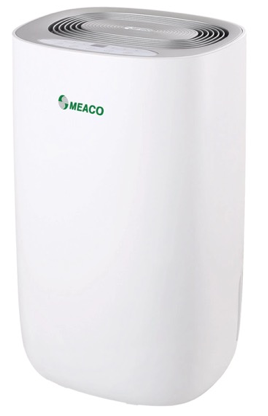
The Meaco MeacoDry Abc 12L is our top dehumidifier pick for year-round use. It’s a compressor unit that performs well in warm rooms (15°C+), runs quietly, and is energy-efficient. If your home is humid during heatwaves, this is the unit to get.
Budget option: Pro Breeze 12L
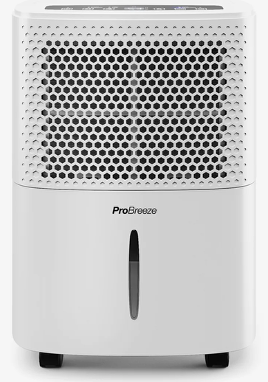
The Pro Breeze 12L offers solid humidity control at a lower price point. Slightly louder than the Meaco, but a capable performer for summer use in living rooms and bedrooms.
Large homes: Meaco 20L Low Energy
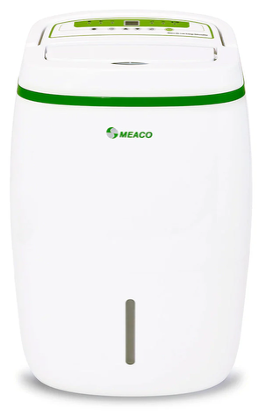
For larger open-plan spaces or properties that consistently suffer from humidity, the Meaco 20L Low Energy has the extraction capacity to make a real dent in high humidity levels quickly. The 6L tank is generous for extended summer running.
| ⚠️ Cold spaces: If you need to run a dehumidifier in an unheated space — a garage, outbuilding, or conservatory — choose a desiccant model. Compressor dehumidifiers stop working effectively below 15°C. The Meaco DD8L Junior (from 1°C) or EcoAir DD1 Simple MK3 are the right tools for this job. |
Running Costs During a Heatwave
Running a dehumidifier during a heatwave won’t break the bank. At the current Ofgem unit rate of 26p/kWh:
| Dehumidifier | Wattage | Cost per Hour | Cost per Day (8hrs) |
| Meaco MeacoDry Abc 12L | 165W | ~4p | ~35p |
| Pro Breeze 12L | 200W | ~5p | ~42p |
| Meaco 20L Low Energy | 255W | ~6p | ~53p |
Running costs calculated at 26.11p/kWh (Ofgem rate, correct as of June 2026). Verify at ofgem.gov.uk for the latest unit rate.
Frequently Asked Questions
Will a dehumidifier make my room cooler?
Not directly — a dehumidifier doesn’t lower air temperature. However, by reducing humidity it can lower the ‘feels like’ temperature, making the room more comfortable. If the air is already dry, you won’t notice much difference.
Should I run a dehumidifier and a fan at the same time?
Yes — this is a good combination. A fan doesn’t cool the air either, but it increases airflow across your skin, speeding up sweat evaporation. Pairing a fan with a dehumidifier addresses both the humidity and the airflow, giving the best possible comfort without air conditioning.
Can a dehumidifier replace an air conditioner?
No. An air conditioner actively removes heat from the room and vents it outside — that’s the key difference. A dehumidifier cannot remove heat. If temperatures in your home are genuinely uncomfortable, an air conditioner is the right tool. A dehumidifier is a useful complement, not a substitute.
Is it safe to run a dehumidifier overnight during a heatwave?
Yes, provided the unit has auto-shutoff when the tank is full (all modern units do). Overnight use is a sensible strategy — the compressor noise is low on units like the Meaco MeacoDry Abc 12L and you’ll wake up to drier air. See our guide to leaving a dehumidifier on overnight for more detail.
What humidity level should I aim for in summer?
The ideal indoor relative humidity is 40–55% RH year-round. In summer, aim for 50–55% — going lower than 40% in hot weather can cause dry skin and eye irritation. A hygrometer like the ThermoPro TP50 lets you monitor this easily.
Does a dehumidifier work better in heat?
Compressor dehumidifiers actually work more efficiently at higher temperatures — they extract more moisture per hour in a warm room than a cold one. So during a summer heatwave, your dehumidifier will be working at close to peak efficiency.
Related Articles
• Best Portable Air Conditioner UK — full roundup of the top portable ACs for UK homes
• Can You Leave a Dehumidifier On Overnight? — safety, efficiency, and whether it makes sense
• Do Dehumidifiers Use a Lot of Electricity? — running costs explained with real UK figures
• Best Hygrometer UK — the best devices to monitor temperature and humidity at home
| About This Article |
| About this article: Written by the UK Air Quality editorial team. We research, test, and independently evaluate dehumidifiers, air purifiers, and related products for UK homes. Our recommendations are based on hands-on assessment and publicly available technical data. Sources and further reading: UK Met Office — UK heatwave guidance: metoffice.gov.uk Ofgem — current electricity unit rates: ofgem.gov.uk NHS — heatwave health advice: nhs.uk/live-well/seasonal-health CIBSE — indoor air quality and humidity guidance: cibse.org |

One Comment