
Can You Leave a Dehumidifier On Overnight? What UK Homes Need to Know
Last updated: 15 July 2026
Affiliate DisclosureThis page contains affiliate links. If you buy through these links, we may earn a small commission at no extra cost to you. See our Affiliate Disclaimer for more information.
Can you leave a dehumidifier on overnight? UK homes ask this more than almost any other question about these appliances — and the short answer is yes, it is safe, and in many cases it is the most effective time to run one.
Humidity rises at night. Temperatures drop, ventilation stops, and everyone in the house is breathing steadily for eight hours. By morning, that moisture has had all night to settle on the coldest surfaces — usually your windows. Running a dehumidifier overnight tackles the problem at source, during the hours when it matters most.
This guide covers everything you need to know: whether it is safe, how much it costs, what settings to use, and which model handles overnight use best.
| Key Takeaways Leaving a dehumidifier on overnight is safe — modern units have auto shut-off, humidistat control, and overheat protection. Night-time is often the highest-humidity period in most UK homes, making it a logical time to run one. Set your target humidity to 50–55% RH for overnight use — low enough to prevent condensation without over-drying. The Meaco MeacoDry Abc 12L is the standout overnight pick — Quiet Mark certified at 36 dB, with a dedicated night mode. Running costs are low: around 4p per hour at 24p/kWh, or roughly 30–35p for an eight-hour night. Cold rooms below 15°C need a desiccant dehumidifier — compressor units are not effective in unheated spaces. |
Is it safe to leave a dehumidifier on overnight?
Yes — provided you are using a reputable modern unit with the standard safety features that have been built into these appliances for years. The concern people have usually comes from a broader anxiety about leaving appliances running unattended, which is understandable. But dehumidifiers are not like tumble dryers or ovens. They run cool, they draw modest amounts of power, and they are designed from the ground up for extended operation.
Here is what makes overnight use safe:
| Safety feature | What it does |
| Humidistat | Shuts the unit down automatically when target RH is reached — it does not run continuously all night at full power |
| Tank full auto shut-off | Stops the unit when the water tank is full, preventing overflow |
| Overheat protection | Cuts power if the motor runs too hot — a built-in failsafe |
| Auto-defrost | On compressor models, prevents ice build-up on the coils in cooler conditions |
| Child lock | Prevents accidental setting changes during the night |
The only meaningful risk with overnight use is noise disturbance — which is a comfort issue, not a safety one. We cover that below.
Why night-time is often the best time to run a dehumidifier
Most people think of dehumidifiers as daytime appliances. In practice, the hours when your home is generating the most moisture without removing any of it are the overnight hours.
Consider what happens in a typical UK home overnight:
- Two adults sleeping adds around 1.5 litres of water vapour through breathing and perspiration
- Windows and trickle vents are typically closed, so no air exchange is happening
- The heating is off or reduced, so indoor temperatures drop — and cooler air holds less moisture
- Any residual moisture from cooking, showering, or laundry that was not removed during the day is still circulating
The result is that relative humidity climbs through the night and peaks in the early hours of the morning — exactly when it is sitting on cold window glass and creating the condensation problem you find when you wake up.
Running a dehumidifier overnight directly addresses this pattern. If you regularly see condensation on your windows in the morning, overnight dehumidifier use is one of the most effective interventions you can make.
Best settings for overnight dehumidifier use
Getting the settings right matters. Too high a target humidity and the unit runs all night without making much difference. Too low and you are wasting electricity and potentially over-drying the air.
| Setting | Recommended value | Why |
| Target humidity (RH) | 50–55% | Prevents condensation without making the air uncomfortably dry |
| Fan speed | Low or Night mode | Minimises noise — sufficient for gradual overnight dehumidification |
| Windows and doors | Closed | Stops the unit constantly fighting incoming moist air |
| Placement | Central in room, away from walls | Allows air to circulate freely to the intake |
| Continuous drain | Optional — use if tank is small | Avoids the unit shutting off mid-night if the tank fills |
Most modern dehumidifiers with a humidistat will cycle on and off automatically once the target humidity is reached. This means the unit is not running at full power all night — it will typically run for an hour or two, reach the target, then idle until humidity climbs again.
How much does it cost to run a dehumidifier overnight?
Running costs are modest — and lower than most people expect, because the humidistat means the unit is not running continuously.
| Scenario | Draw | Cost per hour | Cost per 8hr night | Cost per month (nightly) |
| Meaco MeacoDry Abc 12L — continuous | 165W | 4p | 32p | ~£9.60 |
| Meaco MeacoDry Abc 12L — cycling (typical) | 165W | 4p | 16–20p* | ~£5–6 |
*Typical real-world overnight use involves 4–5 hours of active running rather than a full 8 hours, as the humidistat cycles the unit off once target RH is reached.
All costs calculated at 24p/kWh (Ofgem unit rate).
For a fuller breakdown of dehumidifier running costs, see our guide: Do dehumidifiers use a lot of electricity?
What about noise? Will it disturb your sleep?
This is the most common legitimate concern about overnight dehumidifier use — and the honest answer is that it depends entirely on the unit.
Many budget dehumidifiers run at 45–50 dB or higher. At that level, in a quiet bedroom, you will hear them. Some people adapt; others find it genuinely disruptive, particularly light sleepers.
The solution is to choose a unit designed for quiet operation. There is a meaningful gap between a 40 dB dehumidifier and a 36 dB one — each 3 dB reduction represents roughly half the perceived noise. Units that have earned Quiet Mark certification have been independently tested and verified to operate at an acceptable noise level for home use.
For context: 36 dB is roughly equivalent to a quiet library or soft rainfall. Most people sleep through it without difficulty.
The best dehumidifier for overnight use: Meaco MeacoDry Abc 12L
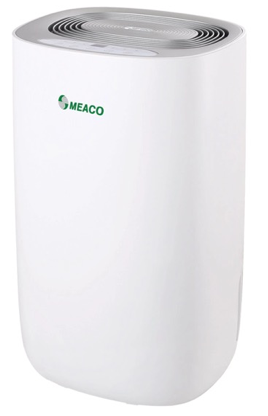
If overnight use is your primary need, the Meaco MeacoDry Abc 12L is the right choice for most UK households. It is the model we recommend most often for bedrooms and living rooms, and overnight use is precisely what it was designed for.
Specifications
| Specification | Detail |
| Type | Compressor |
| Extraction capacity | 12 litres per day (at 30°C, 80% RH) |
| Running draw | ~165W |
| Noise level | 36 dB (low) / 40 dB (max) — Quiet Mark certified |
| Night mode | Yes — reduced fan speed for minimal disturbance |
| Humidistat range | 30–80% RH, adjustable in 5% steps |
| Tank capacity | 2.6 litres |
| Laundry mode | Yes — runs at full power for 6 hours then auto-shuts off |
| Auto shut-off | Yes — tank full and target humidity reached |
| Auto-defrost | Yes |
| Child lock | Yes |
| Warranty | 2 years parts and labour |
| Temperature range | Effective from 15°C — compressor unit, not suitable for cold unheated rooms |
Verdict
| Meaco MeacoDry Abc 12L — overnight use verdict Strengths Quiet Mark certified — 36 dB at low speed is genuinely unobtrusive in a bedroom• Dedicated night mode reduces fan speed further for minimal disturbance Humidistat cycles the unit intelligently — it is not running at full power all night Auto shut-off on tank full means no overflow risk Compact and easy to move between rooms Limitations 2.6L tank — in a very damp room it may fill overnight; a continuous drain hose (sold separately) solves this Compressor type — not effective below 15°C; if your bedroom regularly drops below this, consider a desiccant alternative No built-in on-timer — you set it before bed rather than scheduling it to start |
| ⚠️ Cold room warning The MeacoDry Abc 12L is a compressor dehumidifier, effective from around 15°C. If you are running it in an unheated spare room, conservatory, or garage that drops below 15°C overnight, it will not work effectively and may ice up below 5°C. For cold rooms, you need a desiccant dehumidifier. See our desiccant vs compressor guide for help choosing the right type. |
Should you run a dehumidifier every night?
Not necessarily — it depends on your home, the season, and your current humidity levels. Here is a practical guide:
| Situation | Overnight use? | Notes |
| Condensation on windows every morning | Yes — prioritise this | Overnight is when humidity peaks; run every night through winter |
| Drying laundry indoors | Yes | Close the laundry room door; use laundry mode if drying, normal mode if overnight maintenance |
| Damp or mouldy bedroom | Yes — run continuously until RH drops | Set to 50% and run until the room is stable, then maintain nightly |
| Summer, no condensation issues | Probably not needed | Check with a hygrometer; if RH is already below 55%, the unit has little to do |
| Allergy sufferer (dust mites) | Yes — dust mites thrive above 50% RH | Keeping RH below 50% overnight reduces dust mite activity significantly |
A cheap hygrometer (under £10 from any hardware shop) removes all the guesswork. If your bedroom RH is regularly above 60% overnight, running a dehumidifier will make a measurable difference. If it is already sitting at 50–55%, you may not need to bother.
Practical tips for overnight dehumidifier use
- Keep the door closed — running a dehumidifier in a room with an open door means it is fighting the moisture from the rest of the house
- Empty the tank before bed — if your tank is 2.6L and your room is very damp, it may fill overnight and shut the unit off. Either empty it before bed or use a continuous drain hose
- Place it away from walls and furniture — the intake and exhaust need clear air circulation to work efficiently; at least 30 cm clearance on all sides
- Do not point the exhaust at the bed — the air exiting a dehumidifier is slightly warm and dry; position the unit so exhaust air circulates into the room rather than directly at you
- Clean the filter monthly — a clogged filter reduces efficiency and can increase noise
Frequently asked questions
Can I leave a dehumidifier on while I sleep in the same room?
Yes, if you choose a quiet model. The Meaco MeacoDry Abc 12L at 36 dB is comparable to very soft background noise — most people are not disturbed by it. If you are a very light sleeper, use night mode, which reduces the fan speed further.
Is it better to run a dehumidifier during the day or overnight?
For condensation prevention, overnight is more effective — humidity peaks during the hours when the house is closed up and no ventilation is happening. For laundry drying, daytime use alongside open windows is more efficient. Many people run their unit overnight for humidity management and during the day for laundry drying — both are valid uses.
Will running a dehumidifier overnight dry the air out too much?
Not if you use the humidistat correctly. Set a target of 50–55% RH and the unit will shut off once it reaches that level. It will not continue drawing moisture below your set point. Only if you set an extremely low target (below 40%) would you risk uncomfortably dry air.
How long does it take a dehumidifier to work overnight?
In a typical bedroom, a unit like the Meaco MeacoDry Abc 12L will bring humidity down from 65–70% to 50–55% within one to three hours. After that, it cycles on and off to maintain the target. You will usually notice a difference by morning from the first night, though in very damp rooms it may take several nights of consistent use to see a significant improvement.
Should I run a dehumidifier every night in winter?
If you have condensation problems or high indoor humidity, yes. Winter is when surface condensation is most likely — cold windows, reduced ventilation, and high indoor moisture from heating and cooking. Running the dehumidifier every night through the colder months is the most effective approach.
Should I leave a dehumidifier on all the time instead?
Running one continuously is sometimes the right answer — particularly in very damp homes or during serious damp remediation. See our dedicated guide: How long should you run a Dehumidifier?
Is it safe to leave a dehumidifier on when I’m not home?
Yes — the same safety features that make overnight use safe (humidistat, tank-full auto shut-off, overheat protection) apply whether you’re asleep in the next room or out of the house all day.
The one practical difference is tank capacity: if you won’t be back for 8+ hours, either fit a continuous drain hose so the tank can’t overflow unnoticed, or choose a unit with a larger tank than the Meaco MeacoDry Abc 12L’s 2.6 litres.
As with overnight use, avoid running a compressor dehumidifier in a room that drops below 15°C while you’re away — it won’t do its job effectively.
Quick decision guide
| Should you run your dehumidifier overnight? Condensation on windows every morning: yes — run overnight every night through winter Bedroom RH above 60%: yes — target 50–55% and the unit will cycle automatically Damp or mouldy room: yes — run overnight until RH stabilises below 55% Drying laundry overnight: yes — close the door, use laundry mode for the first few hours if needed Bedroom already below 55% RH: probably not — check with a hygrometer before running overnight Cold unheated room (below 15°C): compressor dehumidifiers will not work — choose a desiccant model |
Related articles
- Condensation on windows every morning — causes and fixes
- Best dehumidifier for a bedroom
- Best dehumidifier for drying laundry
- Desiccant vs compressor dehumidifier — which type do you need?
- Should you leave a dehumidifier on all the time?
- Best whole house dehumidifier
| Sources and further reading Meaco MeacoDry Abc 12L product specifications — meaco.com Quiet Mark — meacodry-abc-12l-compressor-dehumidifier Ofgem unit rate: 24p/kWh (current standing charge reference) NHS: Damp and mould in the home — health guidance |

2 Comments