
Best Portable Air Conditioner for Flat UK (2026): Renter-Friendly Picks
Last updated: 21 July 2026
This page contains affiliate links. If you buy through these links, we may earn a small commission at no extra cost to you. See our Affiliate Disclaimer for more information.
Best portable air conditioner for flat UK — finding one that actually works in a rented flat is harder than it looks. You cannot drill into window frames, your lease may have restrictions, and many units are simply too large or too loud for a flat environment. This guide cuts through the noise: five renter-friendly units reviewed honestly, with real dB figures, running costs at 24p/kWh, and window kit guidance so you know exactly what will fit before you buy.
If you just want a quick overview of all portable AC options, see our full guide to the
If you just want a quick overview of all portable AC options, see our full guide to the best portable air conditioner UK.
Quick Picks: Best Portable Air Conditioners for Flats
| Pick | Product | Best For | Noise | Running Cost/hr |
| Best compact / no tank | Olimpia Splendid Dolceclima Compact 8P | Small rooms, no condensate hassle | 63 dB (Lw) | ~14p |
| Best for large rooms | De’Longhi Pinguino PACEX100 | Open-plan, running cost leader | 45–49 dB | ~17p |
| Best for sash windows | Meaco MeacoCool MC Series | Sash window flats, quiet overnight | 52–53 dB | ~20p |
| Quietest (neighbours) | Dreo AC515S | Noise-sensitive flats, sleep use | 46 dB | ~22p |
| Budget / smart home | Pro Breeze 9000 BTU 4-in-1 | Daytime use only | ~65 dB | ~18p |
Renter Considerations Before You Buy
Flats bring a specific set of constraints that detached-house buyers never face. Work through these before committing to any unit.
Do You Need Landlord Permission?
In most AST (Assured Shorthold Tenancy) agreements, a portable air conditioner qualifies as a portable appliance rather than a fixture — which means you do not need written permission simply to use one. However, the picture changes if:
- The window kit requires screws or adhesive into the frame — this may count as alteration.
- You are in a leasehold flat where the freeholder or managing agent has rules about ventilation or window use.
- Your tenancy agreement explicitly prohibits modifications or large appliances without consent.
If in doubt, drop your landlord a brief email before installation. Most will not object to a portable unit with a non-permanent window seal. Keep a copy of any approval for your records.
Window Type Guide
| Window Type | Compatible? | Notes |
| Casement (side-hinged) | Yes — easiest | Flat window kits fit most sizes; foam seal recommended |
| Casement (top-hinged) | Yes with care | Route hose through gap at bottom; measure before buying |
| Tilt-and-turn | Yes in tilt mode | Tilt to ~15° and seal gap with foam; stable for extended use |
| Vertical sliding sash | Yes with sash kit | Meaco MC Series includes dedicated sash adaptor |
| Horizontal sliding | Yes | Vertical panel kits work well; measure track depth |
| Fixed / triple glazing | No | No openable pane — unit cannot be vented; consider a fan instead |
| Juliet balcony (French door) | Yes | Route hose through door gap with foam seal; check draught |
| Porthole / skylight only | Difficult | Hose extensions rarely reach comfortably; not recommended |
Flat-Specific Heat Problems
Flats overheat differently to houses. The four most common scenarios:
- Top-floor flats: roof absorbs heat all day and releases it overnight. Even a well-sized unit may struggle on a 35°C day if the ceiling is poorly insulated. Pre-cool during the afternoon.
- South- or west-facing rooms: solar gain through glass is the main driver. External blinds or reflective film reduce the load the AC must manage.
- Open-plan living spaces: a single-hose unit must cool a much larger volume; size up by at least one BTU band versus a closed room of the same m².
- Internal rooms with no openable window: a portable AC cannot be used — there is no way to vent the hot exhaust. A tower fan or evaporative cooler is your only option.
Single-Hose Physics in a Flat
Every portable AC on this list uses a single exhaust hose. Understanding the physics helps you set realistic expectations — especially in a flat where every air gap matters.
A single-hose unit draws air from the room, cools it across the evaporator, then exhausts the waste heat outside via the hose. The problem: drawing air out of the room creates negative pressure, which pulls warm outside air in through every gap — under doors, around skirting boards, through letterboxes.
| ⚠️ In a reasonably sealed flat, expect 60–70% of rated BTU capacity in cooling effect. In a draughty older conversion flat with original windows, expect closer to 40–50%. Single-hose units are a compromise — effective when conditions are right, but not a substitute for a fixed split system. |
The good news for flats: modern flats (especially those built or refurbished post-2000) tend to be better sealed than Victorian houses, which means better efficiency than the national average.
The 5 Best Portable Air Conditioners for Flats — Reviewed
1. Olimpia Splendid Dolceclima Compact 8P — Best Compact Pick / No Tank
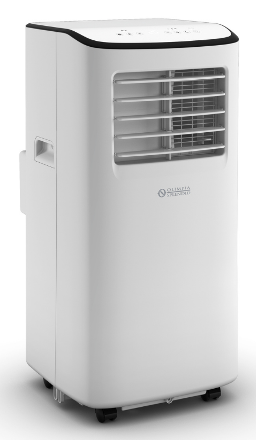
The Olimpia Splendid Dolceclima Compact 8P is the easiest portable AC to live with in a flat. It is genuinely compact, it eliminates the condensate tank entirely via continuous evaporation, and its footprint is small enough to tuck beside a bookcase when not in use. For small-to-medium rooms in a flat — bedroom, home office, single-aspect living room — it handles the job without the faff.
| Specification | Detail |
| Cooling capacity | 8,000 BTU (2.35 kW cooling) |
| Room size (guideline) | Up to ~20 m² |
| Noise level | 63 dB — see orange callout below |
| Power consumption | 850W |
| Running cost (24p/kWh) | ~20p per hour |
| Condensate tank | None — fully self-evaporating |
| Window hose | 120 mm diameter exhaust hose included |
| Dimensions (W×D×H) | 33 × 36 × 73 cm |
| Weight | 21 kg |
| Smart / App control | No |
| ⚠️ Olimpia Splendid dB Methodology: Olimpia quotes 63 dB as a sound power level (Lw), not a sound pressure level (Lp). Sound power measures total acoustic energy emitted; sound pressure is what you actually hear at a given distance. At 1 metre, this unit is likely 48–52 dB (Lp) — comparable to other units in this class. Do not compare the 63 dB figure directly to the dB (A) figures quoted by Dreo, Meaco, or De’Longhi. |
| ✅ Pros | ❌ Cons |
| No condensate tank — zero emptying required | Only 8,000 BTU — not suitable for large open-plan rooms |
| Compact footprint — easy to store between heatwaves | dB figure (63 dB Lw) is not directly comparable to rivals |
| Self-evaporating design suits flats with no drain access | No smart/app control |
| Straightforward controls, no app dependency | Hose diameter (120 mm) is wider than some window kit slots |
| Good value at sub-£400 price point |
| 🔵 Verdict: The Olimpia Splendid Dolceclima Compact 8P is the top pick for renters in small flats who want a no-faff, tank-free unit. The self-evaporating design is a genuine quality-of-life upgrade in a flat where emptying a condensate tank every few hours is not practical. Size it carefully — 8,000 BTU is enough for a bedroom or home office but will struggle in an open-plan kitchen-diner. |
2. De’Longhi Pinguino PACEX100 — Best for Large Rooms / Running Cost Leader
⚠️ Stock note (July 2026): Portable air conditioners are in exceptionally high demand this summer, and stock is fluctuating fast across retailers — including Meaco direct. If the De’Longhi Pinguino PACEX100 shows as unavailable when you check, it’s worth trying again in a day or two rather than assuming it’s discontinued. You can also check availability directly from Meaco or see our other picks below in the meantime.
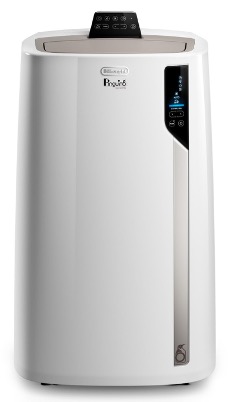
The De’Longhi Pinguino PACEX100 is the most energy-efficient portable AC on this list. Rated A++ and drawing just 700W, it costs roughly 17p per hour to run — meaningfully cheaper than rivals drawing 900–1,000W. For renters in larger flats — open-plan living spaces, L-shaped rooms, living-dining areas — it delivers the most cooling per pound of electricity spent.
| Specification | Detail |
| Cooling capacity | 10,000 BTU (2.93 kW cooling) |
| Room size (guideline) | Up to ~30 m² |
| Noise level | 45–49 dB (A) — sound pressure |
| Power consumption | 700W |
| Running cost (24p/kWh) | ~17p per hour |
| Energy rating | A++ |
| Condensate tank | Self-evaporating; overflow tank if needed (2.4L) |
| Window hose | 150 mm diameter; side-discharge design |
| Dimensions (W×D×H) | 47.5 × 38 × 95 cm |
| Weight | 31 kg |
| Smart / App control | No (remote control included) |
| ✅ Pros | ❌ Cons |
| A++ energy rating — cheapest to run at ~17p/hr | Heavier (31 kg) and taller (95 cm) than most rivals |
| 700W draw — significantly lower than most rivals | 150 mm hose diameter requires wider window kit opening |
| Side-discharge hose suits corner placement in open-plan rooms | No app/smart control |
| Self-evaporating in most conditions; 2.4L overflow tank for high humidity | Higher upfront cost than budget alternatives |
| Genuinely quiet at 45 dB on low fan — usable overnight in larger bedrooms |
| 🔵 Verdict: The De’Longhi Pinguino PACEX100 is the running cost leader across the entire AC slate. If you have a large flat, an open-plan layout, or simply plan to run the unit for many hours per day, the A++ efficiency pays back the higher purchase price in a single heatwave season. The 150 mm hose is wider than most, so measure your window kit slot before buying. |
3. Meaco MeacoCool MC Series — Best for Sash Window Flats
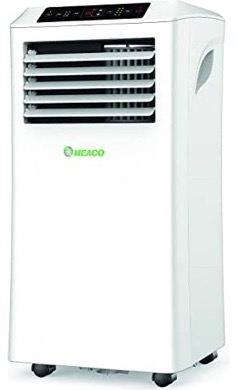
The Meaco MeacoCool MC Series is the best-rounded unit for flats that have vertical sliding sash windows — the Achilles heel of portable AC installation. Meaco includes a dedicated sash window adaptor in the box, which slots into the open sash without requiring any tools, drilling, or adhesive. For renters in period conversions, Victorian terraces converted to flats, or any property with sliding sashes, this is the kit that eliminates the biggest installation headache.
| Specification | Detail |
| Cooling capacity | 9,000 BTU (2.64 kW) / 12,000 BTU model also available |
| Room size (guideline) | 9,000 BTU up to ~25 m²; 12,000 BTU up to ~35 m² |
| Noise level | 52–53 dB (A) — sound pressure |
| Power consumption | 850W (9,000 BTU model) |
| Running cost (24p/kWh) | ~20p per hour |
| Condensate tank | 2.3L tank; auto-evaporation in most conditions |
| Sash window kit | Included — no tools required |
| Dimensions (W×D×H) | 37 × 37.5 × 71.5 cm (9k model) |
| Weight | 23 kg |
| Smart / App control | Yes — Meaco app, works with Alexa and Google Home |
| ✅ Pros | ❌ Cons |
| Dedicated sash window adaptor included — no tools required | 52–53 dB — noticeably louder than Dreo or De’Longhi on low |
| App control — useful when pre-cooling the flat before returning home | App required for full feature access (some users prefer physical controls) |
| Works with Alexa and Google Home | Condensate tank still needs occasional emptying in very humid conditions |
| Auto-evaporation in most UK conditions; 2.3L tank as backup | |
| 12,000 BTU version available for larger rooms |
| 🔵 Verdict: If your flat has sash windows, the Meaco MeacoCool MC Series is the most renter-friendly choice. The included sash adaptor removes what is usually the most frustrating part of the installation, and the app control is genuinely useful for pre-cooling. The 52–53 dB noise level is acceptable for daytime use but is louder than the Dreo or De’Longhi on low — bear that in mind if you’re a light sleeper. |
4. Dreo AC515S — Quietest, Best for Noise-Sensitive Flats
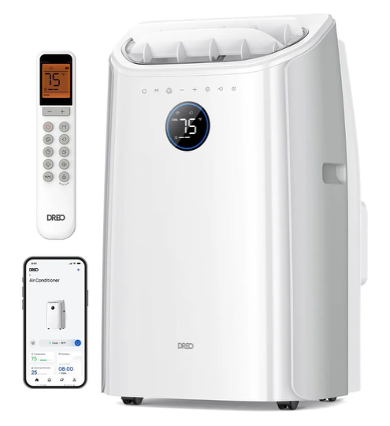
The Dreo AC515S is the quietest portable AC on this list at 46 dB on its lowest setting — a meaningful advantage in a flat where thin walls, adjoining rooms, and shared hallways make noise a neighbour issue as well as a comfort one. If you share a flat, live in a converted period property with poor sound isolation, or simply want a unit you can genuinely sleep through, the Dreo is the noise/sleep leader.
| ⚠️ BTU Discrepancy: The Dreo AC515S is listed at 10,000 BTU on UK Amazon. The US listing quotes 12,000 BTU under the older ASHRAE standard. These are the same physical unit — the difference reflects the testing standard (SACC/DOE vs ASHRAE). The real-world cooling delivered is consistent with a 10,000 BTU SACC rating. Do not compare the US BTU figure to UK-listed competitors. |
| Specification | Detail |
| Cooling capacity | 10,000 BTU (SACC/DOE — UK listing) |
| Room size (guideline) | Up to ~28 m² |
| Noise level | 46 dB (A) — sound pressure, lowest setting |
| Power consumption | ~900W |
| Running cost (24p/kWh) | ~22p per hour |
| Condensate tank | 2.5L; auto-evaporation available |
| Dimensions (W×D×H) | 37.5 × 37 × 75 cm |
| Weight | 28 kg |
| Smart / App control | Yes — Dreo app, Alexa and Google Home compatible |
| ✅ Pros | ❌ Cons |
| 46 dB — quietest on this list; considerate to neighbours and light sleepers | Higher running cost (~22p/hr) than De’Longhi PACEX100 |
| App and voice control (Alexa, Google Home) | BTU discrepancy between UK and US listing can cause confusion — see callout above |
| 10,000 BTU suits most flat bedrooms and medium living rooms | Condensate tank (2.5L) still needs emptying in high-humidity conditions |
| Sleep mode reduces noise further overnight | |
| Auto-evaporation in most conditions |
| 🔵 Verdict: The Dreo AC515S is the noise leader on this list and the top choice for renters who are conscious of disturbing neighbours or need a unit they can comfortably sleep beside. The 46 dB figure is genuinely low for a portable AC. The trade-off is a slightly higher running cost than the De’Longhi — if efficiency matters more than whisper-quiet operation, look at the PACEX100 instead. |
5. Pro Breeze 9000 BTU 4-in-1 — Budget / Smart Home Option (Daytime Use Only)
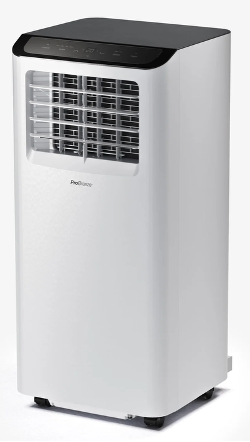
The Pro Breeze 9000 BTU 4-in-1 is the most affordable portable AC on this list and the only one with a meaningful smart home integration at sub-£300. If your priority is budget and you only need daytime cooling — for a home office, living room, or children’s bedroom during waking hours — it does the job. It is not suitable for overnight use.
| ⚠️ Noise Warning: The Pro Breeze 9000 BTU 4-in-1 measures approximately 65 dB in use — significantly louder than the Dreo (46 dB) or De’Longhi (45–49 dB). This unit is not suitable for overnight use or for noise-sensitive shared flats. It is also audible to neighbours in adjoining rooms. Restrict use to daytime hours. |
| Specification | Detail |
| Cooling capacity | 9,000 BTU |
| Room size (guideline) | Up to ~22 m² |
| Noise level | ~65 dB — not suitable for overnight use |
| Power consumption | ~750W |
| Running cost (24p/kWh) | ~18p per hour |
| Condensate tank | 1.6L — requires frequent emptying |
| Modes | Cooling, fan, dehumidifier, sleep (nominal) |
| Smart / App control | Yes — app compatible, works with Alexa |
| Dimensions (W×D×H) | 34 × 31.5 × 70 cm |
| Weight | 20 kg |
| ✅ Pros | ❌ Cons |
| Most affordable on this list | ~65 dB — significantly louder than all other picks on this list |
| Lightweight (20 kg) — easier to move between rooms | Not suitable for overnight use |
| App and Alexa compatible at budget price point | 1.6L condensate tank requires frequent emptying |
| Compact footprint | No dedicated sash window adaptor |
| Sleep mode label is misleading given the noise level |
| 🔵 Verdict: The Pro Breeze 9000 BTU 4-in-1 is worth considering only if budget is the primary constraint and you will use it exclusively during the day. The ~65 dB noise level rules it out for sleep use and makes it inconsiderate in a noise-sensitive flat. For most renters, spending a little more on the Olimpia Splendid or De’Longhi PACEX100 will deliver meaningfully better experience. |
Full Comparison Table
| Product | BTU | Noise | Running Cost/hr | Tank | Sash Kit | App | Flat Suitability |
| Olimpia Splendid Compact 8P | 8,000 | 63 dB Lw* | ~20p | None | No | No | Small rooms, no tank hassle |
| De’Longhi PACEX100 | 10,000 | 45–49 dB | ~17p (A++) | Self-evap (2.4L) | No | No | Large/open-plan rooms |
| Meaco MeacoCool MC | 9,000 | 52–53 dB | ~20p | 2.3L | Yes | Yes | Sash window flats |
| Dreo AC515S | 10,000** | 46 dB | ~22p | 2.5L | No | Yes | Noise-sensitive / sleep |
| Pro Breeze 9000 BTU | 9,000 | ~65 dB ⚠️ | ~18p | 1.6L | No | Yes | Daytime only |
* Olimpia 63 dB is sound power (Lw), not sound pressure (Lp). See product review for explanation.
** Dreo 10,000 BTU is SACC/DOE (UK). US listing quotes 12,000 BTU (ASHRAE). Same hardware; different standard.
Running Costs at 24p/kWh
All figures based on 24p/kWh (Ofgem rate). Heatwave scenario: 12 hours/day for 14 days (a typical UK hot spell).
| Product | Cost/hr | 4 hrs/day × 30 days | 8 hrs/day × 30 days | Heatwave (12 hrs × 14 days) |
| Olimpia Splendid | ~20p | ~£24 | ~£48 | ~£34 |
| De’Longhi PACEX100 | ~17p | ~£20 | ~£41 | ~£29 |
| Meaco MeacoCool MC | ~20p | ~£24 | ~£48 | ~£34 |
| Dreo AC515S | ~22p | ~£26 | ~£53 | ~£37 |
| Pro Breeze 9000 | ~18p | ~£22 | ~£43 | ~£30 |
The De’Longhi PACEX100 is the clear running cost leader. Over a 14-day heatwave at 12 hours/day, you save roughly £8 compared to the Dreo and £5 compared to the Olimpia or Meaco — meaningful over a full summer.
Step-by-Step Flat Installation Guide (No Tools Required)
The following steps apply to casement, tilt-and-turn, and horizontal sliding windows. Sash window flats: use the Meaco sash adaptor kit and skip step 3.
- Position the unit: Place the AC within 1.5 m of the window. Most hose extensions reach 1.2–1.5 m — do not stretch the hose taut, as kinks reduce airflow.
- Fit the window kit: Extend the telescopic panel to the width of your window opening. Casement: insert vertically in the open gap. Tilt-and-turn: open to tilt position (~15°) and insert at the bottom. Horizontal sliding: fit vertically in the open side.
- Seal the gap: Run adhesive foam tape (usually supplied) along any remaining gap between the panel and frame. In rented properties, use removable foam — never silicone or mastic.
- Connect the hose: Attach the hose to both the unit and the window kit connector. Ensure both connectors click or thread fully — a loose hose leaks warm air back into the room.
- Set the condensate drainage: In auto-evaporation mode, no action needed. If your unit has a condensate tank, position it so it is accessible. In long-run sessions (8+ hours), check the tank every 4 hours in humid weather.
- Power on and test: Run the unit for 5 minutes and check the hose outlet at the window — you should feel warm air exiting. If you feel warm air around the hose connector inside the room, recheck the seal.
- Storage: At the end of the season, drain the condensate tank fully, remove and store the window kit, coil the hose loosely (do not tightly coil), and store upright if possible.
Honest Limitations for Flat Use
Portable AC works well in a flat under the right conditions. Here is where it struggles:
- Top-floor heat: A poorly insulated ceiling stores heat all day and releases it at night. Even a correctly sized unit may only reduce temperature by 4–6°C on a 35°C day, not reach the 20–22°C you want.
- Open-plan rooms: Single-hose physics is less efficient in larger, less sealed spaces. Expect the lower end of rated BTU performance.
- Neighbour noise: On a warm night with windows open, your exhaust fan noise travels. The Dreo (46 dB) is the most considerate choice.
- Condensate tanks: Self-evaporating designs (Olimpia, De’Longhi) are the best fit for flats where emptying a tank every 2–3 hours is impractical. If you choose the Meaco or Dreo, expect to empty their tanks in high-humidity conditions.
- Fixed glazing and Juliet balconies: Fixed glazing has no openable pane — a portable AC cannot be used. A Juliet balcony (French door opening inward) can work with a foam seal but is draught-prone.
- UK summer length: The average UK heatwave is 5–10 days. A portable AC may sit unused for weeks. Factor the cost-per-use into your decision; an energy-efficient unit like the De’Longhi softens this concern over time.
Frequently Asked Questions
Do I need to tell my landlord before using a portable air conditioner in my flat?
For a standard portable unit with a removable window seal, most AST tenancy agreements do not require written consent — the unit is classed as a portable appliance. However, always check your specific agreement. If the installation involves screwing into window frames or any permanent modification, written permission is advisable. A brief email to your landlord costs nothing and protects you.
Can I use a portable AC in a flat with sash windows?
Yes. The Meaco MeacoCool MC Series includes a dedicated sash window adaptor that fits most standard UK sash windows without tools or drilling. Lift the lower sash approximately 15–20 cm, slot the adaptor in, and seal the gap with the included foam strip. The adaptor can be fully removed at the end of the season with no trace.
Will a portable AC work in a tilt-and-turn window?
Yes, in tilt mode. Open the window to its tilt position (usually around 15°) to create a gap at the top. Most window kit panels can be inserted horizontally in this gap with foam sealing around it. Ensure the window latch is secure in tilt mode — you do not want it falling to the open position with the kit fitted.
I have no openable windows in my flat. Can I still use a portable AC?
Unfortunately, no. Every portable AC on this list is a single-hose design that requires an opening to vent warm exhaust air. Without a window, door, or other external opening, the unit would simply recirculate warm air back into the room and achieve nothing. A tower fan, desk fan, or evaporative cooler is a better option in this case.
Can I move the unit between rooms in my flat?
Yes, portable ACs are designed to be moved. However, each time you move it to a new room, you need to re-fit the window kit to that room’s window. This takes approximately 10–15 minutes and is easy once you have done it once. Consider whether the effort is worthwhile for short sessions — most users set up in one room (usually the bedroom) and leave it there.
How noisy will a portable AC be to neighbours in adjoining flats?
The exhaust fan noise is the main concern, as it is directed outside. In a typical UK converted flat, neighbours in adjacent rooms will hear a low hum rather than a disruptive noise. The Dreo AC515S (46 dB) is the quietest on this list and the most considerate choice in noise-sensitive buildings. The Pro Breeze (65 dB) is not recommended in shared buildings with thin walls.
Can a portable AC cool an open-plan flat?
With caveats. An open-plan kitchen-diner-living room might be 35–50 m² — well above what a single portable unit is sized for. The De’Longhi PACEX100 (10,000 BTU) is the best choice for larger rooms on this list, but even it will struggle to cool a large south-facing open-plan space on a 35°C day to a comfortable temperature. Manage expectations: a 4–6°C reduction from peak temperature is realistic; 20°C in a 50 m² flat is not.
What is the difference between SACC and BTU, and why does it matter?
BTU (British Thermal Units) is a measure of heat removal capacity. The older ASHRAE standard measured BTU in unrealistically ideal conditions, which inflated figures. The newer SACC/DOE standard (used on UK listings since around 2017) tests in more realistic conditions — typically 20–30% lower. When comparing units, ensure you are comparing SACC figures. The Dreo AC515S is a clear example: 10,000 BTU (UK SACC) vs 12,000 BTU (US ASHRAE) — same unit, different standard. See our full guide, do portable air conditioners work UK, for a detailed explanation.
Quick Decision Guide
| Your Situation | Best Pick |
| Small flat room, want zero tank emptying | Olimpia Splendid Compact 8P |
| Large / open-plan flat, running costs matter | De’Longhi Pinguino PACEX100 |
| Sash windows, want app control | Meaco MeacoCool MC Series |
| Noise-sensitive building, thin walls, sleep use | Dreo AC515S |
| Tight budget, daytime use only | Pro Breeze 9000 BTU 4-in-1 |
| Top-floor flat, worst-case heat scenario | De’Longhi PACEX100 (most BTU-per-watt on list) |
| Tilt-and-turn windows, mid-range budget | Meaco MeacoCool MC Series |
| Fixed glazing / no openable window | Portable AC not suitable — consider a tower fan |
Related Articles
→ Best Portable Air Conditioner UK — full guide covering all room types and budgets
→ Best Portable Air Conditioner for Bedroom UK — noise-first picks with overnight suitability ratings
→ Do Portable Air Conditioners Work UK? — single-hose physics, BTU ratings, and when they are worth buying
→ Best Dehumidifier for Bedroom UK — if humidity rather than heat is your main issue
→ Dehumidifier vs Air Purifier UK — understand which appliance solves which problem

3 Comments