
Best Dehumidifier for Garage UK (2026): Damp, Rust and Tools Sorted
Last updated: 13 September 2026
| Affiliate Disclosure: This page contains affiliate links. If you buy through these links, we may earn a small commission at no extra cost to you. See our Affiliate Disclaimer for more information. |
Finding the best dehumidifier for garage UK use is more complicated than choosing one for a bedroom or living room — because the single biggest variable is temperature. Most UK garages are unheated, which means they regularly drop below 10°C in autumn and winter, and that one fact rules out the majority of compressor dehumidifiers entirely. This guide covers what actually works in a cold British garage, what humidity level to target to protect tools and vehicles, and which specific models to buy.
| Key Takeaways Most UK garages are unheated and drop well below 15°C in winter — compressor dehumidifiers lose effectiveness at these temperatures and you need a desiccant model. Target 45–50% RH year-round to prevent rust on tools and car bodywork, and 40–55% RH to protect stored items from moisture damage. Top cold/unheated garage pick: Meaco DD8L Junior — desiccant, works to 1°C, 39 dB, 8 L/day, 5.9 kg. Budget cold garage alternative: EcoAir DD1 Simple MK3 — desiccant, 34 dB, 7.5 L/day, 300–580 W, 6 kg. Heated or workshop garage: Meaco MeacoDry Abc 12L — compressor, 36–40 dB, 149 W, Quiet Mark certified. Continuous drainage is strongly recommended for a garage — a full tank shuts the unit off, which means your tools are no longer protected. Connect the drain hose to a nearby gully or bucket. |
Why Garages Are a Harder Problem Than the Rest of Your Home
A garage presents three challenges that do not apply indoors. Understanding them makes the product choice obvious.
1. Cold Temperatures Rule Out Most Dehumidifiers
Compressor (refrigerant) dehumidifiers — the kind used in most UK homes — work by drawing air over a cold coil to condense moisture out. This process relies on a meaningful temperature differential between the coil and the incoming air. When ambient temperatures drop below 15°C, extraction efficiency falls sharply. Below 5°C, most compressor models stop extracting moisture at any meaningful rate and many simply shut off. In an unheated UK garage in winter, 5°C is a warm day. If you buy a compressor model for an unheated garage, it will likely do very little from October to March — exactly when you need it most.
Desiccant dehumidifiers work differently. They use a rotating wheel coated in a moisture-absorbing material (typically silica gel), which is heated to release the captured water into a warm airstream that is then ducted to the tank. This process is not dependent on ambient temperature in the same way, and desiccant models work reliably down to 1°C.
2. Unattended Operation Requires Continuous Drainage
In a home, you walk past the dehumidifier every day and notice when the tank is full. In a garage that you visit only occasionally, a full tank means the unit has switched itself off — often for days — and humidity has climbed back up during that time. The solution is to connect the included drain hose and route it to a drain, bucket, or outside. Both recommended desiccant models below include a drain hose. If you cannot reach a suitable drainage point, a condensate pump can lift the water a metre or more to a suitable outlet.
3. The Stakes Are Higher
A damp living room is unpleasant. A damp garage causes material financial damage. Rust on hand tools, corrosion on power tools and machinery, mould on stored soft furnishings, deterioration of classic car bodywork, and moisture damage to stored documents and photographs are all real consequences of uncontrolled garage humidity. Maintaining 45–50% RH prevents rust formation on bare metal, stops mould growth on organic materials, and keeps stored vehicles and equipment in sound condition.
What Humidity Level Should You Target in a Garage?
The target varies slightly depending on what you are protecting:
- Tools and machinery: 45–50% RH. Rust and corrosion on bare metal all but stops below 60% RH, but 50% gives a comfortable margin.
- Car storage: 50–55% RH. Below 40% RH, leather and rubber can dry and crack; above 60% RH, corrosion on bodywork and undercarriage accelerates.
- Stored furniture and soft goods: 40–55% RH. Mould requires sustained humidity above 70% to grow, but sustained dampness above 60% encourages musty odours and mildew on fabric and cardboard.
- Workshop use (people working in the space): 40–60% RH, consistent with NHS recommendations for habitable spaces.
Set your dehumidifier’s humidistat to 50% RH. This hits the optimum point for protecting both metalwork and organic stored materials.
The Best Dehumidifiers for Garages UK
Four models cover every realistic garage scenario. The first two are desiccant and recommended for unheated garages. The third and fourth are compressor models for heated or partially-heated workshop garages.
1. Meaco DD8L Junior — Best Overall for Unheated Garages
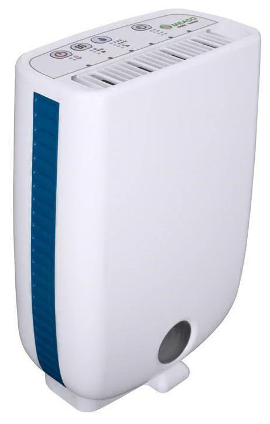
| Specification | Meaco DD8L Junior |
| Type | Desiccant |
| Extraction rate | 8 L/day (equivalent to 16–20 L compressor in cold conditions) |
| Noise level | 39 dB (low) / 43 dB (medium) / 48 dB (high) |
| Power consumption | 30 W (low fan) / 330 W (medium) / 650 W (high) |
| Tank capacity | 2 L |
| Operating temperature | Down to 1°C |
| Continuous drainage | Yes — hose included |
| Laundry mode | Yes |
| Weight | 5.9 kg |
| Wall-mountable | Yes (bracket sold separately) |
| Warranty | 2 years (extendable to 5 years) |
| Best for | Unheated garages, cold stores, cars, boats, caravans |
The Meaco DD8L Junior is the most practical choice for the vast majority of UK unheated garages. Its desiccant technology means it continues to extract moisture reliably through the coldest months, down to 1°C — well below the temperatures at which any compressor model would have given up. At 39 dB on low speed it is unobtrusive enough to leave running overnight or during periods when the garage is not in use.
Meaco’s intelligent control logic is genuinely useful in a garage context: the unit runs for five minutes when it reaches the target humidity, then checks conditions every 30 minutes and only restarts if humidity has risen above the target. In a moderately damp garage this keeps running costs manageable — on low fan speed it draws only 30 W, which is less than most standard light bulbs.
The 2 L tank is small for a garage application. Connect the included drain hose to a suitable outlet — a nearby gully, a bucket you check weekly, or outside if the gradient allows. The wall-mounting option (bracket sold separately) is worth considering for a permanent garage installation, keeping the unit off the floor and out of the way of vehicles and equipment.
| Desiccant vs Compressor in a Cold Garage: Compressor dehumidifiers lose significant extraction efficiency below 15°C. If your garage regularly drops below 15°C in winter — which most unheated UK garages do between October and April — you need a desiccant model like the Meaco DD8L Junior or the EcoAir DD1 Simple MK3 below. A compressor model will not protect your tools during the months you need it most. |
| Pros | Cons |
| Works to 1°C — reliable in all UK winters39 dB on low — unobtrusive for overnight useIntelligent control logic minimises running costsWall-mountable for permanent garage installation5.9 kg — light enough to move easily3-year warranty on current units | 2 L tank fills quickly — continuous drainage strongly recommendedHigher power draw on medium/high settings (330–650 W)Wall bracket not included — sold separately |
| Our Verdict: The Meaco DD8L Junior is the standout choice for unheated garages in the UK. Connect the drain hose on day one, set to 50% RH, and it will maintain a rust-preventing environment through the coldest months without requiring daily attention. |
2. EcoAir DD1 Simple MK3 — Budget Pick for Cold Garages
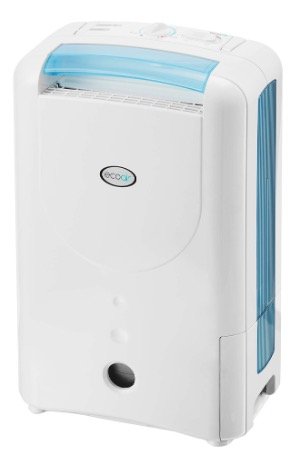
| Specification | EcoAir DD1 Simple MK3 |
| Type | Desiccant |
| Extraction rate | 7.5 L/day (at 20°C, 60% RH) |
| Noise level | 34 dB |
| Power consumption | 300 W (low) / 580 W (high) |
| Tank capacity | 2 L |
| Operating temperature | Down to 1°C |
| Continuous drainage | Yes — 1 m hose included |
| Filter | Antibacterial silver filter |
| Laundry mode | Yes |
| Weight | 6 kg |
| Warranty | 3 years |
| Best for | Budget-conscious buyers, smaller garages, cold stores |
The EcoAir DD1 Simple MK3 offers very similar cold-temperature desiccant performance to the Meaco DD8L Junior at a typically lower price point. At 34 dB it is actually quieter than the DD8L Junior on low speed — Ideal Home’s testing confirmed effective noise reduction — and the 3-year warranty is competitive.
The trade-off is control simplicity. Where the DD8L Junior has Meaco’s intelligent control logic that cycles the unit on and off to minimise running costs, the DD1 Simple uses a rotary dial with preset modes (Energy Saving, Turbo, Laundry). The power consumption figures are higher in practice than the DD8L Junior on low speed — 300 W versus 30 W — though Energy Saving mode does moderate this. For a garage where running costs matter, the DD8L Junior’s control logic has a meaningful advantage over time.
As with the DD8L Junior, the 2 L tank is too small for unattended garage use. Connect the included 1 m drain hose. The antibacterial silver filter is a useful addition for a space that may also be used for occasional occupancy.
| Pros | Cons |
| Very quiet at 34 dB — quieter than DD8L Junior on lowWorks to 1°C — suitable for all UK unheated garagesLower purchase price than Meaco DD8L Junior3-year warrantyAntibacterial silver filter included | 300 W minimum power draw — higher running costs than DD8L Junior on low fanRotary dial control — no intelligent cycling logic2 L tank requires drain hose for unattended operation1 m drain hose may not reach suitable drainage in all garages |
| Our Verdict: The EcoAir DD1 Simple MK3 is the best budget desiccant option for cold UK garages. If the Meaco DD8L Junior is outside budget, this is the alternative we would recommend over any compressor model. Running costs are slightly higher, but cold-weather performance is comparable. |
3. Meaco MeacoDry Abc 12L — Best for Heated or Workshop Garages
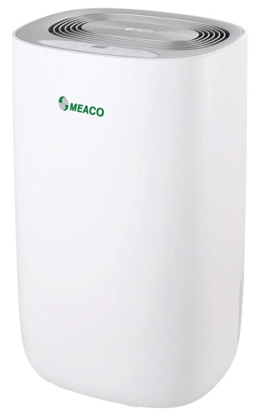
| Specification | Meaco MeacoDry Abc 12L |
| Type | Compressor (refrigerant) |
| Extraction rate | 12 L/day (at 30°C, 80% RH) |
| Noise level | 36–40 dB (Quiet Mark certified) |
| Power consumption | 149 W (typical) / 196 W (max) |
| Tank capacity | 2.6 L |
| Humidistat range | 30–80% RH adjustable |
| Operating temperature | 15°C+ for effective operation |
| Continuous drainage | Yes |
| Laundry mode | Yes |
| Weight | 10.4 kg |
| Warranty | 3 years |
| Best for | Heated garages, workshops, home gyms in garages (15°C+) |
If your garage is heated — whether through a dedicated wall heater, workshop heating, or because it is integrated into the house fabric and benefits from residual warmth — the Meaco MeacoDry Abc 12L is a better choice than a desiccant model. Compressor dehumidifiers are significantly more energy-efficient in warm conditions: the ABC 12L draws 149 W, compared to the DD8L Junior’s 330 W on medium speed. Over a winter of continuous operation, this difference adds up materially.
At 36–40 dB it holds Quiet Mark certification and is suitable for a workshop garage that doubles as a home gym or hobby space. The 2.6 L tank is still small for unattended use — connect the drain hose if the unit will run unsupervised for extended periods.
Important: Do not use the ABC 12L in an unheated garage that drops below 15°C in winter. At those temperatures its extraction rate drops significantly and it provides little meaningful protection for stored tools and vehicles.
| Pros | Cons |
| 149 W power draw — significantly cheaper to run than desiccant models in warm conditionsQuiet Mark certified — suitable for workshop or gym useCompact and lightweight for a 12 L/day machine3-year warranty | Not suitable for unheated garages below 15°C in winter2.6 L tank — drain hose needed for unattended useNot the right tool for cold car storage or unheated outbuildings |
| Our Verdict: The Meaco MeacoDry Abc 12L is the right choice only if your garage is consistently heated above 15°C. For the majority of UK unheated garages, one of the two desiccant models above is the correct answer. |
4. Meaco 20L Low Energy — Large or Persistently Damp Garages
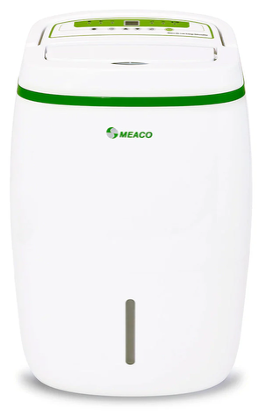
| Specification | Meaco 20L Low Energy |
| Type | Compressor (refrigerant) |
| Extraction rate | 20 L/day (at 30°C, 80% RH) |
| Noise level | 46 dB (max) |
| Power consumption | 219 W (independently verified) |
| Tank capacity | 6 L |
| Humidistat range | 30–80% RH adjustable (5% increments) |
| HEPA filter | Yes — included |
| Operating temperature | 5–35°C |
| Continuous drainage | Yes |
| Weight | approx. 11.8 kg |
| Warranty | 3 years (extendable to 5 years) |
| Best for | Large heated garages, multi-car storage, persistently damp workshops |
For a large double garage, a multi-car storage facility, or a garage with a severe damp problem in a heated environment, the Meaco 20L Low Energy provides the extraction capacity that smaller units cannot match. At 20 L/day it can pull down humidity across a substantial space from a single central position. The 6 L tank is the largest in our lineup — meaningful for unattended operation, though continuous drainage is still preferable for any garage application.
Like the ABC 12L, this is a compressor model and should only be used in a heated garage above 15°C. At 46 dB it is louder than the other units in this guide, but in a garage environment this is rarely a concern.
| Pros | Cons |
| 20 L/day extraction — handles large or very damp spaces6 L tank — largest in lineup, less frequent emptying219 W is efficient for a 20 L/day machineHEPA filter included — useful if garage doubles as workshopWhich? Best Buy award | Compressor — not suitable for unheated garages below 15°C46 dB — louder than other modelsHeavier (approx 11.8 kg)Higher upfront cost than smaller models |
| Our Verdict: The Meaco 20L Low Energy is worth considering only for large, heated garage spaces with substantial damp problems. For standard single UK garages that are unheated, the DD8L Junior or EcoAir DD1 Simple MK3 is the correct starting point. |
Garage Dehumidifier Comparison Table
| Feature | DD8L Junior | EcoAir DD1 Simple | ABC 12L | 20L Low Energy |
| Type | Desiccant | Desiccant | Compressor | Compressor |
| Extraction | 8 L/day | 7.5 L/day | 12 L/day | 20 L/day |
| Noise (low) | 39 dB | 34 dB | 36 dB | 46 dB |
| Wattage (low) | 30 W | 300 W | 149 W | 219 W |
| Tank | 2 L | 2 L | 2.6 L | 6 L |
| Cold garage (<15C) | Yes — to 1C | Yes — to 1C | No | No |
| Drain hose | Included | Included (1 m) | Included | Included |
| Wall-mount | Yes (bracket extra) | No | No | No |
| Warranty | 2–5 years | 3 years | 3 years | 3–5 years |
| Best for | Unheated garage | Budget cold garage | Heated workshop | Large heated garage |
Where to Position a Dehumidifier in a Garage
Placement matters more in a garage than indoors because air circulation is often poor and the space may be cluttered with vehicles and equipment.
- Central position: Place the unit centrally if possible, with at least 30 cm clearance on all sides. Avoid tucking it into a corner behind shelving.
- Avoid placing near the main door: Every time the garage door opens, a flood of damp outdoor air enters. Position the unit away from the door so it is not constantly fighting fresh moisture ingress.
- Exhaust direction: Desiccant dehumidifiers exhaust warm, dry air. Direct this airflow into the space rather than at walls or stored items.
- Elevation: Positioning the unit on a shelf or wall-mounting it (where possible) improves airflow and keeps it clear of any floor-level moisture or flooding risk.
- Drainage route: Plan your drain hose route before positioning the unit. The hose needs to reach a drain, bucket, or outside edge with a suitable fall. If this is not achievable, consider a condensate pump (available for around £30–£50) to lift the water to a suitable outlet.
Getting the Best Results: Five Practical Tips
- Use a hygrometer alongside the dehumidifier. The built-in display on most models shows the humidity level it is reading, but this is localised to the unit’s position. A separate hygrometer placed near stored tools or a vehicle gives you an independent confirmation that the whole space is at target RH.
- Seal obvious air gaps. Gaps under and around the garage door, gaps around pipes entering the building, and cracks in the floor slab are all routes for damp air to enter. A dehumidifier can compensate for these, but sealing them reduces the unit’s workload and your running costs.
- Set to 50% RH and leave it. Resist the temptation to run it on continuous mode. Setting a target humidity and using the humidistat means the unit only runs when needed, which reduces wear and energy use.
- Check the drain hose monthly. Drain hoses can kink, develop algae, or become blocked. A blocked hose means the tank fills and the unit shuts off — check it when you next visit the garage.
- Clean the filter every 2–3 months. Garage environments accumulate dust, oil particles, and debris faster than living spaces. A clogged filter reduces airflow and extraction efficiency significantly.
Frequently Asked Questions
Can I use a normal home dehumidifier in my garage?
Only if your garage is consistently heated above 15°C. Standard compressor (refrigerant) dehumidifiers sold for home use lose extraction efficiency below 15°C and provide minimal protection below 5°C. For an unheated UK garage, you need a desiccant model — the Meaco DD8L Junior or EcoAir DD1 Simple MK3 are the right choices.
How long does it take a dehumidifier to dry out a damp garage?
This depends heavily on how damp the space is. In a moderately damp single garage, you can typically expect to see humidity drop to the 50% target within 24–48 hours of continuous operation. However, if walls, concrete floors, or stored items have absorbed significant moisture over years of neglect, the dehumidifier may need to run for several weeks as moisture gradually releases from the building fabric. Initial extraction rates will be high and slow down as the space approaches target RH.
Should I leave a dehumidifier running all the time in a garage?
Use the humidistat rather than running continuously. Set it to 50% RH and let the unit manage itself — it will run when humidity rises above target and stop when it drops back down. This is more energy-efficient than continuous mode and extends the unit’s lifespan. In a well-sealed garage with no active moisture problems, the unit may only need to run for a few hours a day.
Will a dehumidifier stop my tools from rusting?
Yes, when maintained below 50% RH. Rust and corrosion on bare metal require both moisture and oxygen. Maintaining RH below 50–55% effectively eliminates the moisture component. This is particularly important for hand tools, drill bits, saw blades, and any bare metal surfaces. Note that tools already affected by surface rust will not reverse — a dehumidifier prevents further corrosion but does not repair existing damage.
What size dehumidifier do I need for a garage?
For a standard single UK garage (approximately 14–20 m²), the Meaco DD8L Junior (8 L/day) or EcoAir DD1 Simple MK3 (7.5 L/day) are appropriately sized for an unheated space. For a double garage (approximately 28–40 m²), you may need to run a desiccant unit continuously or consider a higher-capacity model. For a heated large garage or workshop, the Meaco 20L Low Energy (20 L/day) provides adequate capacity for most double-garage configurations.
Can I put a dehumidifier in an unheated garage in winter?
Yes — but only a desiccant model. The Meaco DD8L Junior and EcoAir DD1 Simple MK3 both operate down to 1°C. A compressor dehumidifier will not work effectively in a cold UK garage in winter and should not be used in this application.
Do I need to empty the dehumidifier tank in a garage?
Ideally, no. Connect the drain hose and route the water to a suitable drainage point. In a garage where you do not visit daily, a full tank means the unit switches off and stops protecting your stored tools and vehicles. Continuous drainage eliminates this failure mode. If drainage is not possible, empty the tank at least every 2–3 days during damp periods.
Summary: Which Model Should You Buy?
| Quick Decision Guide: Unheated garage (most UK garages): Meaco DD8L Junior — desiccant, 1°C minimum, 39 dB, 8 L/day, wall-mountable. Unheated garage, budget pick: EcoAir DD1 Simple MK3 — desiccant, 1°C minimum, 34 dB, 7.5 L/day. Heated or workshop garage (consistently above 15°C): Meaco MeacoDry Abc 12L — compressor, 36–40 dB, 149 W, Quiet Mark. Large heated garage or multi-car storage: Meaco 20L Low Energy — compressor, 20 L/day, 6 L tank, HEPA filter. |
Related Reading
Best Dehumidifier for Mould UK
Desiccant vs Compressor Dehumidifier UK: Which Is Right for You?
Best Whole House Dehumidifier UK
Condensation on Windows Every Morning UK: Causes & Fixes
Best Dehumidifier for Cellar UK
| About This ArticleThis article was researched using manufacturer specifications from Meaco and EcoAir, independent test data from Ideal Home and Homebuilding & Renovating, and UK building science and classic car storage guidance. Product specifications verified against manufacturer sources as of June 2026. External authority sources include NHS advice on damp and mould and Asthma + Lung UK on damp and mould. This site is independently run and is not sponsored by any manufacturer. Affiliate commissions help support the running costs of ukairquality.co.uk. |

3 Comments