
Best Whole House Dehumidifier UK (2026): What Actually Works
Last updated: 23 September 2026
This page contains affiliate links. If you buy through these links, we may earn a small commission at no extra cost to you. See our Affiliate Disclaimer for more information.
Best whole house dehumidifier UK options are almost never the ducted systems Americans search for — in British homes, whole-house dehumidification means a high-capacity portable unit sized correctly for the property. UK houses do not have ducted HVAC systems, so the American concept of conditioning air throughout the home via existing ductwork simply does not apply here. This guide explains what actually works for British homes of two to five bedrooms, which models to buy, and how to deploy them effectively.
The NHS recommends keeping indoor humidity between 40% and 60% RH. Sustained humidity above 65% — very common in UK homes in autumn and winter — leads to condensation, mould growth, and the health problems that accompany poor indoor air quality, as detailed in NHS guidance on damp and mould.
Key Takeaways
| At a glance: UK homes do not have ducted HVAC — whole-house dehumidification means a high-capacity portable unit (or two), not an installed system. The Meaco 20L Low Energy is the best single unit for 3–5 bedroom homes: 20L/day extraction, ~6p/hr, Control Logic runs the compressor for only ~10 minutes per hour under typical UK conditions. For 2–3 bed homes, the Meaco MeacoDry Abc 12L is quieter (36–40 dB, Quiet Mark certified), cheaper to run (~4p/hr), and right-sized for smaller properties. For 2–3 bed homes, the Meaco MeacoDry Abc 12L is quieter (36–40 dB, Quiet Mark certified), cheaper to run (~4p/hr), and right-sized for smaller properties. Compressor dehumidifiers stop working effectively below 15 °C — for cold garages, conservatories, or unheated spaces, add a Meaco DD8L Junior (desiccant, works from 1 °C). Continuous drain is essential for whole-house deployment. Target 55% RH for ongoing maintenance; drop to 45–50% if active mould is present until it clears; do not go below 45% long-term. |
Quick Picks: Best Whole House Dehumidifier UK
| Model | Best For | Extraction | Running Cost |
| Meaco 20L Low Energy | 3–5 bed houses — top pick | 20L/day | ~6p/hr |
| Meaco MeacoDry Abc 12L | 2–3 bed houses / flats | 12L/day | ~4p/hr |
| Meaco DD8L Junior | Cold / unheated rooms | 8L/day | ~9p/hr |
| Pro Breeze 12L | Budget, smaller homes | 12L/day | ~7p/hr |
What Does “Whole House Dehumidification” Mean in the UK?
Most UK homes do not have ducted HVAC systems. Central heating runs via radiators, and there is no network of air ducts connecting rooms together. This means the American concept of a single ducted dehumidifier conditioning air throughout the property via existing ductwork simply does not apply to the vast majority of British homes.
In practice, whole-house dehumidification in a UK home means one of three approaches:
- A single high-capacity portable unit. Placed centrally — hallway, landing, or main living room — and relied upon to reduce overall humidity across the property as air circulates naturally between rooms with interior doors left ajar.
- Multiple units in different zones. Typically one in a bedroom, one in a living area, and sometimes one in a utility room or conservatory. Each manages its own space.
- A whole-home ventilation system. Such as a Positive Input Ventilation (PIV) unit installed in the loft, which continuously introduces fresh, drier air from outside. These require professional installation and are more common in new-builds.
For most UK homeowners dealing with condensation, damp, and mould, a high-capacity portable dehumidifier is the most practical, cost-effective, and immediately available solution. That is what this guide focuses on.
Do You Actually Need a Whole-House Approach?
Before buying a high-capacity dehumidifier, it is worth checking whether whole-house dehumidification is actually what you need — or whether the problem is localised. Most UK damp and condensation problems originate in specific rooms: bathrooms and kitchens (where moisture is generated), bedrooms (where overnight breathing and closed windows trap humidity), and utility rooms (where drying laundry adds significant moisture to the air).
A whole-house approach makes sense when:
- Condensation or damp appears in multiple rooms across the property
- The house feels persistently clammy, particularly in autumn and winter
- Humidity readings in different rooms consistently show over 65% RH
- You have a large, older property with poor insulation and a history of damp
- You have already addressed room-specific problems but overall humidity remains high
If any of these apply, a high-capacity unit like the Meaco 20L Low Energy placed on the landing with interior doors left open often provides effective whole-house coverage. For a localised single-room issue, a smaller 12L unit will usually suffice.
How to Size a Dehumidifier for Your Home
The right capacity depends on your home size and the severity of the damp problem. Use this as a starting guide:
| Property size | Recommended capacity | Best pick | Works below 15 °C? | Notes |
| Studio / 1-bed flat | 8–12L/day | Meaco Abc 12L | No | Add DD8L Junior for cold rooms |
| 2–3 bed house | 12L/day | Meaco Abc 12L | No | Add DD8L Junior for cold rooms |
| 3–4 bed house | 20L/day | Meaco 20L Low Energy | No | Add DD8L Junior for cold rooms |
| 4–5 bed house | 20L/day + second unit | Meaco 20L + Meaco Abc 12L | No | DD8L Junior for cold areas |
| Cold / unheated space | 8L/day desiccant | Meaco DD8L Junior | Yes — works to 1 °C | Essential for garages, conservatories, cellars |
| ⚠️ Cold Room Warning: Compressor dehumidifiers stop working efficiently below 15 °C. For cold or unheated spaces — garages, conservatories, unheated utility rooms, or north-facing rooms that drop below 15 °C in winter — you need a desiccant model. The Meaco DD8L Junior operates reliably from 1 °C and is the correct tool for those spaces. |
1. Meaco 20L Low Energy — Best Overall for Whole-House Use
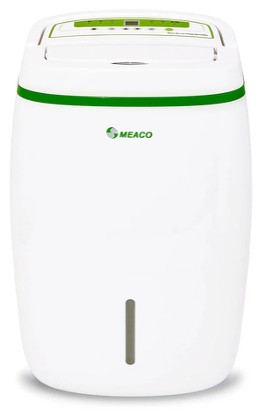
The Meaco 20L Low Energy is the definitive choice for whole-house dehumidification in a UK home of three bedrooms or more. Rated for homes up to five bedrooms, it extracts up to 20 litres of moisture per day at a running cost of around 6p per hour at 26.11p/kWh — one of the lowest in its class. Its Control Logic system samples the air every 30 minutes and only runs the compressor when humidity exceeds your target, meaning it operates for roughly 10 minutes in every hour under typical UK conditions rather than continuously. This makes the effective daily running cost considerably lower than the headline wattage suggests.
For whole-house deployment, place the Meaco 20L Low Energy on the landing or in the hallway with interior doors left ajar, connect a continuous drain hose to a nearby sink or floor drain, set the target humidity to 55% RH, and leave it to cycle automatically. This single-unit approach manages humidity across a three to four bedroom house effectively.
| Specification | Detail |
| Type | Compressor (refrigerant) |
| Extraction rate | 20 litres/day (at 30 °C, 80% RH) |
| Noise level | 44–46 dB |
| Power consumption | 219–255W |
| Tank capacity | 6L |
| Operating temperature | 5–35 °C |
| Humidistat | Yes — Control Logic, adjustable 30–80% RH |
| Continuous drain | Yes — 6L tank + gravity hose |
| Filter | HEPA filter included |
| Running cost | ~6p/hr at 26.11p/kWh |
| Warranty | 3 years (Meaco) |
- Pros
- Rated for homes up to 5 bedrooms — highest portable capacity in this guide
- Control Logic runs compressor ~10 min/hr under typical UK conditions — very efficient
- ~5p/hr — among the lowest running costs for a 20L unit
- 6L tank + continuous drain — suitable for permanent, maintenance-free deployment
- HEPA filter doubles as a light air purifier
- Auto-louvre distributes treated air effectively
- 3-year Meaco warranty
- Cons
- Compressor — not effective below 15 °C; needs a desiccant partner for cold areas
- 44–46 dB — not quiet enough for overnight bedroom use at close range
- Higher upfront cost than budget alternatives
| Verdict: The Meaco 20L Low Energy is the definitive whole-house pick for UK homes of three bedrooms or more. Place it centrally, connect a drain hose, set your target humidity, and leave it to manage the whole property. The Control Logic system makes it far more economical to run than the headline wattage implies. |
2. Meaco MeacoDry Abc 12L — Best for Smaller Houses and Flats
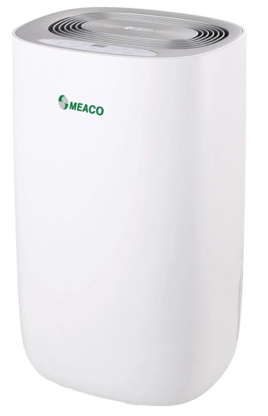
For a smaller property — a two or three bedroom house, a large flat, or a semi-detached where damp is moderate rather than severe — the Meaco MeacoDry Abc 12L offers excellent whole-house performance at a lower price point. Extracting up to 12 litres per day at around 4p per hour at 26.11p/kWh, it is one of the most energy-efficient dehumidifiers in its class and holds the Quiet Mark seal of approval for its 36–40 dB operating noise. For context, 40 dB is approximately the level of a quiet library — genuinely unobtrusive in a hallway or living room.
The Meaco MeacoDry Abc 12L is slim, modern, and fitted with an adjustable humidistat (30–80% RH), continuous drain connection, auto-defrost for cold snaps, and Laundry Mode. For a smaller UK home where damp is present but not severe, this is often the more practical choice: lower purchase price, lower running costs, and quiet enough to use near a seating area or home office.
| Specification | Detail |
| Type | Compressor (refrigerant) |
| Extraction rate | 12 litres/day |
| Noise level | 36–40 dB (Quiet Mark certified) |
| Power consumption | 149–160W |
| Tank capacity | 2.6L |
| Operating temperature | 10–35 °C (auto-defrost for cold snaps) |
| Humidistat | Yes, adjustable 30–80% RH |
| Modes | Auto, Laundry (6-hour timer), continuous |
| Running cost | ~4p/hr at 26.11p/kWh |
| Warranty | 3 years (Meaco) |
- Pros
- Quiet Mark certified — 36–40 dB, one of the quietest compressors available
- ~4p/hr — the lowest running cost in this guide
- Compact, slim design — suits hallways and living spaces without intruding
- Laundry Mode, auto-defrost, continuous drain, adjustable humidistat
- 3-year Meaco warranty
- Cons
- 12L/day may be insufficient for a large house with severe damp — step up to the 20L
- Compressor — less effective below 10 °C even with auto-defrost
- 2.6L tank is small — continuous drain recommended for whole-house use
| Verdict: The Meaco MeacoDry Abc 12L is the best whole-house pick for smaller UK properties — a two or three bedroom house or large flat with moderate damp. Quieter and cheaper to run than the 20L model, it is ideal where noise and running cost matter as much as raw extraction capacity. |
3. Meaco DD8L Junior — Best for Cold Rooms and Unheated Spaces
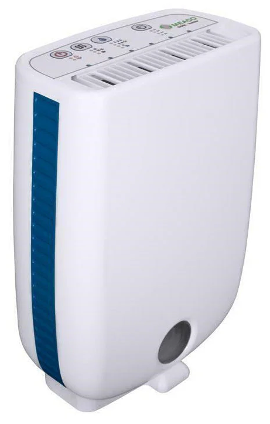
If any part of your damp problem originates in a cold, unheated area — a garage, conservatory, utility room, or north-facing bedroom that stays below 15 °C in winter — you need a desiccant dehumidifier. The Meaco DD8L Junior is the best option for this role. As a desiccant unit using a heated rotor rather than a refrigerant circuit, it works reliably from 1 °C — far below the operating threshold of any compressor model.
In a whole-house strategy, the Meaco DD8L Junior pairs naturally with the Meaco 20L Low Energy: the 20L handles the main heated living areas while the DD8L Junior manages cold or unheated spaces that a compressor unit cannot treat effectively in winter. The desiccant also emits warm air as a by-product, which is genuinely useful in a cold garage or conservatory.
| Specification | Detail |
| Type | Desiccant (heated rotor — no refrigerant) |
| Extraction rate | 8 litres/day (at 20 °C, 60% RH) |
| Noise level | 34–42 dB |
| Power consumption (auto) | 330W (~9p/hr at 26.11p/kWh) |
| Power consumption (laundry) | 650W (laundry/high speed mode only) |
| Tank capacity | 2L |
| Operating temperature | 1–35 °C — designed for cold spaces |
| Weight | 6 kg — lightweight and portable |
| Continuous drain | Yes — gravity hose |
| Auto-restart | Yes — resumes after power cut |
| Warranty | 3 years (Meaco) |
| ⚠️ Wattage note: The DD8L Junior draws 330W on auto mode — this is the normal running figure. The 650W figure sometimes quoted refers to laundry/high-speed mode only. Use 330W for running cost calculations and EHU planning. |
- Pros
- Works from 1 °C — the only reliable option for cold, unheated spaces
- Emits warm air as a by-product — useful in a cold garage or conservatory
- Continuous drain and auto-restart for unattended operation
- Lightweight at 6 kg — easy to move between cold spots as needed
- 3-year Meaco warranty
- Cons
- Higher wattage than compressor models when used in warm conditions
- Lower extraction rate than the Meaco 20L in warm, humid conditions
- Not the best choice for summer use in already-warm rooms — generates extra heat
- 2L tank requires frequent emptying if not using continuous drain
| Verdict: The Meaco DD8L Junior is the essential second unit in a whole-house strategy, handling cold areas that compressor models cannot touch in winter. As a standalone unit for a cold garage, conservatory, or unheated room, it is the best portable desiccant dehumidifier available in the UK. |
4. Pro Breeze 12L — Best Budget Whole-House Option
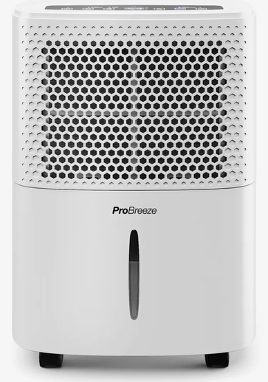
For buyers on a tight budget who need a capable 12L compressor dehumidifier for whole-house use in a smaller, heated property, the Pro Breeze 12L is a reliable, no-frills option. A Which? Best Buy award winner, it includes a continuous drain connection, adjustable humidistat, laundry mode, and auto-shutoff. The noise level is rated at ≤38 dB by the manufacturer — slightly less refined than the Meaco Abc 12L in real-world use, but acceptable for daytime running in a hallway or living area.
One caveat: at ~7p/hr versus the Meaco MeacoDry Abc 12L‘s ~4p/hr, the Pro Breeze 12L‘s higher running cost can erode the initial price saving over a full year of operation. If you plan to run a dehumidifier regularly throughout autumn and winter, the Meaco is the better long-term investment.
| Specification | Detail |
| Type | Compressor (refrigerant) |
| Extraction rate | 12 litres/day |
| Noise level | ≤38 dB (manufacturer spec) |
| Power consumption | ~200W |
| Tank capacity | 1.8L |
| Operating temperature | 5–32 °C |
| Humidistat | Yes, adjustable |
| Continuous drain | Yes — 1.8L tank + continuous drain hose |
| Award | Which? Best Buy |
| Running cost | ~7p/hr at 26.11p/kWh |
| Warranty | 1 year |
- Pros
- Which? Best Buy — independently verified performance
- Lower purchase price than equivalent Meaco models
- Continuous drain, laundry mode, and auto-shutoff included
- Compact and easy to move between rooms
- 4 wheels for easy portability
- Cons
- ~7p/hr running cost — higher than Meaco Abc 12L (~4p/hr) over a full year
- Not Quiet Mark certified; noisier than the Meaco Abc in real-world use
- 1.8L tank requires frequent emptying without continuous drain
- 1-year warranty vs 3 years on Meaco models
| Verdict: A workable budget option for whole-house use in a smaller, heated home. Which? Best Buy endorsement means the core performance is solid. If budget allows, the Meaco MeacoDry Abc 12L is more efficient and quieter over the long run — but the Pro Breeze gets the job done at a lower entry price. |
Whole House Dehumidifier UK — Full Comparison
| Model | Type | Extraction | Noise | Tank | Best for |
| Meaco 20L Low Energy | Compressor | 20L/day | 44–46 dB | 6L | 3–5 bed, whole house |
| Meaco Abc 12L | Compressor | 12L/day | 36–40 dB | 2.6L | 2–3 bed / flat |
| Meaco DD8L Junior | Desiccant | 8L/day | 34–42 dB | 2L | Cold / unheated spaces |
| Pro Breeze 12L | Compressor | 12L/day | ≤38 dB | 1.8L | Budget / smaller home |
Running Costs: What Does a Whole-House Dehumidifier Actually Cost?
All figures calculated at 26.11p/kWh (Ofgem unit rate, Q3 2026). The Meaco 20L effective daily cost accounts for the Control Logic running the compressor for approximately 10 minutes per hour under typical UK conditions, not continuously. The continuous-run column is relevant for severe damp scenarios or persistent winter use.
| Model | Power | Cost/hr | Est. daily (8 hrs) | Est. annual* | Continuous run (24 hrs) |
| Meaco 20L Low Energy | 219–255W | ~6p | ~13p (effective) | ~£49–65 | ~£1.36/day |
| Meaco Abc 12L | 149–160W | ~4p | ~11p (effective) | ~£39–52 | ~£0.95/day |
| Meaco DD8L Junior (330W auto) | 330W | ~9p | ~69p | ~£79–96 | ~£2.07/day |
| Pro Breeze 12L | ~200W | ~7p | ~52p | ~£60–71 | ~£1.25/day |
* Annual cost estimates assume 8 hours of daily operation across the heating season. Actual costs vary with ambient humidity, property size, and how often the target humidity is exceeded. The Meaco 20L Low Energy’s Control Logic makes its effective cost considerably lower than its peak wattage implies.
How to Approach Whole-House Dehumidification: A Step-by-Step Guide
Step 1: Identify where moisture is being generated
The most common sources of indoor moisture in a UK home are cooking without adequate extraction, showering and bathing, drying laundry indoors, and overnight breathing in closed bedrooms. Before deploying a dehumidifier, ensure extractor fans in the kitchen and bathroom are working and being used — ventilating these rooms reduces the moisture load on the dehumidifier significantly.
Step 2: Measure your actual humidity
A cheap hygrometer (available for a few pounds online) placed in different rooms tells you where humidity is actually highest. This is often not where you expect — a back bedroom or hallway can be significantly damper than the main living room. Target the dehumidifier at the space with the highest sustained humidity reading.
Step 3: Choose your deployment strategy
For a three to four bedroom house, a single Meaco 20L Low Energy placed on the landing with interior doors left open often provides effective whole-house coverage. For a larger property or one with cold, unheated spaces, consider two units: the Meaco 20L Low Energy for the main heated living areas and a Meaco DD8L Junior for any cold or unheated zones.
Step 4: Use continuous drain
For whole-house deployment, continuous drain is essential. Emptying a tank daily is not practical for a unit running around the clock. Connect a drain hose to a nearby sink, floor drain, or outside via gravity. Both the Meaco 20L Low Energy and the Meaco MeacoDry Abc 12L support continuous drain as standard.
Step 5: Set the right target humidity
Set your target humidity to 55% RH as a starting point. If the house has an existing mould problem, drop to 45–50% until it resolves, then return to 55% for ongoing maintenance. Do not set it below 45% long-term — very dry air can cause its own problems, including dried-out wooden floors and furniture and irritated airways.
Step 6: Review placement every season
In summer, humidity sources shift — open windows help more and the dehumidifier may need to run less. In winter, move it closer to the highest-moisture area (often a utility room with indoor drying). In very cold weather, confirm that cold rooms are covered by a desiccant unit — see our guide on desiccant vs compressor dehumidifiers UK for a full breakdown — rather than leaving a compressor model to struggle below 15 °C.
What About Ducted Whole-House Dehumidifiers?
Ducted whole-house dehumidifiers — units installed in the loft, basement, or utility room that condition air throughout the property via ductwork — do exist in the UK. They are primarily used in new-build properties with mechanical ventilation systems, in large period properties with chronic damp, or in commercial settings.
The main brands available in the UK for ducted installation include Dantherm, Calorex, and Condair. These are professional-grade products that require installation by a qualified HVAC engineer and carry a price tag well above the portable units in this guide. Running costs are lower per litre of extraction, but installation costs typically run into thousands of pounds.
Bottom line: For the overwhelming majority of UK homeowners, a high-capacity portable dehumidifier — such as the Meaco 20L Low Energy — is more practical, immediately available, requires no installation, and can be relocated as needs change. A ducted system is only worth exploring if you have a large property with persistent whole-house humidity problems that portable units cannot adequately address.
Frequently Asked Questions
What is the best whole house dehumidifier for the UK?
For most UK homes of three bedrooms or more, the Meaco 20L Low Energy is the best portable whole-house dehumidifier. Rated for homes up to five bedrooms, it costs around 5p per hour to run at 24p/kWh and includes continuous drain for permanent, maintenance-free operation. For smaller properties of two to three bedrooms, the Meaco MeacoDry Abc 12L (36–40 dB, ~4p/hr) is the quieter, more energy-efficient choice.
Can one dehumidifier dehumidify a whole house?
In many cases, yes — with the right placement and capacity. A high-capacity unit like the Meaco 20L Low Energy placed on the landing or hallway with interior doors left ajar can manage overall humidity across a three to four bedroom house. For larger properties or homes with cold unheated spaces, a second unit — particularly a desiccant model like the Meaco DD8L Junior — may be needed for comprehensive coverage.
What is the best place to put a whole house dehumidifier?
The landing or hallway is the most effective central location in a typical UK house, as it connects all rooms and allows natural air circulation with interior doors open. Avoid placing the Meaco 20L Low Energy in a single closed room — it will only treat the air in that space. On a single-storey property or flat, the hallway at the centre of the floor plan is usually the most effective position.
What size dehumidifier do I need for a 3 bedroom house?
For a three-bedroom house, a 20L/day compressor dehumidifier is the right size for whole-house coverage. The Meaco 20L Low Energy is rated for homes up to five bedrooms and its Control Logic system prevents it from running unnecessarily in a smaller home. If the damp problem is mild or the house is on the smaller side for three bedrooms, the Meaco MeacoDry Abc 12L (12L/day) may be sufficient.
What size dehumidifier do I need for a 4 or 5 bedroom house?
A four or five bedroom house typically needs a Meaco 20L Low Energy as the primary unit, potentially supported by a Meaco MeacoDry Abc 12Lin a second zone for large properties or those with a particularly persistent damp problem. Place the 20L centrally and the 12L in the highest-moisture secondary area.
How much does it cost to run a whole house dehumidifier in the UK?
The Meaco 20L Low Energy costs around 6p per hour at 26.11p/kWh. Thanks to its Control Logic system running the compressor for around 10 minutes in every hour under typical UK conditions, the effective daily running cost is considerably lower than the headline figure — roughly 13p per day over an 8-hour operating period. The Meaco MeacoDry Abc 12L is even more economical at ~4p/hr, making it the cheapest option for smaller properties.
Do I need a desiccant or compressor dehumidifier for my whole house?
For the main heated areas of a UK home, a compressor model like the Meaco 20L Low Energy or Meaco MeacoDry Abc 12L is the most efficient choice. If your property has cold unheated rooms — a conservatory, garage, or unheated utility room — the Meaco DD8L Junior is needed for those areas, as compressor models lose effectiveness below 15 °C. See our full guide on desiccant vs compressor dehumidifiers UK for a detailed comparison.
Is a whole house dehumidifier worth it in the UK?
If you have persistent damp, condensation, or mould affecting multiple rooms, a high-capacity dehumidifier is almost certainly worth the investment. The Meaco 20L Low Energy costs around 6p per hour and can prevent far more costly problems — structural damp remediation, mould treatment, and the health issues associated with poor indoor air quality. For a home with a chronic moisture problem, a quality dehumidifier typically pays for itself within a single heating season.
What is the difference between a whole home dehumidifier and a room dehumidifier?
The terms refer to capacity and placement strategy rather than a fundamentally different type of product. A whole home or whole house dehumidifier is simply a high-capacity portable unit — typically 20L/day — placed centrally and sized to manage humidity across an entire property. A room dehumidifier is typically 10–12L/day and designed for a single space. The Meaco 20L Low Energy is specifically designed for whole-home use; the Meaco MeacoDry Abc 12L occupies the middle ground, capable of managing a smaller whole home or a large single room.
Our Verdict
For most UK homes, the Meaco 20L Low Energy is the best whole house dehumidifier UK buyers can purchase. It is powerful enough for a five-bedroom house, costs around 6p per hour to run, and is designed for permanent deployment on a continuous drain with a Control Logic system that keeps effective running costs very low. Place it centrally, set your target humidity, and it manages the whole property with minimal intervention.
For smaller homes or flats, the Meaco MeacoDry Abc 12L (36–40 dB, ~4p/hr) is quieter, cheaper to run, and perfectly capable of managing a two to three bedroom property. If any part of your home is cold or unheated, add the Meaco DD8L Junior for those spaces — it is the only portable dehumidifier that works reliably from 1 °C. Budget buyers with a smaller heated home will find the Pro Breeze 12L a capable entry point, though the long-term running cost difference versus the Meaco MeacoDry Abc 12L is worth factoring in before buying.

7 Comments