
Do Dehumidifiers Use a Lot of Electricity? Running Costs Explained
Last updated: 5 September 2026
Affiliate Disclosure: This page contains affiliate links. If you buy through these links, we may earn a small commission at no extra cost to you. See our Affiliate Disclaimer for more information.
Do dehumidifiers use a lot of electricity? No — most UK models cost between 3p and 8p per hour to run, which puts them among the more affordable appliances in your home, especially when you weigh that against the cost of damp damage.
| ✅ Key Takeaways Most compressor dehumidifiers draw 150–300W — that’s roughly 4–7p per hour at the Ofgem rate of 24p/kWh. Desiccant dehumidifiers draw more power (300–500W in normal use) but work effectively in cold spaces where compressors fail. Running a dehumidifier 8 hours a day typically costs £3–£14 per month — far less than a tumble dryer or electric heater. A humidistat-equipped model cuts costs significantly by stopping the compressor once your target humidity is reached.Running costs are modest. The real cost of not using one — mould damage, structural damp, health impacts — is far higher. |
How Much Electricity Does a Dehumidifier Use?
Wattage varies by type and size. Here’s a realistic breakdown of what you can expect from common UK models, with running costs calculated at 24p/kWh (the Ofgem unit rate):
| Model / type | Wattage | Cost/hr | 8 hrs/day cost | Monthly cost |
| Small compressor (e.g. 10–12L) | 150–200W | 4–5p | 32–40p | ~£9–12 |
| Mid-size compressor (e.g. 20L) | 200–250W | 5–6p | 40–48p | ~£12–14 |
| Large compressor (e.g. 25L+) | 250–300W | 6–7p | 48–57p | ~£14–17 |
| Desiccant (normal mode) | 300–500W | 7–12p | 56–96p | ~£17–29 |
| Meaco DD8L Junior (auto mode) | 330W | ~8p | ~64p | ~£19 |
| Meaco 20L Low Energy | 219W | ~5p | ~42p | ~£13 |
All costs calculated at 24p/kWh (Ofgem unit rate). Monthly figures assume 8 hours of compressor-on time per day — humidistat cycling will reduce this in practice.
| ⚠ Desiccant vs Compressor: the temperature ruleCompressor dehumidifiers lose effectiveness below 15°C and the coils will ice over below 5°C — making them useless in unheated garages, cellars, or conservatories in winter. A desiccant dehumidifier uses more electricity but works from as low as 1°C. If your space is cold, the desiccant’s higher wattage is the price of it actually working. See our desiccant vs compressor guide for full guidance. |
How Does a Dehumidifier Compare to Other Appliances?
Put in context, dehumidifiers are one of the cheapest appliances to run continuously:
| Appliance | Typical wattage | Cost per hour | Notes |
| Electric kettle | 2,000–3,000W | 48–72p | Short bursts only |
| Tumble dryer | 2,000–2,500W | 48–60p | Per cycle ~£1–£1.50 |
| Electric fan heater | 2,000–3,000W | 48–72p | Expensive to run continuously |
| Washing machine | 700–2,500W | varies | Per cycle ~40–80p |
| Fridge-freezer | 100–200W | 2–5p | Runs 24/7 like a dehumidifier |
| Dehumidifier (compressor) | 150–300W | 4–7p | Comparable to a fridge-freezer |
| Dehumidifier (desiccant) | 300–500W | 7–12p | Higher draw, but cold-room capable |
Running a compressor dehumidifier all day costs roughly the same as running your fridge-freezer. The comparison that matters most: a dehumidifier costs pence per day; damp-related structural repairs cost thousands.
What Affects How Much Electricity a Dehumidifier Uses?
1. Humidity levels
The damper the space, the harder the compressor works and the longer it runs. A very damp room after flooding will see near-continuous running; a well-managed home with a humidistat set to 50% RH will see the compressor cycle on and off throughout the day, cutting overall consumption significantly.
2. Room size
Undersizing a dehumidifier for a large space means the unit runs longer to achieve the same result. Matching capacity to room size (roughly 10–12L/day per average bedroom, 20L+ for open-plan or whole-house use) is more energy-efficient than running a small unit flat-out.
3. Temperature
Compressor efficiency drops as temperature falls. Below 15°C a compressor dehumidifier loses effectiveness — it draws the same electricity but extracts less moisture per hour, making it poor value. Desiccant models maintain consistent efficiency across temperatures.
4. Humidistat use
This is the biggest controllable factor. A dehumidifier without a humidistat runs continuously; one with a humidistat set to 50% RH will cycle on and off once the target is reached, potentially halving energy consumption compared to continuous running.
| 💡 The humidistat is your biggest energy-saving tool Set target RH to 50% — the midpoint of the healthy 40–60% rangeThe compressor stops automatically once target is reached The unit rechecks periodically and restarts only if humidity rises again Result: the compressor runs for a fraction of total time once the home is stabilised Without a humidistat: ~£13/month. With humidistat cycling at 40% on-time: ~£5/month(Meaco 20L Low Energy example at 24p/kWh). |
Can a Dehumidifier Actually Save You Money?
Yes — indirectly, and sometimes quite significantly. Here’s where the savings come from:
- Dry air feels warmer. At the same thermostat setting, a home at 50% RH feels warmer than one at 70% RH. Some households find they can lower the thermostat by 1–2°C without noticing — that’s a meaningful heating saving over a UK winter.
- Preventing mould remediation costs. Professional mould treatment typically runs £200–£1,000+ depending on severity. A dehumidifier costing £5–£15/month to run is a fraction of that.
- Protecting structural fabric. Persistent damp causes plaster failure, timber rot, and damage to insulation. These are multi-thousand-pound repairs in older UK homes.
- Protecting contents. Clothes, furniture, books, and electronics deteriorate faster in high-humidity environments. Hard to quantify, but the savings are real.
Our Recommended Energy-Efficient Models
Best overall: Meaco 20L Low Energy
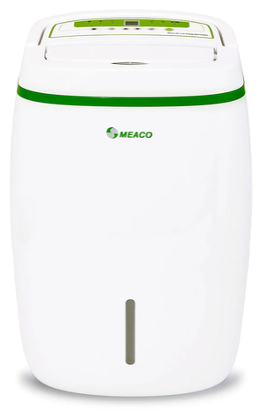
The Meaco 20L Low Energy lives up to its name. At 219W it’s one of the most efficient 20L compressor dehumidifiers available — and its humidistat drops the unit to fan-only mode once target RH is hit, then rechecks every 30 minutes rather than crude on/off cycling.
| Specification | Detail |
| Capacity | 20 litres/day |
| Wattage | 219W (~5p/hr) |
| Noise | 46 dB maximum |
| Tank | 6 litres |
| Operating temp | 5–35°C |
| Humidistat | Yes — fan-only + 30-min sleep cycle |
| Continuous drain | Yes |
| Warranty | 2 years standard, extendable to 5 years |
| 🔵 Verdict The Meaco 20L Low Energy is the go-to choice for energy-conscious UK buyers. Low wattage, intelligent humidistat cycling, continuous drain support — it’s built for long-term, low-cost operation. |
Best for cold spaces: Meaco DD8L Junior
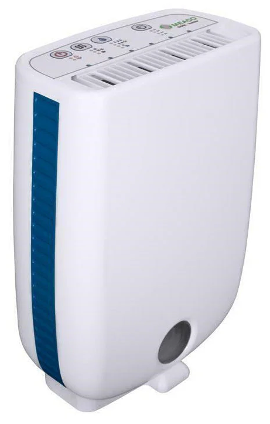
If your problem space is a garage, cellar, or unheated room, the Meaco DD8L Junior is the energy-efficient desiccant pick. It draws 330W on auto mode (not the 650W laundry/boost figure sometimes quoted) and operates from as low as 1°C.
| Specification | Detail |
| Capacity | 8 litres/day |
| Wattage (auto mode) | 330W (~8p/hr) |
| Operating temp | 1–35°C |
| Tank | 2 litres |
| Type | Desiccant |
Best compact option: Meaco MeacoDry Abc 12L
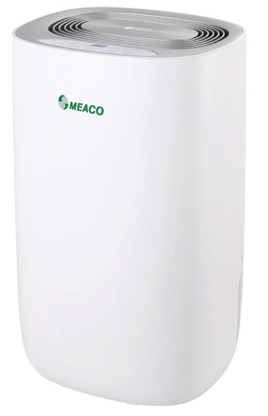
For smaller spaces — a bedroom, a bathroom, a single damp room — the Meaco MeacoDry Abc 12L is a well-made, quiet compressor unit that won’t dominate your electricity bill.
How to Reduce Your Dehumidifier Running Costs
- Use the humidistat — set to 50% RH and let the unit cycle automatically rather than running flat-out.
- Right-size the unit — a 12L machine struggling in a large open-plan space will run longer and cost more than a correctly sized 20L unit.
- Close doors and windows — dehumidifying an open space wastes energy; contain the area you’re treating.
- Use continuous drain — a full tank stops the unit; a continuous drain hose keeps it running efficiently without interruption.
- Target peak humidity times — if you run the unit during and after cooking, showering, or drying laundry, you intercept moisture at source rather than playing catch-up.
- Choose a low-wattage model — a 219W machine at 24p/kWh costs significantly less over a year than a 300W+ equivalent doing the same job.
| ⚠ Running overnight: what to know Leaving a dehumidifier on overnight is safe — modern units have automatic tank-full shut-off and thermal protection. The main considerations are noise (46 dB on the Meaco 20L is audible in a quiet bedroom) and tank capacity (a 6L tank will fill overnight in a very damp home). A continuous drain hose resolves the tank issue entirely. For more detail, see our guide: Can You Leave a Dehumidifier On Overnight? |
Frequently Asked Questions
Do dehumidifiers use a lot of electricity overnight?
No. Running a compressor dehumidifier overnight (8 hours) costs roughly 32–57p depending on wattage. A 219W model like the Meaco 20L Low Energy costs around 42p for 8 hours at 24p/kWh — with a humidistat engaged, real overnight cost will be lower as the compressor cycles off once target RH is reached.
Is it cheaper to run a dehumidifier or heating to deal with damp?
A dehumidifier is almost always cheaper. A 2kW electric fan heater costs ~48p per hour; a dehumidifier costs 5–12p per hour and actually removes the moisture causing the damp rather than just warming the air around it. Heating alone does not solve a humidity problem.
Should I leave my dehumidifier running all the time?
In the initial weeks, yes — continuous running gets humidity under control faster. Once you’re at 45–55% RH, switch to humidistat control and let the unit manage itself. See our full guide: Should You Leave a Dehumidifier on Overnight?
What is the cheapest dehumidifier to run in the UK?
Among tested models, the Meaco 20L Low Energy is consistently one of the most efficient — 219W for a full 20L/day capacity. The Meaco MeacoDry Abc 12L is also very efficient for smaller spaces.
Do desiccant dehumidifiers use more electricity than compressor models?
Yes — typically 300–500W versus 150–300W for a compressor. But in spaces below 15°C, a compressor dehumidifier loses effectiveness and the desiccant’s higher draw is the cost of it actually doing the job. In heated living spaces, a compressor is the more energy-efficient choice.
How much does it cost to run a dehumidifier for a month?
At 8 hours per day and 24p/kWh: roughly £9–£17/month for a compressor model, £17–£29/month for a desiccant. With humidistat cycling engaged, real-world costs are typically 40–60% of these figures once initial humidity is brought under control.
Related Articles
| Keep Reading Can You Leave a Dehumidifier On Overnight? — overnight safety, noise, and tank considerations. Desiccant vs Compressor Dehumidifier UK — which type is right for your home and budget?Best Dehumidifier for Mould UK — recommended models if damp and mould are your primary concern. Condensation on Windows Every Morning — why it happens and how a dehumidifier fixes it. Best Whole House Dehumidifier UK — if you need whole-home coverage rather than a single room. |
| Sources & About This Page Running cost calculations use the Ofgem unit rate of 24p/kWh. Appliance wattage figures are industry-standard estimates. Model specifications sourced from manufacturer data. This article was written by the ukairquality.co.uk editorial team and reviewed for accuracy before publication. |

2 Comments