
Where to Put a Dehumidifier in a Bedroom UK (Best Placement Guide)
Last updated: 5 September 2026
| Affiliate Disclosure: If you buy through links on this page, we may earn a small commission at no extra cost to you. This never influences our recommendations. |
You’ve bought a dehumidifier. Now you’re staring at it wondering where on earth to put it. In a bedroom, placement matters more than most people realise — the wrong spot and you’re half as effective. The right spot and you’ll wake up to clear windows, fresher air, and no musty smell.
This guide covers exactly where to put a dehumidifier in a bedroom in a UK home, including what to avoid, how to handle common scenarios like condensation or en-suites, and which Meaco models are quiet enough to run overnight.
| Quick Answer: For general bedroom humidity, place your dehumidifier centrally on the floor with at least 20–30 cm clearance on all sides. If condensation on windows is your main problem, position it near the window wall with the intake facing inward. Avoid corners — they restrict airflow and cut effectiveness significantly. |
Why Bedroom Placement Matters
A dehumidifier works by drawing in humid air, passing it over cooling coils to condense the moisture, then blowing the drier air back out. If the airflow is restricted — by a wall, a wardrobe, heavy curtains, or a corner — it can only process the air immediately around it. The rest of the room stays damp.
Bedrooms are particularly prone to high humidity because:
- You breathe out moisture all night — an adult exhales roughly a litre of water vapour every eight hours
- UK bedrooms are often tightly insulated with little ventilation
- Cold window surfaces cause condensation when warm, moist bedroom air meets them
- Adjoining en-suites or shared walls with bathrooms push extra moisture into the room
Getting the position right means your dehumidifier works efficiently, runs for fewer hours, and uses less electricity.
The Golden Rules for Bedroom Dehumidifier Placement
Keep at least 20–30 cm clearance on all sides
Every dehumidifier has an air intake and an outlet. Block either with a wall, the back of a wardrobe, or a thick curtain, and the unit struggles. Leave at least 20 cm on the sides and ideally 30 cm behind the unit. Aim the outlet across the room rather than straight at a wall.
Place it near the source of moisture
The single most effective thing you can do is position the dehumidifier near where moisture originates or accumulates. In a bedroom, that’s usually the window wall (where condensation forms) or near an en-suite door. The unit doesn’t have to be right next to the problem — one to two metres away is fine as long as there’s a clear airflow path.
Don’t put it in a corner
A corner restricts air circulation from two sides simultaneously. The dehumidifier can only draw from the air directly in front of it, leaving the rest of the room largely unaffected. Central placement — even off-centre is better than a corner — is almost always more effective.
Keep doors closed (but not sealed)
Closing the bedroom door while the dehumidifier runs concentrates its effort on that one room. You don’t need a completely airtight seal, but an open door means the unit is fighting the humidity of the entire upstairs rather than just your bedroom. If you want to dehumidify multiple rooms, a hallway or landing placement with interior doors slightly open can work — but a bedroom unit works best in a closed room.
Keep windows closed
Open windows let in fresh humid air from outside, undoing the work your dehumidifier is doing. In a UK climate, outside air is often more humid than the target indoor level. Close windows while the unit is running.
Best Placement by Bedroom Situation
Different bedrooms have different problems. Here’s a quick guide to the best placement position for the most common UK bedroom scenarios:
| Situation | Best Placement | Why |
| Condensation on windows every morning | Near the window wall, intake facing inward | Targets the coldest surface where moisture gathers first |
| General bedroom humidity / breathing overnight | Central floor position, away from furniture | Draws moist air evenly from all parts of the room |
| Wardrobe or corner mould | Directly outside the affected area, 1–2 m away | Reduces localised humidity without blocking airflow |
| Drying laundry in the bedroom | 1 m from the airer, intake facing clothes | Captures moisture at the source before it settles |
| En-suite or adjoining bathroom | Just outside the bathroom door, intake facing the opening | Catches moisture before it spreads into the bedroom |
| Small bedroom (under 10 m²) | Elevated on a low table, centre of room | Improves airflow in tight spaces with thick carpet |
Can You Run a Dehumidifier Overnight in a Bedroom?
Yes — but noise is a genuine consideration. Most compressor (refrigerant) dehumidifiers run at 35–45 dB on their lowest setting, which is roughly the level of a quiet conversation. Some people sleep through this without issue; others find it disruptive.
If you plan to run it overnight, position it as far from the bed as practically possible — on the opposite side of the room or near the door — to put some distance between you and the noise. Many modern dehumidifiers also have a “laundry” or “night” mode that reduces fan speed and noise at the cost of slightly slower moisture removal.
The Meaco MeacoDry Abc 12L and Meaco 20L Low Energy are both popular choices for overnight use in UK bedrooms — they’re quiet enough on their lower settings for most sleepers.
See our full guide on how long you should run a dehumidifier for more on timing.
Best Dehumidifiers for Bedrooms in the UK
Not all dehumidifiers are well suited to bedrooms. The key requirements are: quiet operation, compact footprint, and a built-in humidistat so the unit switches off when the target humidity is reached — rather than running all night.
Best for most bedrooms: Meaco MeacoDry Abc 12L
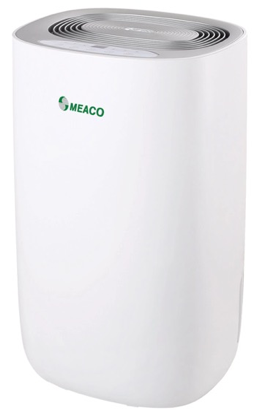
The Meaco MeacoDry Abc 12L is consistently rated among the quietest compressor dehumidifiers available in the UK. It’s compact enough to sit on the floor without dominating a typical bedroom, has a built-in humidistat with programmable target humidity, and runs quietly on its lower fan settings. A good all-rounder for bedrooms suffering from condensation or general overnight moisture.
| Our Pick: Meaco MeacoDry Abc 12LQuiet, compact, and one of the best-rated bedroom dehumidifiers in the UK. Built-in humidistat, auto-shutoff, and suitable for rooms up to about 30 m². |
Best for larger bedrooms: Meaco 20L Low Energy
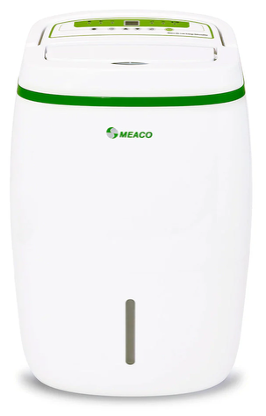
For larger bedrooms — or where a bedroom connects to an en-suite or dressing room — the Meaco 20L Low Energy offers more capacity without a significant noise penalty. It’s designed to be energy-efficient and runs quietly enough for most people to sleep near it on a low setting.
| Our Pick: Meaco 20L Low EnergyHigher capacity for larger bedrooms or rooms with adjoining en-suites. Energy-efficient, quiet on low settings, and suitable for whole-floor coverage if interior doors are left open. |
Best for small bedrooms: Pro Breeze 12L
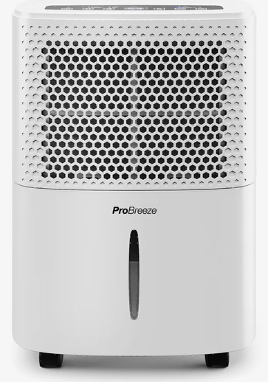
If you have a smaller box bedroom or a single room in a flat, the Pro Breeze 12L is a more budget-friendly option. It’s less feature-rich than the Meaco models but handles the basics well and is compact enough to sit unobtrusively in a small room.
| Our Pick: Pro Breeze 12LCompact and budget-friendly for smaller bedrooms. Less feature-rich than Meaco but a solid option if you don’t need all the bells and whistles. |
Common Placement Mistakes to Avoid
- Behind the door: The door swinging open and shut disturbs airflow and the unit may get knocked. Keep it away from high-traffic areas.
- Under a window sill: Can work if there’s clearance, but check the outlet isn’t blowing warm dry air straight at the glass — this reduces condensation efficiency.
- Inside a wardrobe: Wardrobes restrict airflow severely. If you have mould inside a wardrobe, position the unit outside with the door open, not inside.
- On carpet without elevation: Very thick carpet can reduce airflow at floor level. If you notice the unit struggling, try raising it on a low sturdy table.
- Next to a radiator: Heat confuses some models and can cause the unit to register false humidity readings. Keep at least 1 m from any heat source.
- In a corner: As covered above — always avoid corners. Two walls blocking intake and outlet simultaneously is the single most common bedroom placement mistake.
What Humidity Level Should a Bedroom Be?
The NHS and most UK housing guidance recommends keeping indoor relative humidity between 40% and 60%. Bedrooms at night can easily tip above this due to breathing, especially in well-insulated homes. Set your dehumidifier’s target humidity to 50–55% for sleeping. Most modern units will then run until they reach that level and switch off automatically.
If you want to understand humidity levels in more detail, our guide on what humidity level is too high in a house covers this thoroughly.
| For NHS guidance on damp and humidity in the home, see the NHS: Is your home making you ill? page. |
Frequently Asked Questions
Should a dehumidifier be placed on the floor or elevated?
Most full-size dehumidifiers are designed to be used on the floor. However, in small rooms with thick carpet, elevating the unit on a low sturdy table can improve airflow. Always check your model’s manual — some specify floor-only use.
Is it safe to run a dehumidifier in a bedroom while sleeping?
Yes, it’s safe. Modern dehumidifiers have auto-shutoff when the tank is full and built-in humidistats that turn the unit off when the target humidity is reached. The main consideration is noise — choose a quiet model like the Meaco MeacoDry Abc 12L and position it as far from the bed as possible.
How far from the wall should a dehumidifier be?
At least 20 cm from the sides and back of the unit to any wall or piece of furniture. Ideally 30 cm. The outlet should face into the room, not towards a wall.
Can I put a dehumidifier near a radiator in the bedroom?
No — keep at least 1 m from any heat source. Radiator heat can affect the unit’s humidity sensing and put extra strain on the compressor mechanism.
Should I close the bedroom door when using a dehumidifier?
Yes. Closing the door concentrates the dehumidifier’s effort on the bedroom rather than the whole upstairs. This makes it more effective and typically reduces run time.
Can a dehumidifier help with mould in a wardrobe?
Yes, but position it outside the wardrobe with the door open — not inside. Placing a full-size dehumidifier inside a wardrobe will severely restrict airflow. See our full guide on the best dehumidifier for mould for more detail.
