
Best Air Purifier for Dust UK 2026: Tested Picks for Every Room
| Affiliate Disclosure: This page contains affiliate links. If you buy through these links, we may earn a small commission at no extra cost to you. See our Affiliate Disclaimer for more information. |
Best air purifier for dust UK — if you find yourself dusting the same surfaces every few days, sneezing first thing in the morning, or waking up with a blocked nose, household dust and dust mite allergens are likely the cause. A correctly sized air purifier with a True HEPA filter can reduce airborne dust particles by 85–96%, significantly slow how quickly surfaces re-accumulate dust, and provide meaningful relief for dust allergy and asthma sufferers.
In this guide every recommended model has been selected on CADR (Clean Air Delivery Rate), filter quality, and real-world dust performance. All are available in the UK right now.
| Quick answer — best picks by use case• Best overall for dust: Levoit Core 400S — highest CADR in the Levoit range, H13 True HEPA, laser PM2.5 sensor, ozone-free, covers up to 37 m²• Best for dust mite allergies: Coway AP-1512HH — fast-responding particle sensor, excellent HEPA performance, compact and quiet• Best for large rooms: Winix 5500-2 — strong CADR, True HEPA, covers up to 33 m², PlasmaWave switchable• Best for small bedrooms: Levoit Core 300S — 22 dB sleep mode, H13 True HEPA, ozone-free, ideal for rooms up to 20 m²• Best for very large rooms: Blueair Blue Pure 211+ — covers up to 54 m², note: ioniser cannot be disabled |
What is household dust and why does it matter?
Household dust is not a single substance — it is a mixture of skin cells, textile fibres, soil tracked indoors, pollen, pet dander, mould spores, and the waste particles produced by house dust mites. According to Asthma + Lung UK, dust mite allergens are among the most common indoor triggers for asthma and allergic rhinitis in the UK.
Dust particles range widely in size:
- PM10 (coarse): visible dust, textile fibres, large skin flakes — settles on surfaces relatively quickly
- PM2.5 (fine): invisible to the naked eye, stays airborne for hours, penetrates deep into the lungs
- Dust mite allergens: carried on PM10 and PM2.5 particles — a True HEPA filter captures both the particles and the allergens attached to them
Independent research published in the journal Allergy found that HEPA air filtration reduced airborne dust mite allergens (Der f 1) by a median of 75% and pet allergens by up to 89% in occupied homes. For dust allergy and asthma sufferers, this is a clinically meaningful reduction.
What to look for in an air purifier for dust
True HEPA — non-negotiable
A True HEPA (H13) filter captures 99.97% of particles down to 0.3 microns — which covers the full range of dust particle sizes including the fine PM2.5 particles that cause the most respiratory harm. Avoid “HEPA-type” or “HEPA-style” labelling — these are unverified marketing terms with no standard definition.
CADR — size the purifier to your room
CADR (Clean Air Delivery Rate) measures how quickly a purifier delivers clean, filtered air. For dust control, aim for a unit that achieves at least five air changes per hour (ACH) in your room. A purifier running in a room twice its rated size will not keep up with ongoing dust generation.
| Room size guide• Up to 20 m² (small bedroom): Levoit Core 300S• Up to 33–37 m² (master bedroom, living room): Levoit Core 400S, Winix 5500-2, or Coway AP-1512HH• Up to 54 m² (large open-plan room): Blueair Blue Pure 211+ |
A washable pre-filter
In a high-dust home, a washable pre-filter that catches larger dust particles before they reach the HEPA filter significantly extends filter life. The Winix 5500-2 and Blueair Blue Pure 211+ both have washable pre-filters. The Levoit Core 400S and Coway AP-1512HH have replaceable pre-filter layers.
Auto mode and a particle sensor
A particle sensor that detects real-time dust levels and adjusts fan speed automatically is particularly useful for dust — dust generation spikes when you vacuum, make the bed, or move through a room. The Coway AP-1512HH, Levoit Core 400S, and Winix 5500-2 all include air quality sensors with auto mode.
Best air purifiers for dust UK 2026 — reviewed
#1 — Levoit Core 400S — Best overall for dust
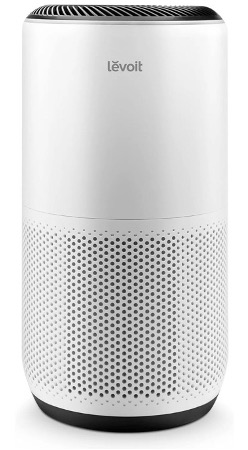
Levoit Core 400S is our top pick for dust. Its H13 True HEPA filter and high CADR — 244 CFM / ~415 m³/h — make quick work of airborne dust in rooms up to 37 m². In independent testing it achieved a 96% reduction in PM2.5 in a sealed 20 m² room within 60 minutes, the strongest result in its price bracket. Its laser PM2.5 sensor detects dust spikes in real time and ramps the fan up automatically.
- HEPA grade: H13 True HEPA — 99.97% at 0.3 microns
- Dust CADR: 244 CFM / ~415 m³/h
- Room coverage: Up to 37 m² (5 ACH)
- Sensor: Laser PM2.5 sensor with auto mode
- Ioniser: None — 100% ozone-free
- Best for: Master bedrooms, living rooms, open-plan spaces, dust allergy sufferers
✅ Pros
- 96% PM2.5 reduction in independent testing — best in class under £200
- Laser sensor reacts to dust spikes from vacuuming or bed-making automatically
- Covers 37 m² — handles most UK master bedrooms and living rooms
- 100% ozone-free — safe for asthma sufferers and children
- VeSync app for scheduling — run at full speed before bedtime, drop to sleep mode automatically
❌ Cons
- Carbon filter bonded to HEPA — replace both together
- Larger footprint than the Core 300S — less suitable for a small bedside table
#2 — Coway AP-1512HH — Best for dust mite allergies
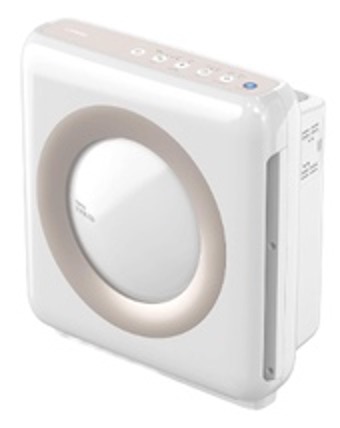
Coway AP-1512HH is our pick for dust mite allergy sufferers. Its particle sensor is among the fastest-responding available at this price point — it detects PM2.5 spikes within seconds and ramps the fan up immediately. In independent tests it achieved among the fastest particle-removal rates in its class. It is also compact, quiet (24 dB on low), and fits unobtrusively in a bedroom corner.
- HEPA grade: True HEPA — 99.97% at 0.3 microns
- Dust CADR: 233 CFM / ~396 m³/h
- Room coverage: Up to 33 m² (5 ACH)
- Sensor: Particle sensor with auto mode and colour air quality indicator
- Ioniser: Built-in — switchable (recommend: off)
- Best for: Dust mite allergy, asthma, bedrooms, anyone wanting auto-reactive dust control
✅ Pros
- Particle sensor responds within seconds — catches dust spikes from daily activity immediately
- Among the fastest particle removal rates at this price point
- Very quiet at 24 dB on low — suitable for overnight bedroom use
- Compact footprint — fits easily beside a bed or in a corner
- Ioniser fully switchable — turn off for ozone-free operation
❌ Cons
- Covers 33 m² — not suited to very large rooms
- Ioniser on by default — must be switched off manually
- No app or Wi-Fi connectivity
#3 — Winix 5500-2 — Best for large rooms with dust and odours
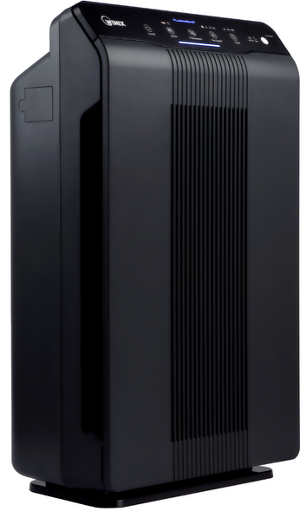
Winix 5500-2 combines strong dust performance with the best odour removal of our recommendations, thanks to its genuine charcoal pellet carbon filter. If your dust problem comes with pet smells or cooking odours, the Winix handles both more effectively than its rivals. Its washable pre-filter is particularly useful in high-dust homes, catching larger particles before they reach the HEPA and extending filter life.
- HEPA grade: True HEPA — 99.97% at 0.3 microns
- Dust CADR: 243 CFM / ~413 m³/h
- Room coverage: Up to 33 m² (5 ACH)
- Pre-filter: Washable — vacuum or rinse to extend HEPA life
- Ioniser: PlasmaWave — switchable (recommend: off)
- Best for: Living rooms with pets or cooking smells, high-dust homes, remote control users
✅ Pros
- Washable pre-filter catches large dust particles and extends HEPA filter life
- Excellent CADR for dust at 243 CFM — matches the Core 400S
- Genuine charcoal pellet carbon — superior odour removal alongside dust filtration
- Includes a physical remote control
- Filter production confirmed until at least 2032 despite US discontinuation
❌ Cons
- 28 dB sleep mode — slightly noisier than the Levoit and Coway options
- No app or smart home connectivity
- PlasmaWave must be switched off manually
| Note on UK availability: The Winix 5500-2 was discontinued in the US but remains available and fully supported in the UK. Winix has confirmed filter production until at least 2032. |
#4 — Levoit Core 300S — Best for small bedrooms
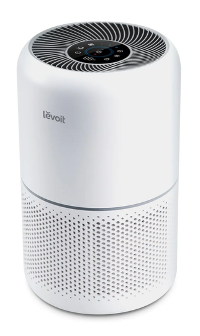
Levoit Core 300S is the right choice for smaller bedrooms up to 20 m². At 22 dB on sleep mode it is the quietest purifier on this list, its display dims completely overnight, and it is confirmed 100% ozone-free — making it our recommended choice for children’s bedrooms and nurseries dealing with dust and dust mite allergens.
- HEPA grade: H13 True HEPA — 99.97% at 0.3 microns
- Dust CADR: 145 CFM / ~247 m³/h
- Room coverage: Up to 20 m² (5 ACH)
- Noise: 22 dB sleep mode — quietest on this list
- Ioniser: None — 100% ozone-free
- Best for: Small bedrooms, children’s rooms, nurseries, light sleepers with dust allergies
✅ Pros
- 22 dB sleep mode — genuinely inaudible to most sleepers
- Display dims completely overnight — no light disruption
- 100% ozone-free — safe for nurseries and children
- Compact — fits on a bedside table
- Natural upgrade path: Core 300 → Levoit Core 300S → Levoit Core 400S
❌ Cons
- Covers only 20 m² — not suited to larger master bedrooms or living rooms
- No air quality sensor or auto mode
#5 — Blueair Blue Pure 211+ — Best for large open-plan rooms
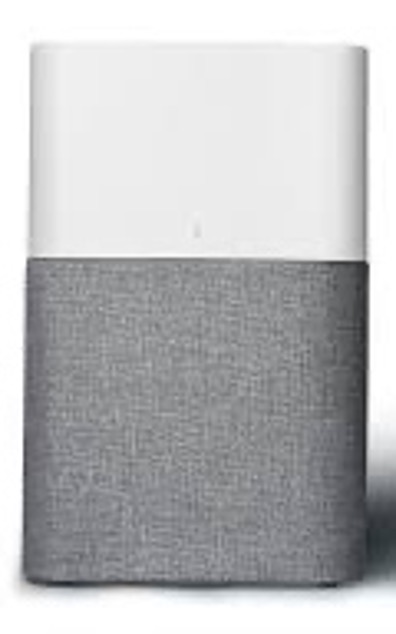
Blueair Blue Pure 211+ covers the largest area of any model on this list — up to 54 m² — and runs quietly enough for continuous use. Its HEPASilent technology combines mechanical and electrostatic filtration and is effective across the full range of dust particle sizes. However, its built-in ioniser cannot be disabled, which means it produces trace ozone continuously. We do not recommend it for nurseries or for anyone with respiratory sensitivities who requires confirmed ozone-free operation.
- Filtration: HEPASilent (electrostatic + mechanical) — captures particles down to 0.1 microns
- Room coverage: Up to 54 m²
- Noise: ~22 dB on lowest setting
- Ioniser: Built-in — cannot be disabled
- Best for: Large open-plan rooms, living rooms, spaces where room coverage is the priority
✅ Pros
- Covers 54 m² — the largest coverage of any model on this list
- Very quiet at ~22 dB on lowest setting
- HEPASilent captures particles down to 0.1 microns
- Washable fabric pre-filter extends filter life
❌ Cons
- Ioniser cannot be disabled — not suitable for nurseries or ozone-sensitive households
- Fabric carbon pre-filter is lightweight — limited odour removal
- Higher upfront cost than Levoit and Coway alternatives
At-a-glance comparison
| Model | HEPA | Dust CADR | Coverage | Sensor? | Ioniser |
| Levoit Core 400S | H13 True HEPA | 244 CFM | Up to 37 m² | Yes — laser | None |
| Coway AP-1512HH | True HEPA | 233 CFM | Up to 33 m² | Yes — fast | Switchable |
| Winix 5500-2 | True HEPA | 243 CFM | Up to 33 m² | Yes | Switchable |
| Levoit Core 300S | H13 True HEPA | 145 CFM | Up to 20 m² | No | None |
| Blueair Blue Pure 211+ | HEPASilent | N/A | Up to 54 m² | Yes | Cannot disable |
| Blueair Blue Pure 211+: ioniser cannot be disabled — not recommended for nurseries or ozone-sensitive households. |
Getting the most out of your air purifier
- Run it continuously on auto mode: dust is generated constantly — from movement, bedding, cooking, and pets. An air purifier running only occasionally cannot keep up. Run it 24/7 on auto or low speed; the fan ramps up automatically when dust levels spike.
- Position it where dust is highest: bedrooms are the priority — dust mite allergen exposure is highest in bedding and mattresses. Place the purifier near the bed, at breathing-zone height rather than on the floor.
- Vacuum with a HEPA vacuum: standard vacuums recirculate fine dust particles back into the air. A HEPA-filtered vacuum combined with an air purifier running during and after vacuuming gives the best results.
- Keep humidity between 40–60%: dust mites thrive above 60% relative humidity. A dehumidifier paired with your air purifier provides a double defence — see our guide to running a dehumidifier and air purifier together.
- Replace filters on schedule: a clogged HEPA filter loses efficiency rapidly. In a high-dust home, check filters every 6 months rather than annually.
Frequently asked questions
Do air purifiers actually help with dust?
Yes — significantly. Independent research has shown HEPA air filtration reduces airborne dust mite allergens by a median of 75% and reduces airborne PM2.5 particles by up to 96% in a closed room. They will not eliminate dust entirely — dust that has already settled on surfaces requires vacuuming and cleaning — but they meaningfully reduce the amount of dust and allergens in the air you breathe.
What’s the best air purifier for dust mite allergy?
The Coway AP-1512HH is our top pick for dust mite allergy specifically, due to its fast-responding particle sensor and strong HEPA performance. For larger rooms, the Levoit Core 400S adds a laser PM2.5 sensor and wider coverage. Both should be used with the ioniser switched off (or not applicable, in the Core 400S’s case) for confirmed ozone-free operation.
Should I run the air purifier when I’m not home?
Yes. Dust accumulates continuously regardless of whether you’re in the room. Running the purifier on a low setting or using a scheduled timer (available on the Levoit Core 400S via the VeSync app) while you’re out means you return to cleaner air rather than starting from scratch every time you walk in.
Does an air purifier help with dust allergies?
Yes, for the airborne component. Dust allergy symptoms are triggered by airborne particles — dust mite waste, skin cells, and other fine particles that a HEPA filter captures effectively. Symptoms from settled dust on surfaces require physical cleaning rather than air filtration, but the combination of regular cleaning and continuous air purification provides the most significant relief.
Is the Levoit Core 300S good enough for dust in a small bedroom?
Yes — for rooms up to 20 m², the Levoit Core 300S handles dust effectively. Its H13 True HEPA filter captures 99.97% of particles and it runs at 22 dB on sleep mode. For a larger bedroom, step up to the Levoit Core 400S.
Our verdict
For the majority of UK homes, the Levoit Core 400S is the standout air purifier for dust: H13 True HEPA, a laser PM2.5 sensor that reacts to dust spikes automatically, strong CADR, coverage up to 37 m², and confirmed ozone-free operation. It is the most complete dust-control package at its price point.
For dust mite allergy sufferers who want the fastest particle-sensor response in a compact unit, the Coway AP-1512HH is the pick — just switch the ioniser off. If your dust problem is accompanied by pet odours or cooking smells, the Winix 5500-2 adds superior carbon filtration alongside its strong dust CADR. For small bedrooms and nurseries, the Levoit Core 300S at 22 dB sleep mode and confirmed ozone-free is the right choice. And for very large open-plan rooms where coverage is the priority, the Blueair Blue Pure 211+ covers 54 m² — though its non-disableable ioniser rules it out for nurseries and ozone-sensitive households.
Related articles
- Air purifiers: Best Air Purifier for Bedroom UK | Best Air Purifier for Asthma UK 2026 | Best Air Purifier for Pet Allergies UK 2026
- Comparisons: Coway vs Levoit Air Purifier UK | Winix vs Levoit Air Purifier UK | Best Air Purifier Under £100 UK 2026
Dehumidifiers: Does a Dehumidifier Help with Dust Mites UK | Can You Run a Dehumidifier and Air Purifier at the Same Time UK
