
Condensation on Windows Every Morning? Causes and Fixes
Last updated: 28 September 2026
Affiliate Disclosure. This page contains affiliate links. If you buy through these links, we may earn a small commission at no extra cost to you. See our Affiliate Disclaimer for more information.
Condensation on windows every morning homes experience is one of the most common winter complaints — and one of the most misunderstood.
You wake up, pull back the curtains, and find a film of water sitting on the glass. Sometimes it drips onto the sill. Sometimes there’s visible mould starting to form in the corners. It feels like a building problem, but in most cases it isn’t — it’s a moisture and ventilation problem, and it’s fixable.
This guide explains exactly why condensation forms overnight, how to tell which type you’re dealing with, and what actually works to stop it.
| Key Takeaways Condensation on windows overnight is almost always surface condensation — warm moist air hitting cold glass. The root cause is high indoor relative humidity, typically above 60–65% RH. Ventilation and dehumidification together are more effective than either alone. Desiccant dehumidifiers work in cold rooms; compressor units lose effectiveness below 15°C. Persistent condensation despite low humidity suggests interstitial condensation — a structural issue needing professional assessment. |
Why condensation forms on windows overnight
Condensation forms when warm, moist air comes into contact with a cold surface. At night, indoor temperatures drop, windows cool rapidly (especially single-glazed or older double-glazed units), and the dew point of the air inside your home is reached. That’s the temperature at which air can no longer hold all its moisture — and the excess water deposits on the coldest available surface, which is almost always the glass.
It’s more common in the morning because indoor temperatures are at their lowest after several hours without heating, and overnight activity (breathing, any remaining cooking or drying smells) keeps adding moisture to the air while nothing is removing it.
The technical term is surface condensation, and it’s distinct from interstitial condensation (moisture forming inside wall cavities) and rising damp (groundwater moving upward through masonry). Understanding which type you have determines the correct fix.
Three types of condensation — and how to tell them apart
Not all window moisture is the same. Here’s a quick diagnostic:
| Type | Where it appears | When | Likely cause |
| Surface condensation | On the glass, inside surface | Mornings, especially winter | High indoor humidity + cold glass |
| Interstitial condensation | Inside the wall/window frame cavity | Persistent; may not be visible directly | Structural moisture migration |
| Failed double glazing | Between the panes (inside the unit) | Permanent; doesn’t clear with heat | Broken window seal |
| Rising damp | On walls below 1m, not windows directly | Year-round, worsening in wet weather | Groundwater through masonry |
If the condensation clears by mid-morning once the heating comes on and the sun warms the glass, you almost certainly have surface condensation — the most common and most fixable type.
If moisture sits permanently between the panes (a milky or foggy appearance that doesn’t change with temperature), the window seal has failed. The only fix is replacing the double-glazing unit.
If you have damp patches on walls rather than windows, and they appear at low level, rising damp is more likely. That’s a job for a qualified damp surveyor, not a dehumidifier.
The real problem: indoor relative humidity
Surface condensation is a symptom. The underlying cause in almost every UK home is relative humidity (RH) that is too high indoors.
A normal, comfortable indoor RH sits between 40–60%. Above 60%, condensation risk increases significantly. Above 70%, mould begins to grow on cold surfaces within 24–48 hours.
A typical UK household generates between 10 and 15 litres of moisture per day just through normal activity:
| Source | Moisture added per day (approx.) |
| Breathing and perspiration (2 adults) | 1.5–2 litres |
| Cooking (3 meals) | 3 litres |
| Bathing/showering (2 people) | 1.5 litres |
| Drying laundry indoors | 4–6 litres per load |
| Houseplants (10 average) | 1 litre |
| Boiling kettle (10 times) | 0.5 litres |
Drying laundry indoors is the single biggest controllable source of moisture in most homes. If you’re drying clothes on a radiator or airer and getting condensation problems, that’s very likely the primary driver.
What actually works: a 7-step approach
There’s no single magic fix. Surface condensation responds to a combination of measures applied consistently. Here’s the hierarchy, from simplest to most involved.
Step 1: Ventilate at the right times
Open windows briefly after cooking, showering, and in the morning — even for 5–10 minutes. The goal is to flush out moisture-laden air before it has time to condense overnight.
Trickle vents (the small slots at the top of modern window frames) should be kept open year-round, not closed in winter. Many people close them to keep warmth in; this is counterproductive for condensation.
Step 2: Use extractor fans properly
Kitchen and bathroom extractor fans should run during and for at least 15–20 minutes after cooking or showering. If your fan is noisy, old, or inadequate, consider replacing it — a good extractor fan is one of the most cost-effective interventions against condensation.
If you don’t have an extractor fan in the kitchen, a kitchen window opened a crack while cooking makes a significant difference.
Step 3: Stop drying laundry on radiators
This is the highest-impact change most households can make. A single load of laundry dried indoors adds 4–6 litres of moisture directly to your air. If you must dry indoors, use a dedicated laundry dehumidifier in a closed room with the door shut.
Step 4: Keep a background level of heating
Allowing rooms to get very cold overnight and then rapidly heating them in the morning creates conditions where condensation forms easily. A constant low background temperature (around 15°C minimum) is more effective for condensation prevention than heating on a timer that allows cold drops overnight.
Step 5: Use a dehumidifier in problem rooms
A dehumidifier removes moisture directly from the air, tackling the root cause rather than the symptom. For bedrooms and living rooms with condensation problems, running a dehumidifier overnight brings RH down to the 50–55% range where condensation is unlikely.
For unheated or cold rooms (conservatories, garages, spare bedrooms), a desiccant dehumidifier is required. Compressor-based units lose effectiveness below 15°C and can ice up below 5°C.
| ⚠️ Cold room warning: if the room drops below 15°C regularly, a compressor dehumidifier will not work effectively. Choose a desiccant model — the Meaco DD8L Junior operates reliably from 1°C. |
Step 6: Check your insulation and glazing
Better-insulated windows have a higher surface temperature, which means the dew point is less likely to be reached. Secondary glazing, internal window insulation film, or simply replacing failed double-glazing units reduces condensation risk significantly.
Heavy curtains drawn across cold windows at night can trap cold air behind them and actually increase condensation on the glass surface. Keep curtains slightly away from the glass, or opt for blinds that don’t seal against the frame.
Step 7: Monitor humidity — don’t guess
A hygrometer costs under £10 and tells you your exact indoor RH. Without measuring, you’re guessing. Place one in each problem room. If RH is consistently above 60%, you need more ventilation, a dehumidifier, or both. If it’s already below 55% and you still have condensation, the issue may be cold bridging or a structural problem.
Room-by-room condensation guide
Bedroom
Bedrooms generate a lot of moisture overnight — two people sleeping can add around 1.5 litres of water vapour. Keep trickle vents open, ventilate for 10 minutes after waking, and consider running a dehumidifier overnight. For a bedroom dehumidifier, see our
For bedroom-specific picks, see our best dehumidifier for a bedroom guide.
Kitchen
Cooking generates significant moisture. Always use the extractor fan, keep the kitchen door closed while cooking to contain steam, and open a window. Condensation on kitchen windows during cooking is normal; condensation still present the next morning suggests ventilation isn’t adequate.
Bathroom
Showers and baths produce concentrated bursts of moisture. An extractor fan running for 20 minutes after use is the primary defence. If you don’t have a window in the bathroom, a humidity-triggered extractor fan (which switches on automatically when RH rises) is worth installing.
Living room
Condensation in living rooms often points to a combination of inadequate ventilation and high occupant moisture (breathing, cooking smells drifting through). Ensure trickle vents are open, and consider a dehumidifier if you’re also drying laundry here.
Conservatory
Conservatories are particularly prone to condensation because they get very cold overnight. A desiccant dehumidifier running in a conservatory during the winter months can transform the space. Compressor units are not suitable here.
See our best dehumidifier for a conservatory guide for specific recommendations.
Spare bedroom / box room
Unoccupied rooms with low ventilation and low heating are condensation hotspots. If the room is used for storage, mould can develop unnoticed for months. Keep the door slightly ajar to allow some air circulation, or run a small dehumidifier.
Which dehumidifier is right for condensation problems?
Most condensation problems in regularly heated UK homes respond well to a compressor dehumidifier. For cold, unheated, or poorly insulated spaces, a desiccant model is required.
Meaco DD8L Junior — best for cold rooms
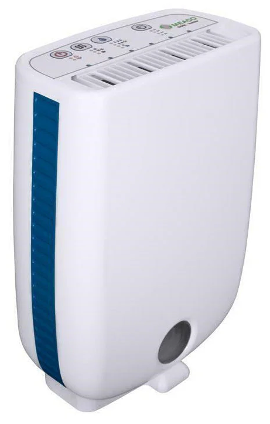
The Meaco DD8L Junior is a desiccant dehumidifier that works from 1°C — making it the right choice for conservatories, garages, and unheated spare rooms.
| ⚠️ Wattage note: the DD8L Junior draws around 330W in auto mode (normal running draw). The 650W figure is laundry/high mode only — used when the laundry setting is active. Normal overnight running costs are based on 330W. |
It extracts up to 8 litres per day and has a laundry mode for accelerated drying. Quiet enough for bedroom use at low-to-medium settings. 3-year warranty, with extension available.
Meaco MeacoDry Abc 12L — best all-rounder for heated homes
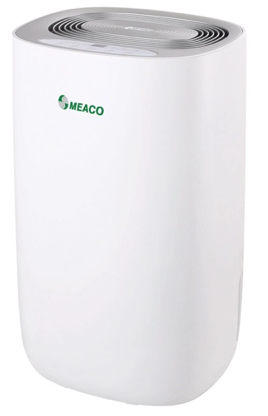
The Meaco MeacoDry Abc 12L is a compact, efficient compressor dehumidifier well-suited to living rooms and bedrooms in centrally-heated homes.
Quiet, energy-efficient, and reliably built. It extracts up to 12 litres per day in typical conditions and has a continuous drain option for set-and-forget running. Not suitable for rooms regularly below 15°C.
Pro Breeze 12L — budget pick
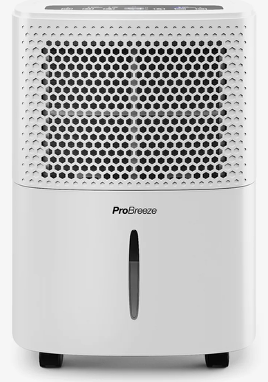
The Pro Breeze 12L offers solid performance at a lower price point. Good for bedrooms and small living rooms in heated homes.
Noise at lowest setting: ≤38 dB (manufacturer spec). Not Quiet Mark certified, but quiet enough for overnight use in most rooms.
Meaco 20L Low Energy — for larger homes
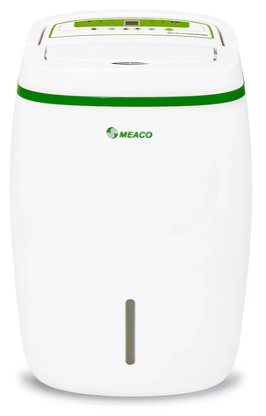
The Meaco 20L Low Energy suits larger homes with multiple damp rooms or whole-house humidity issues.
6-litre tank, energy-efficient for its extraction capacity, and well-regarded for reliability. If condensation is appearing in multiple rooms, a single high-capacity unit running in a central hallway can treat the whole property.
Dehumidifier comparison
| Model | Type | Capacity | Running draw | Cold rooms? | Warranty |
| Meaco DD8L Junior | Desiccant | 8L/day | 330W auto / 650W laundry | Yes (from 1°C) | 3 yrs (extendable) |
| Meaco MeacoDry Abc 12L | Compressor | 12L/day | ~165W | No (15°C min) | 2 years |
| Pro Breeze 12L | Compressor | 12L/day | ~200W | No (15°C min) | 2 years |
| Meaco 20L Low Energy | Compressor | 20L/day | ~255W | No (15°C min) | 2 years |
Running costs at 24p/kWh (Ofgem rate)
| Model | Draw | Per hour | Per 8hr night | Per 24hrs | Per month (24hrs) |
| Meaco DD8L Junior | 330W | 8p | 63p | £1.90 | ~£57 |
| Meaco MeacoDry Abc 12L | 165W | 4p | 32p | 95p | ~£29 |
| Pro Breeze 12L | 200W | 5p | 38p | £1.15 | ~£35 |
| Meaco 20L Low Energy | 255W | 6p | 49p | £1.46 | ~£44 |
Running costs calculated at 24p/kWh (Ofgem unit rate). Real-world usage will vary — most dehumidifiers cycle on and off automatically once target humidity is reached, so actual costs are typically lower than continuous-run figures.
Frequently asked questions
Is condensation on windows in the morning normal?
Yes, in cold weather — particularly in older or less well-insulated homes. It becomes a problem when it’s happening every morning throughout the winter, when mould is forming, or when water is sitting on the sill and causing damage. Occasional condensation on a cold night is not a structural defect.
Why do I get condensation on double-glazed windows?
Double glazing is significantly better than single glazing at preventing condensation, but it doesn’t eliminate the problem if indoor humidity is high. The interior surface of double glazing is warmer than single glazing, but in a high-humidity room it can still drop below the dew point overnight.
If condensation appears between the panes (inside the sealed unit), the seal has failed and the unit needs replacing.
Can a dehumidifier stop condensation on windows?
Yes — by reducing indoor relative humidity to below 55%, you raise the dew point threshold. Even if the window surface gets cold overnight, the air no longer has enough moisture to deposit on it. Running a dehumidifier in bedrooms and living rooms is one of the most effective interventions for chronic condensation problems.
What humidity level should I aim for to prevent condensation?
Keep indoor RH between 40–55% for the best balance between comfort and condensation prevention. Below 40% can cause dry skin and irritate respiratory conditions. Above 60% significantly increases condensation and mould risk.
Should I leave trickle vents open in winter?
Yes. Trickle vents are designed to provide background ventilation without significant heat loss. Closing them in winter to retain warmth is a common mistake — the small heat loss is outweighed by the reduction in condensation and mould risk.
Do curtains make condensation worse?
Heavy curtains drawn tight against the window can trap cold air behind them, creating a microclimate where the glass gets even colder and condensation is more likely. Leave a gap between curtains and the glass, or switch to blinds. This won’t solve a high-humidity problem, but it removes an aggravating factor.
Why is condensation worse in some rooms than others?
Several factors: north-facing rooms get less sun, so windows stay colder. Rooms with poor ventilation trap moisture. Rooms with high occupancy or moisture-generating activities (kitchens, bathrooms, bedrooms) produce more water vapour. Cold bridging (poor insulation at window frames or wall junctions) creates locally cold surfaces that condense moisture even when room RH is moderate.
Quick decision guide
| Match your situation to the right fix: Condensation clears by mid-morning: surface condensation — improve ventilation and reduce humidity with a dehumidifier. Moisture between the panes: failed window seal — glazing unit needs replacing. Cold, unheated room (conservatory, garage): desiccant dehumidifier only — compressor units will not work below 15°C. Drying laundry indoors: highest-priority change — dry in a closed room with a dehumidifier or outdoors. Condensation despite low RH: cold bridging or structural issue — get a damp survey. Multiple rooms affected: high-capacity dehumidifier in a central location (hallway/landing) can treat the whole house. |
Related articles
- Best dehumidifier for a bedroom
- Best dehumidifier for a conservatory
- Best dehumidifier for mould
- Desiccant vs compressor dehumidifier
- Best whole house dehumidifier
- Best Car Dehumidifier UK
| Sources and further reading NHS: Damp and mould — health effects and guidance RICS: Understanding damp and condensation in residential properties Energy Saving Trust: Ventilation and condensation guidance Meaco product specifications — meaco.com Ofgem unit rate: 24p/kWh (Ofgem standing charge reference) |

6 Comments